

A copy was created using a 3D printer, based on the brain MRI belonging to Psychiatrist Prof. Dr. Nevzat Tarhan. Neurology specialist Prof. Dr. Sultan Tarlacı, noting that a replica of a living human brain was printed for the first time in Turkey, stated, “Thanks to technology making modeling easier, it is possible to see all the indentations and protrusions in the brain’s replica.” Prof. Dr. Nevzat Tarhan, stating that the theoretically conceived work could become a reality, added, “Now, through a 3D printer, a person’s brain volume and pressure changes can be monitored in many early diagnoses and throughout the course of a disease.”
Content
Prof. Dr. Sultan Tarlacı: “First-ever 3D copy of a living human brain made in Turkey”
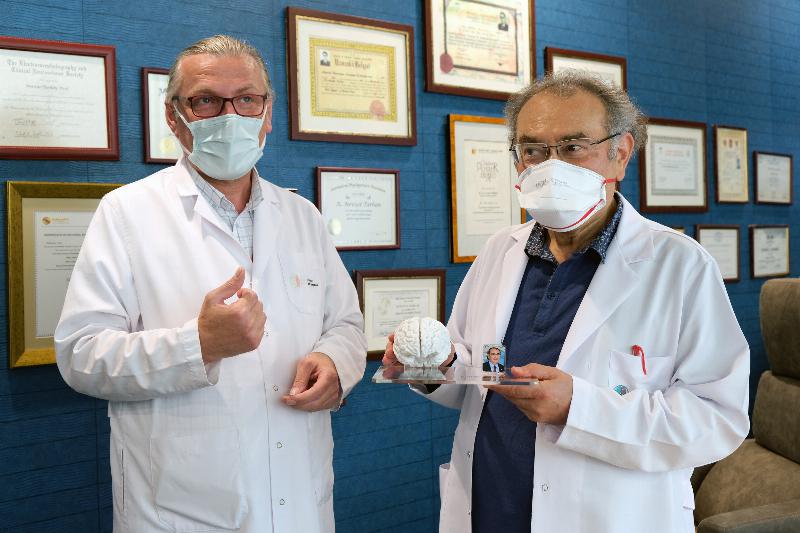
Prof. Dr. Sultan Tarlacı, Neurology Specialist at Üsküdar Üniversitesi NPİSTANBUL Brain Hospital, presented the replica of his own brain, produced via a 3D printer using an MRI scan, to Prof. Dr. Nevzat Tarhan.
Prof. Dr. Sultan Tarlacı: “MRI images can be rendered in 3D”
Prof. Dr. Sultan Tarlacı stated that in the past, silicone was poured into skulls to understand the structure of the brain inside, “With this method, the brain’s structure was understood, but it was a crude method. The external traces of the brain itself were not visible. More recently, this process was done with tomography. Tomography scans the brain, but they started modeling it with computer assistance. An MRI image is normally two-dimensional, but it’s possible to make it three-dimensional with some computer programs. The idea actually originated from this point. We thought we could do it because 3D printers exist. Then, there are some computer programs that elaborate on this situation in detail. In fact, even houses have been built with these printers,” he said.
Prof. Dr. Sultan Tarlacı: “A first was achieved in Turkey”
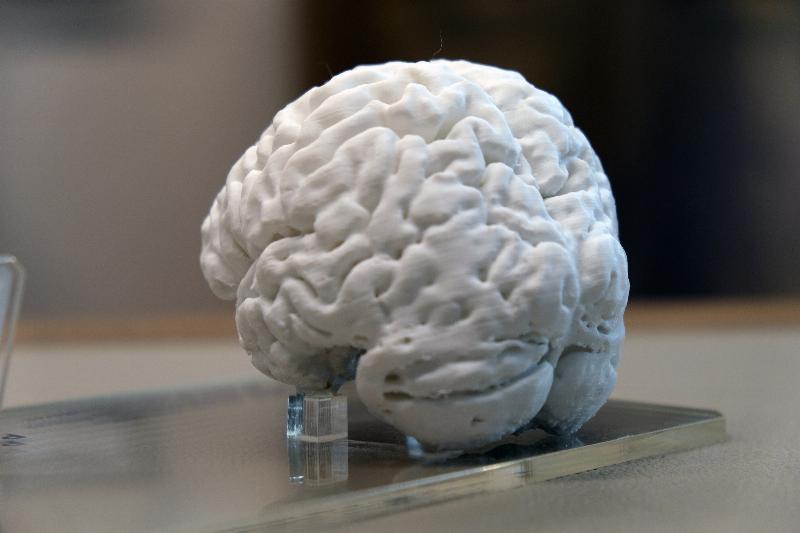
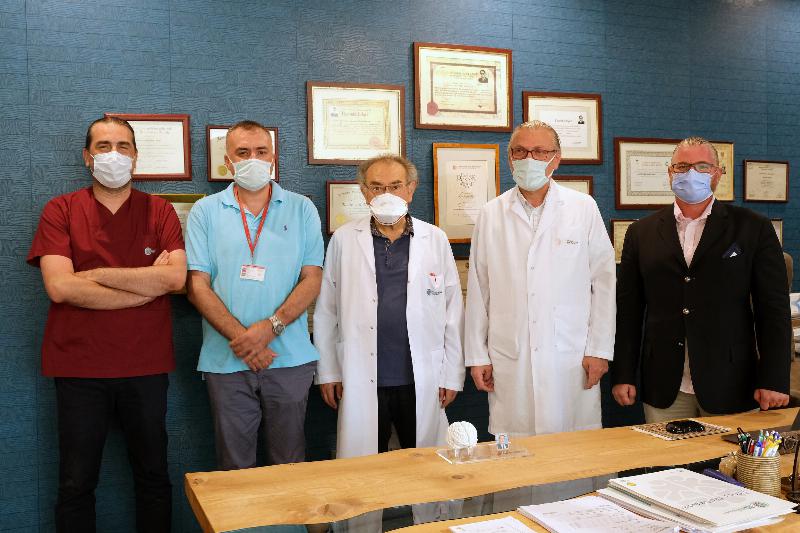
Prof. Dr. Sultan Tarlacı stated that they thought they could do this work for Prof. Dr. Nevzat Tarhan, “We obtained an MRI scan taken in 2018 from our esteemed professor. Regarding how to print it, we first exchanged ideas with Assoc. Prof. Dr. Türker Tekin Ergüzel, Head of the Software Engineering Department at Üsküdar Üniversitesi, and Dr. Ihab Elaff, Project Development Director of Computer Engineering. Subsequently, we met with the head of the 3D Printer Center. We received a positive response that they could print it, and the process of creating an exact replica of the brain began. It was delivered to us without any coloring or intervention. A replica of a living human brain, exactly as it is inside the skull, was produced externally. Although a few examples of this extraordinary work have been done globally, we achieved a first in Turkey,” he said.
Prof. Dr. Sultan Tarlacı: “All details are visible in the brain’s replica”
Prof. Dr. Sultan Tarlacı stated that the replica shows the brain’s indentations, protrusions, and overall crude structure, but provides a great deal of information, and continued:
“By looking at the indentations and protrusions in the frontal lobe of the brain, one can understand the size of the motor, perception-sensory, and visual cortex, as well as self-efficacy, creativity, and problem-solving skills. Previously, this was done by taking photographs of Einstein’s brain after his autopsy. However, since it was sliced into pieces, the entire brain is not currently available. A scientist, by examining those photographs, stated that Einstein’s perception center was larger and made many other comments about it. This was just an examination based on photographs. Here, however, we have a real brain. All details, including the professor’s brain folds, indentations, and protrusions, are present on the brain’s replica.”
Prof. Dr. Sultan Tarlacı: “There is parallel development with technology”
Prof. Dr. Sultan Tarlacı stated, ‘Further exploration of the brain has an impact on drug development, reducing side effects, and finding more effective drugs, and will continue to do so,’ and continued:
“For example, looking at the vaccine discovery journey, a vaccine was found in 1 year. More accurately, the vaccine wasn’t found in one year; it’s a process of at least 20 years. Factors such as technology production, vaccine inclination, replication, how it will be packaged, and administered to the body are being modified for the vaccine. This happens thanks to technology. Therefore, the accumulated knowledge of technology is somehow reflected in both neurological and psychiatric diseases. MRI is also a result of technological development. Resolution is increasing steadily. Transcranial Magnetic Stimulation (TMS) therapy has existed since the 1980s, but what we use is its more advanced version, Deep Transcranial Magnetic Stimulation (Deep TMS), which is a newer treatment method. There is a development that runs parallel to technology.”
Prof. Dr. Sultan Tarlacı: “Technology facilitates modeling”
Prof. Dr. Sultan Tarlacı also stated that work is being carried out on human brain modeling on an international scale, “High-resolution, high-quality images from different parts of the world are being collected to try and model the fine structure of the brain. Of course, even 1 mm is a very large area for the brain. Within a 1 mm area, there are tens of thousands of cells and hundreds of thousands of connections. In other words, there are micron-level structures. This means even thinner than a strand of hair. Technology facilitates understanding and modeling. Where this will lead is gradually to copying. We will see it as a crude structure now, later as a fine structure, and eventually as a function,” he said.
Prof. Dr. Nevzat Tarhan: “It looks better than expected”
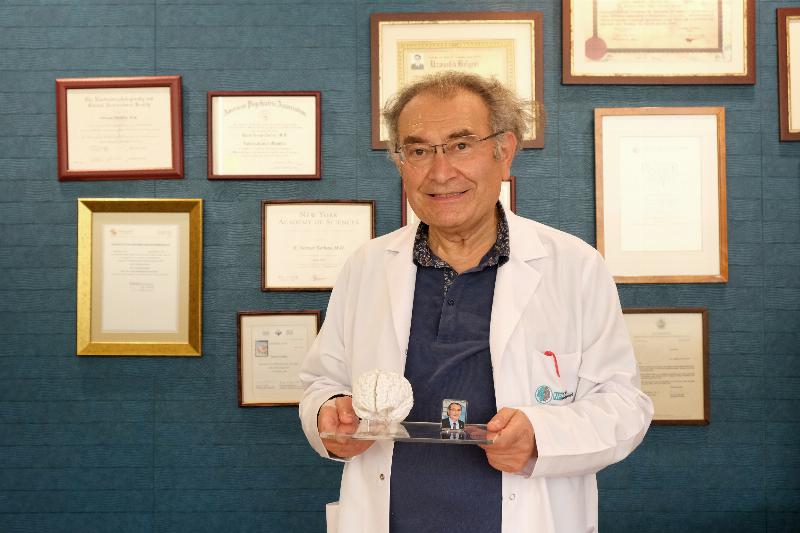
Prof. Dr. Nevzat Tarhan stated that the gift was a surprise for him, “Theoretically, I anticipated something like this could be done, but it was very exciting that our neurology specialists presented such a gift. I thank our neurologist and neuroradiologist professors. Our professor Prof. Dr. Sultan Tarlacı stated that this brain is the first brain made with a 3D printer in Turkey. To be honest, I was expecting it to be a bit smaller. I saw that it was better than my expectations,” he said.
Prof. Dr. Nevzat Tarhan: “Brain treatment will be possible with radiofrequency”
Prof. Dr. Nevzat Tarhan stated, ‘Now, through a 3D printer, a person’s brain volume and pressure changes can be monitored in many early diagnoses and throughout the course of a disease,’ and continued:
“Furthermore, changes in the brain’s network and maps of brain pathways, such as tractography, can be extracted. Currently, the new frontier of science is the brain. The emergence of connections in the brain will also change the diagnosis of psychiatric diseases. For instance, instead of saying ‘schizophrenia,’ we will say ‘it is a connection disorder of this specific brain region.’ This now indicates that we have the possibility to treat the brain with radiofrequency. In the coming years, we will have the opportunity to treat only the affected area in the brain via radiofrequency waves, without any surgical intervention. In this way, many brain diseases can be treated, and impaired functions can be restored. This has now moved beyond science fiction and entered the realm of scientific feasibility, becoming applicable.”
Share
Update Date: February 28, 2026
Creation Date: September 02, 2021
Request a Call
Other News
- Social responsibility courses moved to the field
- Erasmus+ Orientation Week completed at Üsküdar
- Prof. Nevzat Tarhan: “Brain secretes ‘dark glue’ in social media lynchers!”
- Prof. Nevzat Tarhan: “Every segment of society should be able to say, ‘This constitution is my constitution!’”
- OHS releases guide for safe operation of industrial robots