

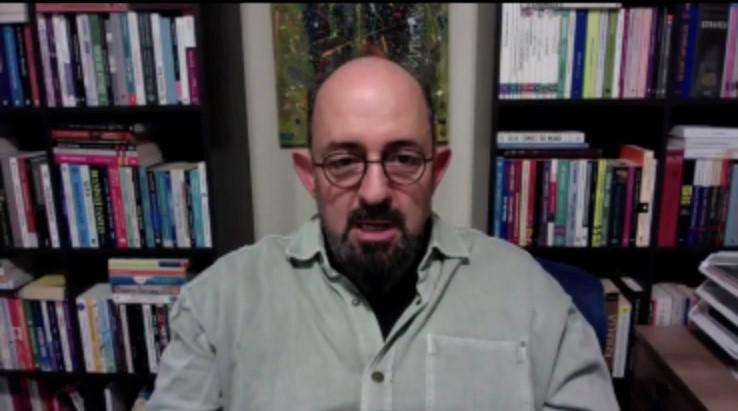
The 46th Session of the '1 Topic 1 Guest' program, organized by the Üsküdar University Occupational Safety, Occupational Health and Environmental Health Application and Research Center, took place. The guest of the program was Prof. Dr. Sinan Canan, a faculty member of the Department of Psychology, Faculty of Humanities and Social Sciences. Making evaluations on the topic of 'Rules Governing Our Behavior - Decision Making Under Pressure and Stress', Prof. Dr. Canan stated: "Men tend to take more risks under stress. Women, on the contrary, avoid risk. Although men and women may seem equal, their brains are different because, in certain periods, in old times, men were hunters, with muscle and hormone structures geared towards fighting, while women were tasked with roles such as reproduction, keeping children alive, and keeping the family together."
Content
Prof. Dr. Sinan Canan: “Uncertainty is the biggest stressor for humans”
“We can say the brain is a highly developed movement control system”
Noting that brain cells work with an electrical language, Prof. Dr. Sinan Canan evaluated the relationship between living beings and the brain. Canan said; "If a living being is large and not stationary, if it moves, these beings have brains. Whales and worms have brains just like humans. Plants and fungi do not have brains. Living beings that are stationary do not have brains. Since there is no brain structure, there is no sense of pain. When we break a branch off a tree, it's not like the pain of losing an arm or leg for us. We humans can find solutions to the sensation of pain. We can say the brain is a highly developed movement control system. When we look at living beings with brains, from the nervous systems and brains of marine life like jellyfish to the structure of the most complex creatures like humans, we see that they are fundamentally the same. In terms of basic information processing, there is no difference. Nerve cells are one of the cells in the body, but they specialize in certain tasks. Our liver cells work to secrete bile to remove toxic substances from the blood. Our brain cells are like transmitters that receive stimuli and transmit them elsewhere. They work with an electrical language. Nerve cells can receive data from many sources."
“We have been forced to use our intelligence to survive”
Canan pointed out that humans have survived by possessing intelligence; "To correctly understand the function of a creature's nervous system and body, we need to know how this creature was created to adapt to a habitat, how it was finely tuned. The field that helps us with this is evolutionary biology. We need to look at what historical processes the creature has gone through. A strange picture emerges for humans. Humans have the largest brain relative to their body, which we can observe when we list living beings. But why do we have such a developed brain? It is often asked why we have to carry an organ with such high costs. If biology burns energy so lavishly, there is an explanation. When we close our eyes and imagine ourselves, we imagine ourselves clothed because we don't know ourselves without clothes. In the animal kingdom, there is no creature more helpless than us in our naked state. Everything else is the same with other creatures, only helplessness and nakedness are different. As humans became naked and weaker, they became a creature that challenged its mind more. We have been forced to use our intelligence to survive. It has been constituted as a creature where the more intelligent ones were selected in each generation, and intelligence emerged as its distinguishing feature."
“Uncertainty is the biggest stressor for humans”
Canan explained the stress system in detail; "Why do we instinctively choose paths that can sometimes be very unsafe instead of the safest path we know in a moment of danger? The way to understand this is to understand how the system called the stress response, in human's factory settings, works. This system is activated to produce three reactions: fight, flight, or freeze; there is no other stress beyond these three repertoires. If you are chasing prey, the fight mode is on; if you are an animal to be hunted and a predator is running, the system works to tell you to flee; or if you are faced with something you cannot cope with, a freeze reaction is given to make you cower and wait for the danger to pass. It works perfectly in all animals. So, when does the same stress system activate our blood sugar levels? You open the closet in the morning, 'What will I wear today?' As you say this, the stress system is already activating. Why? Uncertainty is the biggest stressor for humans. If you don't know what will happen after a certain period, it means death is also a possibility at the end of the line. 'What will they ask in the exam?' 'How many years will I live?' 'What will my career be?' Questions about the future make us very tense. Fight, flight, or freeze cannot be applied to us. If you're stuck in traffic, we can't fight, flee, or freeze."
“Mild stress increases learning”
Canan also explained the male and female brain in terms of their characteristics and response to stress; "Even if we say comfortable, soft armchairs are for watching movies, when we sit down with a book in hand, we fall asleep after a maximum of twenty minutes; the brain deactivates. Studies conducted in schools show that there is a different effect on female students compared to male students. Moderate stress increases learning in male students, while it impairs learning in female students. There is a different situation for stress in men and women. Men tend to take more risks under stress. Women, on the contrary, avoid risk. Although men and women may seem equal, their brains are different because, in certain periods, in old times, men were hunters, with muscle and hormone structures geared towards fighting, while women were tasked with roles such as reproduction, keeping children alive, and keeping the family together. The best thing we excel at is this: we imagine something existing in the future that is not present now. We take our past experiences and step onto the path leading to the future. Our minds are given to us to create and do things. We gather experiences and set off to reach that dream."
Share
Request a Call
Other News
- The book that read today's digital threats in 2014: Being a Conscious Family
- Experts warn: 'Instead of memorizing letters, teach pencil grip, scissor use, and coloring'
- School fear and school love both start in the family!
- Family is not merely transforming, it is being battered under a serious assault
- Artificial intelligence opens the door to early diagnosis in autism!