

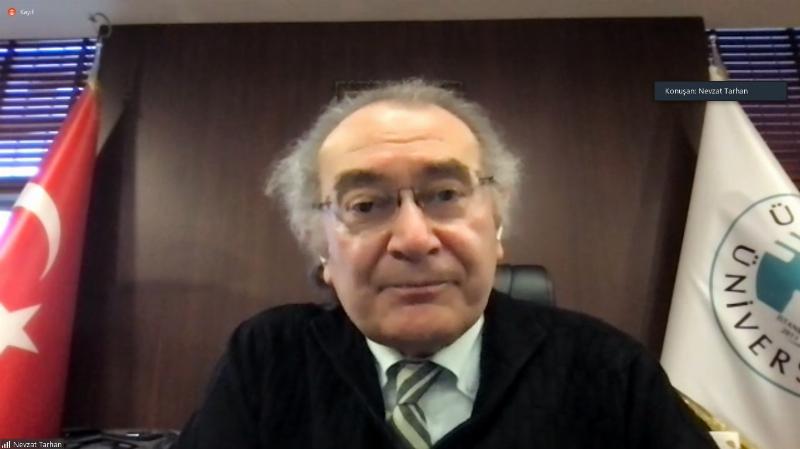
The “Different Perspectives on Vaccine Hesitancy and Vaccination Programs” event was held by Üsküdar Üniversitesi Faculty of Medicine. The opening speech of the face-to-face event was delivered by Üsküdar Üniversitesi Founding Rector, Psychiatrist Prof. Dr. Nevzat Tarhan. Tarhan, who divided vaccine opponents into 3 groups, likened COVID-19 to a snake bite and the vaccine to a mosquito bite. Tarhan noted that life essentially means taking risks, emphasizing the need to analyze quantifiable risks and take them.
Content
Prof. Dr. Nevzat Tarhan's 'Mosquito bite or snake bite?' Analogy...
Mosquito bite or snake bite?
Prof. Dr. Nevzat Tarhan, who participated via Zoom in the event held at Üsküdar Üniversitesi NP Medical Campus Ibn-i Sina Hall, pointed out that vaccine opponents should be analyzed by dividing them into three groups. Tarhan said: “I divide vaccine opponents into three groups. There are those who are completely and categorically against vaccines as a doctrine. There are 'activist-type' vaccine opponents. Their number is small, but they are very vocal. The second group consists of those who have fears about the vaccine. They look at news about vaccines and are influenced by some reports, such as 'vaccines can cause heart attacks' or 'vaccines can kill.' In fact, when we look at the probability calculations of the vaccine harming a person versus COVID-19 harming a person, COVID-19 is like a snake bite, while the threat from the vaccine is like a mosquito bite. Why do some people not accept a mosquito bite when there is a threat like a snake bite? Because they will personally get the vaccine, but they think COVID-19 hasn't arrived yet, won't come to them, or won't infect them. We have many examples of professors and patients who have had COVID-19. It leaves a serious shock in the body, wearing down and tiring the body. Of course, it can also strengthen the immune system in young people. Ultimately, no disease is desired, but when it comes, efforts are made to overcome it in the healthiest way. The third group is those who ignore, disregard, or deny the issue. They deny it. They don't believe in the disease, thinking 'the vaccine is unnecessary,' 'what's the point of a vaccine,' or 'the disease isn't even real.' There are skeptical types who think this disease is a virus produced in a laboratory, part of a conspiracy theory. The third group consists of those who have uncertainties in their minds about the vaccine... We need to analyze vaccine opponents by dividing them into three groups.”
“The person seems to be experiencing their trauma in the form of vaccine hesitancy”
Tarhan, stating that some vaccine opponents might be against vaccines due to certain traumas: “When we look at those who actively oppose vaccines, we see that many of them have childhood traumas related to doctors and healthcare. Due to these traumas, there is a certain respect for doctors and judges in society, but also a hatred. Unfortunately, this is a reality. In such cases, those individuals might have a trauma that would lead them to blame a healthcare professional in various ways. That person seems to be experiencing their trauma in the form of vaccine hesitancy. These are irrational thinkers. How we behave towards them is important. If we, as healthcare professionals, act hesitantly, if we are not confident, and act indecisively, then in such situations, these individuals will seize upon this as major proof and push the issue further. Therefore, when approaching a vaccine opponent, we need to use a counter-evidence method. We will ask them for evidence as to why they are against the vaccine. We will say, 'Tell me your evidence, and I will tell you the counter-evidence.' Within this evidence-counter-evidence dilemma, we need to somehow persuade and correct their ideas. In other words, we must help those who are active and categorically against vaccines through persuasion. We need to tell them, 'List the harms, and we will provide evidence against them and explain.' Therefore, we need to understand why a person is against the vaccine. We first need to prepare mentally regarding the vaccine. We cannot explain something to others if we ourselves are not convinced or do not believe in it. First, we must believe, first, we must resolve the questions in our minds, and then it becomes easier for the other party to believe.”
“Life essentially means taking risks”
Prof. Dr. Nevzat Tarhan, discussing how to approach the second group: “In our approach to the group acting out of fear, we need to analyze that fear. Why are you afraid? When making a decision here, there is a risk-benefit ratio. If you weigh what you gain and lose by getting vaccinated against what you gain and lose by not getting vaccinated, the benefits of the vaccine will outweigh the risks. We absolutely need to have a set of information regarding this. If we accumulate this information, our process of convincing the other party becomes easier. Those struggling with this fear often say that the vaccine has a one-in-a-million side effect. For example, during the COVID-19 pandemic, many young healthcare personnel died due to COVID-19. 300-400 people died in one year. Normally, there is no example of a healthcare professional dying from the flu. COVID-19 caused this, but there is no single example of someone dying directly due to the vaccine in a causal context. If that were the case, even going out on the street would be a risk. Life essentially means taking risks. Life means being able to take quantifiable risks. Going out is a risk, getting in a car is a risk, but you can't progress in life without taking risks. Therefore, treatment is also a risk we give to the patient. So, we need to analyze quantifiable risks and take them. Even taking aspirin is a risk; one of the simplest surgeries, appendectomy, has a 1-2% complication risk, but not having the surgery poses a bigger problem. There's even a beautiful saying: 'If you ask which drug has no side effects, the drug with the fewest side effects is the one never taken.' Everything certainly has a side effect. Therefore, even going out and breathing is a risk, but if you don't take that risk, we cannot progress in life. For this reason, we need to perform risk analysis, risk-benefit analysis. If we do this, it becomes easier to convince vaccine opponents,” he stated.
After Prof. Dr. Nevzat Tarhan concluded his opening speech, Health Editor Çağla Üren spoke on “Myths of Vaccine Hesitancy from Past to Present”, Dr. Ayşenur Özdil from Cerrahpaşa University Public Health on “Vaccine Hesitancy Today”, Dr. Ayhan Özşahin, Head of the Family Medicine Department at Üsküdar Üniversitesi Faculty of Medicine, on “Our Vaccine Story Starting from Birth”, and Assoc. Prof. Dr. Aylin Tutgun Ünal, Director of ÜSÇÖZÜM, on “Strategies for Making Vaccines Likable and Acceptable to Vaccine Opponents and Social Media Management”.
Share
Update Date: February 28, 2026
Creation Date: January 21, 2022
Request a Call
Other News
- Social responsibility courses moved to the field
- Erasmus+ Orientation Week completed at Üsküdar
- Prof. Nevzat Tarhan: “Brain secretes ‘dark glue’ in social media lynchers!”
- Prof. Nevzat Tarhan: “Every segment of society should be able to say, ‘This constitution is my constitution!’”
- OHS releases guide for safe operation of industrial robots