

Founding Rector of Üsküdar Üniversitesi, Psychiatrist Prof. Dr. Nevzat Tarhan was a live broadcast guest on the program organized by Izmit Guidance and Research Center. In the program, which addressed the topic “How Does the Pandemic Affect Psychology?”, Tarhan made striking statements about post-pandemic societal psychology and particularly the younger generation most affected by the pandemic. Stating that the psychological disorders expected after Covid-19 have started to show their effects among young people, Tarhan drew attention to the importance of strong family ties in preventing these disorders. Tarhan said; “Especially young people with weak family support, children growing up in broken families, or in families with conflicting communication, have increasingly gravitated towards social isolation.”
Content
Prof. Dr. Nevzat Tarhan: “Young people with weak family ties are leaning towards social isolation”
“Post-pandemic psychiatric illnesses increased among young people”
Teachers providing education in guidance showed great interest in the program organized by Izmit Guidance and Research Center (RAM). Making striking statements about post-pandemic societal psychology, Tarhan said, “The group most affected by the pandemic was young people.” Tarhan; “The pandemic affected everyone. Contrary to expectations, it was not the elderly but young people who were most affected by this process. As Üsküdar Üniversitesi, we conducted a rapid study on Covid-19 in April 2020. We applied a 6-question scale in the areas of perceptions, anxieties, fears related to the pandemic, and post-pandemic maturity. This research was carried out by 25 postgraduate students on 6,318 people from different parts of Turkey. Based on this research, we made predictions about what needed to be done regarding crisis management, the measures to be taken, and the post-crisis period. There is physical discomfort and health issues in the Covid-19 pandemic. After the pandemic, situations such as more loneliness, less trust, more anxiety about the future, less happiness, more fear of death, more violent incidents, less entertainment, more frequent depression, panic disorder, and social problems emerged in society. The World Health Organization had warned that a pandemic of psychiatric illnesses was expected in the post-pandemic period. We are currently seeing its warnings being most effective among young people.”
“Young people with weak family ties are leaning towards social isolation”
Stating that the psychological disorders expected after the pandemic have started to show their effects among young people, Tarhan drew attention to the importance of strong family ties in preventing these disorders. Tarhan; “Especially in young people with weak family support, in broken families, or in families with conflicting communication, children have increasingly gravitated towards social isolation. They got lost in the internet and their adaptation was disrupted. A generation emerged that could not learn social skills and lacked social responsibility. Young people aged 18 and over were much more easily affected by a global crisis like the pandemic because they had no prior mental preparation for it. According to statistics regarding 8th, 10th, and 12th-grade students, the rate of face-to-face meetings among students in the 1980s was found to be almost every day, meaning one hundred percent. In the 90s, this rate was over 50 percent, and in the 2010s, it started to decline. The reason is the spread of the internet. Since 2015, this rate has fallen below 30 percent. It has now decreased even further. These rates globally indicate the direction we are heading. At this point, countries are rapidly establishing ‘Ministries of Loneliness’. An interesting result emerges while it's expected to be higher among the elderly: the rate of 16-24 year olds who say ‘I feel very lonely’ is 40 percent among young people. For this reason, suicide epidemics are very high among young people. The pandemic has significantly accelerated the world's drift towards loneliness globally.”
“The pandemic was a period of global crisis”
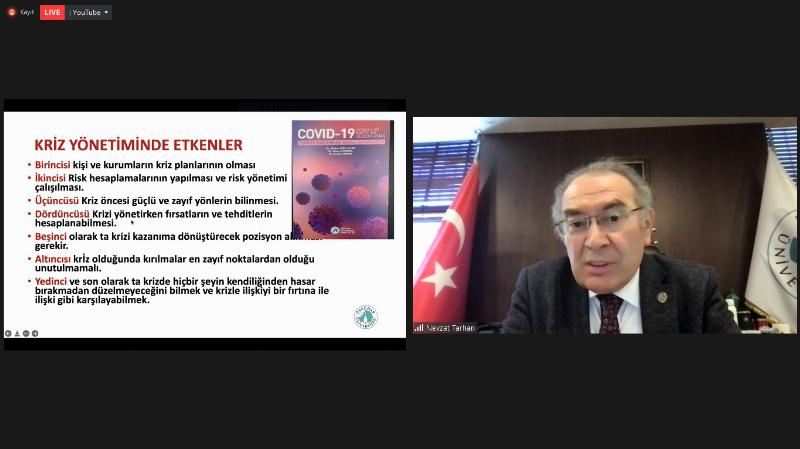
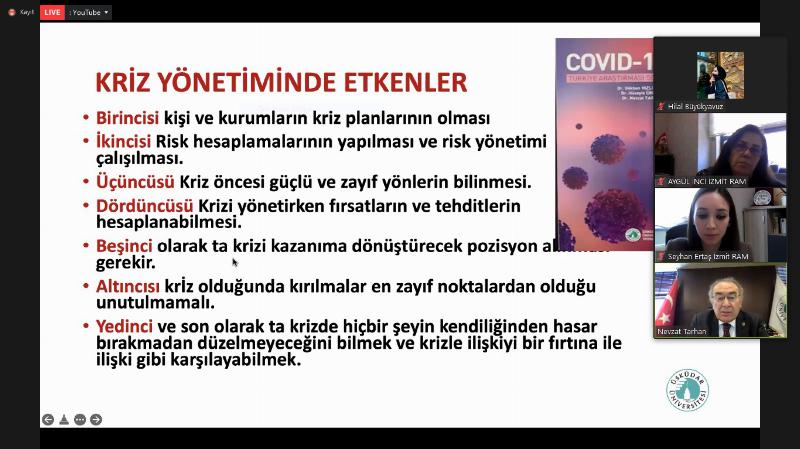
Stating that the pandemic was a period of crisis, Tarhan made detailed statements about the work that needed to be done before and after the crisis. Tarhan; “From a crisis management perspective, there are certain things that need to be done during a pandemic. Firstly, institutions need to have a crisis plan. As an Eastern culture, we pride ourselves on managing crises very well. However, we do not have the habit of making pre-crisis plans before a crisis occurs. Yet, a smart captain is not the one who overcomes the storm, but the one who manages not to be caught in it. For this, there are precursors to potential crises, which are the biggest lessons crises can teach. International secret services conduct pre-crisis global trends surveys. According to those trends, they foresee potential crises and take precautions in advance. The second stage is to carry out risk calculations. Then, knowing the strong characteristics before the crisis and being able to calculate opportunities and threats while managing the crisis. After this stage, it is necessary to take the right position to turn the crisis into an advantage and to remember that when a crisis occurs, the breaking point is at the weakest spot. The final stage is to know that a crisis will not resolve without leaving any damage. We took some of these measures, and in terms of vaccines for the crisis, Turkey is first in terms of easy access to many vaccines. Thank God, we were successful in that aspect of the crisis.”
“The pandemic made us understand the value of what we have”
Making statements about the ‘Post-Traumatic Growth Scale’ research conducted during the pandemic, Tarhan pointed out that the pandemic increased the value of life in people's eyes. Tarhan; “There is a ‘Post-Traumatic Growth Scale’ for psychologically addressing crises. Participants are asked 6 questions on this scale. We implemented this research 1 month after the pandemic began. The results were quite interesting. ‘The priority of things I decide in life has changed’ increased by 59 percent, ‘My interest in spiritual matters increased’ by 49 percent, ‘I understood that I can face difficulties’ showed a 56 percent increase, ‘I can accept events as they are’ showed a 56 percent increase, ‘I started to attach more importance to my social relationships’ by 48 percent, ‘I understood the value of certain people more’ showed a 74 percent increase. All of these show that, on average, about 60 percent of society can take the right position regarding post-traumatic growth. To be able to take this position, one must certainly have this psychological maturity.”
“The internet means unsafe streets in the safe environment of the home”
Making statements about the symptoms and causes of internet addiction, Tarhan stated that young people are wandering in unsafe streets with the internet, even in the safe environment of their homes. Tarhan; “A scale was developed to measure internet addiction. The scale has almost the same characteristics as substance addiction, revealing situations such as the loss of control. Internet addiction is considered a behavioral addiction. Just as gambling is an addiction, internet addiction emerges in the same way. It becomes the person's only area of interest in life. In such situations, it manifests as the person feeling bad when they cannot access the object of their addiction, the internet they are addicted to. Another symptom is that the person feels withdrawal when they cannot access it. Another symptom is that the person's principle of the right to life is severely disrupted. They abandon many important tasks in life and focus solely on the internet. The same symptom is present in most substance addictions. This time, the reward-punishment system is disrupted. Young people, of course, are very easily in the risk group in this regard because their psychological responses are not very developed. When those who use the internet harmfully are researched, two important results emerge. First is a weak family, meaning if family ties are weak, if there is no rule-based environment at home, if parents have lost their leadership to the child. In such situations, the child naturally does what they like. The second part is friendships. Especially after the age of 11-12, this becomes more important for a young person than parents. This age group can experience identity confusion. In the past, there were social rules of society that warned young people; they conveyed ethical standards. Society used to protect young people; now the norms in society have been disrupted. Furthermore, effects starting from television, such as current smartphones, tablets, etc., have become the open door of the home due to the influence of technology. The child can roam in the safe environments of the home but also in unsafe areas.”
“While 20th-century skills were technical and academic, 21st-century skills are social and emotional”
Stating that the spirit of the times has changed, Tarhan underlined that 21st-century skills should not be neglected when raising the younger generation. Tarhan; “Everything has changed now, young people's perspective on life is very different from our generations. Classic. There are 21st-century skills. If we don't apply these skills, we will lose Generation Z. 20th-century skills were focused on technical, academic skills. Teaching more technical skills like foreign languages, computer skills, etc. In the 21st century, a system focused on social and emotional skills emerged. Those with high social and emotional skills will be successful in the 21st century. This needs to be taught to young people. We, with the generation we call Gen Z, do not speak the same language. Therefore, it is important to speak the same language with them. We should explain things to young people not through concepts of religious shame, prohibition, sin, but through scientific soundness. We must convey to young people the understanding that they, not society, need to be honest and hardworking. Today, we live in an era of individualism, even hyper-individualism. Here, our own truths, for example, value education was given, okay, nice, but value education is not given through conferences or sermons; it is given through value-based education. These trainings should be given in daily life. Young people need to learn those values with their justifications because they need them. Therefore, it is necessary to work with young people on the harms of excessive internet use, again with justifications. If young people have big goals, they need to manage their time correctly. The young generation cannot control internet use because they don't manage their time. This concept needs to be taught by the age of 12.”
“There is a need for the development of a culture of self-criticism in Turkey”
Referring to the importance of the balance between freedom and responsibility in life, Tarhan underlined that a new era began during the pandemic on the path to becoming a better person by realizing flaws through self-criticism. Tarhan; “We are free in life, but we are also responsible at the same time. When young people learn the balance of freedom and responsibility, they know how to respect the rights of others. During the pandemic, the new generation was socially isolated, deprived of some things, but children benefit if parents have been good role models in terms of psychological maturity, impulse control, and resilience training, and if there has been a warm atmosphere at home. Most of the young people who come to us as cases do not have a good or warm, supportive family environment; instead of socially supportive families, there are weak families. If family ties are weak, breakdowns occur. Crises strengthen family ties, and a situation like the ranks closing emerges during a crisis. For this, as a society, we need to develop ourselves in terms of self-criticism and accountability. The strongest person is the one who confronts themselves. People who avoid confronting their mistakes by taking the easy way out blame others for their faults. With this perspective, you can never mature in life; you will always make mistakes. During the pandemic, people's sense of responsibility also developed. If we can practice self-criticism, we will realize our mistakes that we usually deceive ourselves about by attributing them to external causes.”
Share
Request a Call
Other News
- The book that read today's digital threats in 2014: Being a Conscious Family
- Experts warn: 'Instead of memorizing letters, teach pencil grip, scissor use, and coloring'
- School fear and school love both start in the family!
- Family is not merely transforming, it is being battered under a serious assault
- Artificial intelligence opens the door to early diagnosis in autism!