

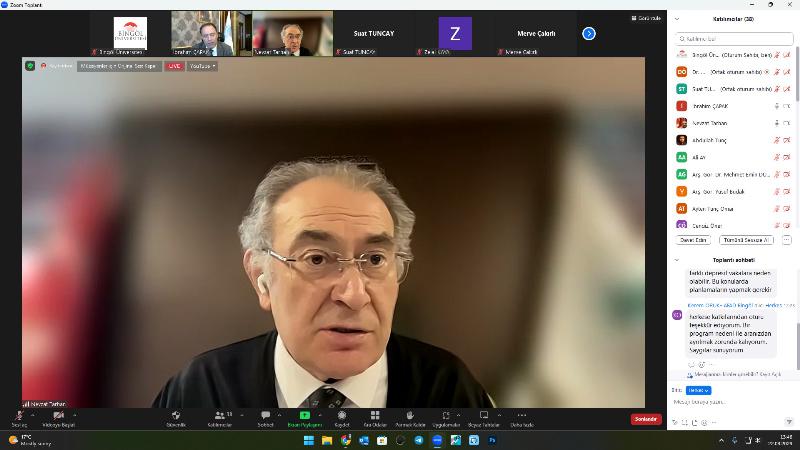
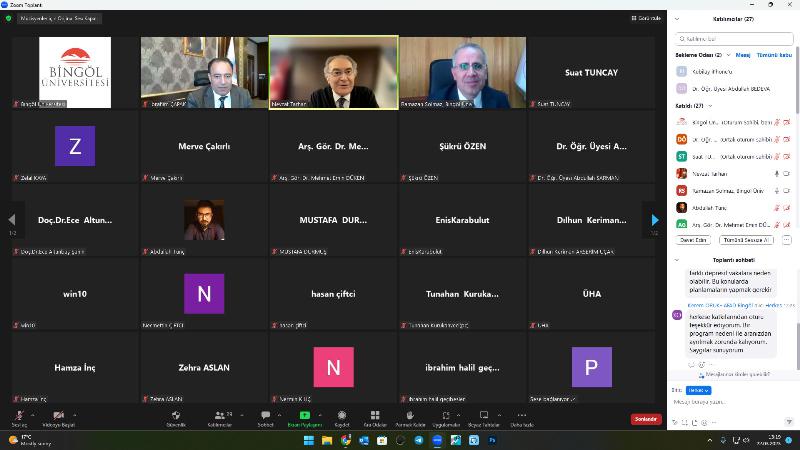
Üsküdar Üniversitesi Founding Rector, Psychiatrist Prof. Dr. Nevzat Tarhan made striking statements at the “Earthquake and Children Symposium” organized by Bingöl University. In the symposium, moderated by Bingöl University Rector Prof. Dr. İbrahim Çapak, Tarhan evaluated the recent earthquakes specifically in terms of child psychology. Tarhan stated that children might not be able to make sense of some measures taken in the disaster area, emphasizing that it should be explained to them that these were for preventive purposes. Tarhan also noted that in disaster situations, such as the major earthquake experienced, children might question God with concepts of good and evil. Drawing attention to the fact that aid flowed to the region from all corners of Turkey immediately after the earthquake, Tarhan also stated that we are a role model society in the world for helping the disadvantaged.
Content
Prof. Dr. Nevzat Tarhan: “We are a role model society in the world for helping the disadvantaged”
“It is necessary to turn children's earthquake traumas into an opportunity”
Evaluating the earthquakes that occurred during the online program specifically in terms of child psychology, Prof. Dr. Nevzat Tarhan pointed out the necessity of turning children's earthquake traumas into an opportunity and imparting the necessary awareness about earthquakes. Tarhan said; “The recent major earthquakes are recorded as the largest in Turkey's history. Our lives will now largely be divided into before and after the earthquake. In fact, this division is a good thing, and it also applies to children. When discussing earthquake-related issues with children, while considering what children should do before an earthquake and how they should be informed and educated, it is also necessary to turn the major trauma they experienced into an opportunity. Every danger has a threat dimension and an opportunity dimension. However, only the threat dimension of traumas is always discussed. The state of social unease affects disadvantaged individuals more. The weak, the powerless, the sick, and children are more affected. They will be more victimized in an earthquake situation.”
“Mistreatment of a child is imprinted as trauma on their developing psyche”
Tarhan began by explaining the concept of 'childhood traumas,' stating that it lies at the core of the earthquake and child relationship. Tarhan said; “Before delving into the relationship between earthquakes and children, it is useful to discuss ‘What is trauma?’ The significance of trauma for a child is very close to the parents' perspective. For example, we talk about childhood traumas. In psychiatric treatment, we routinely examine almost every patient using a childhood trauma scale and try to find the root cause of the child's or adult's illness based on those traumas. For instance, one of these childhood traumas is physical abuse. There are physical abuses such as a child being beaten with a belt out of fear, toilet training being enforced through fear, or being confined to a room. Mistreatment of a child is imprinted as trauma on that child's developing psyche, and they are affected. Another cause of trauma is physical neglect. For example, a child comes home and there's no food. They are locked out or hungry, and no one at home cares. Their clothes are tattered and messy. This is physical neglect. Then there is emotional abuse. Making a promise to a child and not keeping it is emotional abuse. You don't do something even though you promised. This constitutes emotional abuse because it fails to build trust in the child. For example, you say you will give them money but don't. You give things grudgingly. This also becomes emotional abuse. In other words, using love like a stick: for instance, we say, 'If you don't do this, I won't love you.' We do this a lot.”
“Children will understand if the measures taken are explained with reasons”
Tarhan emphasized that childhood traumas can be interpreted differently in later years and stated that measures taken due to earthquakes should be explained to children. Tarhan said; “It is possible to interpret childhood traumas after growing up. For example, if a person still experiences emotional or physical abuse by their mother or father as if it were happening, even after 15 years, therapy is needed in such cases. Children observe and imitate their parents' actions and are in a learning process. In earthquake-prone areas, people sometimes do not sleep at night. In such situations, if they explain to the child nicely that 'they are in an earthquake-prone area and therefore do not sleep at night, doing so as a precaution to calm themselves,' then the child will not perceive it as trauma. It is necessary to explain the reasons to the child. If you say nothing, there might be problems. For example, people in earthquake zones normally stop waiting at night after a month, but if the mother continues to do the same thing 2-5 months later, the child will also do the same. When you look at the child, they might act similarly to the family. Here, if we explain the measures taken to the child with reasons, they will surely understand. When talking to a child, let's not talk while standing; let's crouch down to their level, talk and explain like an adult, but let's not expect adult behavior from them. If this happens, the child will mature, but expecting adult behavior from a child of that age would be unfair.”
“Children may question God with good-bad concepts after an earthquake”
Tarhan stated that after major disasters, especially children, but generally all people, will have some questions about the idea of God, and he emphasized the importance of being able to answer these questions. Tarhan said; “After disasters like earthquakes, children ask; ‘Why did God cause such a catastrophe in the world, doesn't God love us?’ When children ask this question, we need to know how to answer. We live in a world of causes. God seemingly tests us through these causes. It's easier to explain to children. Once someone asks whether God is punishing us, why such a great disaster occurred, I first ask the person what their conception of God is. For example, when we look at Christian theology, it is asked why God created evil. If there is such an absolute, powerful, willing, wise God, how can these evils exist? People are born with disabilities, children are abused, and many innocents remain under the rubble in earthquakes like these. They ask how such a God can be good. According to the belief in Tawhid (Oneness of God), God is closer to us than our jugular vein; He can guide us by the forelock on our forehead – as stated in a verse in the Holy Quran – this means that God is dominant over everything, and His name 'Al-Qayyum' means everything happens by His grace. If we look at this earthquake only from a worldly perspective, we cannot sit here, you cannot move around in the world if you look at it solely from a worldly perspective. Life is not just about worldly life. We cannot solve the mysteries of the universe with only five senses. This therefore, when looking at truth, we must look holistically. We need to look beyond the universe, with the dimension of unseen reality. We try to seek truth within the material universe, whereas we should look by stepping outside the universe.”
“If adults are negatively affected by the earthquake, children are also negatively affected”
Emphasizing that society had adopted a capitalist morality, Tarhan pointed out that what is more likely to leave greater wounds in children than the earthquake itself are parents' incorrect perceptions about the earthquake and poor communication with their children. Tarhan said; “Before the earthquake, as a society, we had adopted capitalist morality; capitalist morality is a ruthless morality that disregards even neighbors and says you shouldn't even care about your father's tears if necessary. We had started to implement savage capitalism as if we were combining it with religiosity, and fate told us we were doing it wrong, saying not to take savage capitalism as a role model, not to imitate popular culture, to shake ourselves up and come to our senses. Let us do this, and when we do, rest assured that children will also be influenced by us. When children see our comfort, when they see that we have resolved this issue in our minds, when we direct ourselves towards good instead of evil – for example, when we lie less, when we act more compassionately, when we increase the time spent together as a family – children will be less affected by traumas. The biggest trauma for a child is being deprived of their parents, or parental neglect. This earthquake does not affect the child as much as the parents' mistakes; therefore, if we are thinking of the child, we must first correct our own behavior. If we, as adults, are negatively affected by the earthquake, the child is also negatively affected, but if the earthquake guides us towards good, truth, and beauty, the child will also guide themselves well and beautifully.”
“We are a role model society in the world for helping the disadvantaged”
Tarhan stated that we are a role model society in the world for helping the disadvantaged; “There are losses, there are children taken under protection; our state already has a foster family system for them, and the Ministry of Family and Social Services has a good infrastructure in this regard. We are truly a role model society in the world for helping the disadvantaged. Here, too, we passed a very good test; everyone rushed to help the earthquake region from other areas. At our university, too, we saw young people sending aid for 24 hours, day and night, without ceasing, doing it entirely with their own resources. We criticize them as Generation Z, but those young people also passed a very good test. That is why fate gave us a warning to turn our course towards good and right in this direction, telling us to turn our course to normal morality, not capitalist morality; let's show this to ourselves and our children. It is necessary to protect the victimized, disadvantaged children in the earthquake region. Here, the ideal is not foster families, but organizations like 'sevgi evleri' (houses of love) under state supervision or voluntary associations. For example, we have an association called Mutlu Yuva (Happy Home) that we established in Istanbul, and this association carries out serious work in many places across Anatolia in cooperation with the Ministry of Family and Social Services. These children stay in homes with foster mothers every day, as if living in a home environment, receiving not only professional social services but also psychological and care services, and are educated on grasping some characteristics of family life. Therefore, we are thankfully good in our societal characteristics on this matter. If the test for disadvantaged people is to draw correct lessons from such an event, then the test for those who are in an advantageous situation, far from the earthquake, is to help the victimized and oppressed earthquake victims. We are all currently undergoing a test. Generally, after 2-3 months, that region is forgotten; we should not forget the region. A system should be established there so that the initial aid and adoption continue sustainably; doing that is very important right now.” With these statements, he once again underlined the importance of always remembering the disaster region.
Share
Request a Call
Other News
- The book that read today's digital threats in 2014: Being a Conscious Family
- Experts warn: 'Instead of memorizing letters, teach pencil grip, scissor use, and coloring'
- School fear and school love both start in the family!
- Family is not merely transforming, it is being battered under a serious assault
- Artificial intelligence opens the door to early diagnosis in autism!