

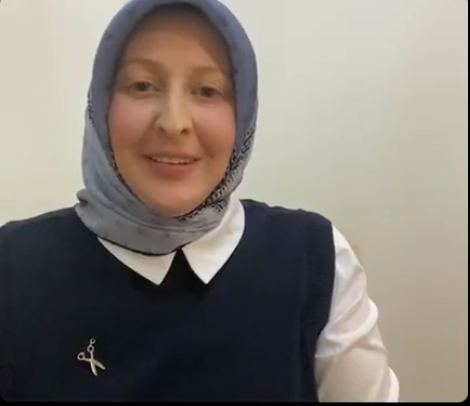
Üsküdar Üniversitesi Founding Rector, Psychiatrist Prof. Dr. Nevzat Tarhan, was a live broadcast guest at the event titled 'Women in a Changing World,' organized by the Ankara Provincial Mufti's Office of the Presidency of Religious Affairs, Family and Religious Guidance Bureau (ADRB). Explaining the existing roles of women today with examples from history, Prof. Dr. Nevzat Tarhan said; “Patriarchal male culture has chosen the role of Hz. Fatıma as the role for women. However, the role for women of this era is the role of Hz. Aisha. That role suits this time much better. Women will possess knowledge, they will exist through their ideas. There will be women who read, think, exist through their ideas, and express themselves in this way. If so, men will respect them, and women will accept themselves in this way.”
Content
Prof. Dr. Nevzat Tarhan; "Women will possess knowledge, they will exist through their ideas"

"Modernism gave birth to a woman model glorified with applause, then abandoned"
In the program moderated by Preacher Şükran Budak of the Family and Religious Guidance Bureau (ADRB), Prof. Dr. Nevzat Tarhan emphasized that, contrary to modernism, women should not be seen merely through sexuality and physical appearance; “A journalist interviews an artist in Hollywood who has turned 40. He asks the artist, ‘What is a woman's nightmare?’ The artist replies, ‘Turning 40.’ The journalist asks why. The artist says, ‘I don't get applause like before, I don't attract attention.’ In other words, modernism gave birth to a woman model glorified with applause but then abandoned. It defines a woman's role focused on visual pleasure, external, physical appearance. This is male feminism. An image of women emerged that defines them not by their inner appearance but by their outer appearance. For example, many global myths were created about this. It was said, ‘There are no ugly women, only unkempt women.’ This is a famous quote by Christian Dior. It is now used as a cliché, like a slogan. So, what is this, in fact? It is modernism seeing women solely as a sexual role and identity. What truly makes a woman a woman is 20% physical appearance and sexuality. The other 80% is her personality. Her loveliness, romantic aspects, empathetic aspects. Her compassion, her motherhood, her tenderness. All of these suddenly fell by the wayside. Now, a young girl picks up a picture and says, ‘I want to look like this.’”
"Humanity is paying the price"
Prof. Dr. Nevzat Tarhan, evaluating cases he frequently encounters in the younger generation, stated; “Currently, I am encountering more cases of Anorexia nervosa than I did during my student years, and these cases are mostly among young girls. They are less common in boys. For example, there's a skirt obsession, like ‘my skirt is tight, oh no, I gained weight.’ There are people who weigh 29 kilos but see themselves as fat, obese. At 29 kilos, they look in the mirror and say they are too heavy. They eat pasta by cutting it, to that extent... And beyond this is body dysmorphic disorder. We used to encounter only a few scattered cases during my assistantship. Now there are so many. These young people are victims of Western culture with body dysmorphic disorder. Body image disorder means constantly undergoing one surgery after another, saying ‘this part of me is like this, that part of me is like that.’ At the top of their mental map, their mental pyramid, is physical appearance. Eating, drinking, and external appearance. After that comes being human. This is the kind of woman's role that has emerged. And because this woman's role is against human psychological nature, and even biological nature, humanity is paying the price.”
"Actually, the book's title is 'Female Psychology,' but I wrote this book for men"
Prof. Dr. Nevzat Tarhan, explaining the perspectives provided by the feminist movement among men in our culture and discussing his work on this topic, said; “In male-female relationships, feminism was actually a justified movement at the outset. That is, it was a movement concerning women's equality in rights and opportunities. However, upon examination, male culture is not ready for this movement. In Turkey, male culture is not ready for the women's liberation movement. Therefore, when we consider the biological differences between women and men, along with the historical background of women's roles, for example, by looking at Turks in Central Asia, Chinese, and the Age of Bliss, we can see that mental power has come to the forefront in women's social roles, instead of physical strength. Mental power is prominent. Since this situation now equalizes all people, both women and men have equal rights and opportunities. I said that men also need to understand this. Actually, the book's title is ‘Female Psychology,’ but I wrote this book for men. Note that it heavily focuses on male-female relationships. The biological and psychological differences between women and men. I observed this. A cultural change is happening in this way. In such situations, we need to find a path to modernization within our own cultural values. Our tradition is currently harming us at this point.”
"It is possible for women to modernize while preserving their own culture"
Prof. Dr. Nevzat Tarhan, stating that violence against women cannot be prevented by laws, said; “Without mental transformation in society, there will be no cultural transformation, no social transformation. Violence against women is tried to be rectified with laws. But laws are consequences. What good is it to fight against the resulting outcome if you don't correct the causes, if you don't diagnose and treat the disease? These are entirely superficial interventions. The law attempting to prevent violence against women, domestic violence, with more laws. Preventing it with laws is a completely deceptive populist approach. Here, protection and prevention must heavily focus on mental transformation. That's why, since 2003, I have tried to address most of my books through topics of family and preventive mental health. I wrote that it is possible for women to modernize while preserving their own culture.”
"The role for women of this era is Hz. Aisha"
Prof. Dr. Nevzat Tarhan, explaining specific women's roles with examples from the Age of Bliss, said; “The examples of these times actually exist in the life of Prophet Muhammad (PBUH) during the Age of Bliss. I sometimes explain this, but they misunderstand. Of course, since you are familiar, you will understand better; that is, there are three female roles in the life of Prophet Muhammad (PBUH). First is Hz. Khadijah. There is a role of Hz. Khadijah as a maternal figure, comforting him, listening to him when the first revelation came, supporting him, and giving him morale. She was 15 years older than Prophet Muhammad (PBUH). Then the second female role is his daughter, Hz. Fatıma. Hz. Fatıma married Hz. Ali. She chose to remain in her husband's shadow. She did not come to the forefront. There are not many hadiths or narrations about Hz. Fatıma. She raised her children at home, Hz. Hasan and Hz. Hussein, and maintained a warm relationship with Hz. Ali. So much so that Hz. Ali used to say, ‘When I see Fatıma, my heart opens, I feel at ease.’ It was such a warm relationship. This self-sacrificing and giving role of Fatıma was very pleasing to patriarchal culture. So much so that our patriarchal culture founded a state called Fatimid and defined this as the role of women, just imagine. But there is another role in our culture. The role of Hz. Aisha. What kind of role is Hz. Aisha's? She would object to Prophet Muhammad (PBUH), ask questions, seek answers, get jealous, and challenge him. But when asked whom he loved the most, Prophet Muhammad (PBUH) received a gift and they asked, ‘To whom are you taking it?’ Prophet Muhammad (PBUH) said, ‘I am taking it to the one I love most.’ He took it and gave it to Hz. Aisha. Prophet Muhammad (PBUH) says this to Hz. Aisha. Now, that is also a role. All three are correct. Parties can choose one of the three. I am not saying one is right and the other is wrong. But patriarchal male culture has chosen the role of Hz. Fatıma as the role for women. However, the role for women of this era is the role of Hz. Aisha. That role suits this time much better. Women will possess knowledge, they will exist through their ideas. I even have a saying that circulates widely on the internet: ‘Women need to stop being sad princesses and become wise women.’ Women who read, think, exist through their ideas, and express themselves in this way. If so, men will respect them, and women will accept themselves in this way. When women act like sad princesses, men try to dominate them.”
"Family is the first environment where a child learns human relations and socializes"
Prof. Dr. Nevzat Tarhan, speaking about the family's effects on children, said; “No one should object to women's socialization. Motherhood and the role of home, family is our last refuge. We need to protect this refuge. Where the family disintegrates, children cannot be happy. They cannot individuate, develop, or socialize. The human race would end. Mating is biological, but marriage is cultural, therefore it's about social learning. Humankind does not inherently possess sociality; it learns it later. Humankind learns to socialize in the environment it lives in. Family is the first environment where a child learns human relations and socializes. More than 50% of all information a person learns between 0-6 years of age, some views from 0-6 years are reduced to 0-3 years. Such a situation exists. That's why the 0-3 age range is currently accepted as the early childhood period. Research and application centers related to this period have been opened in England. We also opened a center for early childhood mental health. We brought a psychiatrist working on this subject from England to Turkey and awarded them an honorary doctorate.”
"Injustice and oppression open the door to all immoralities"
Prof. Dr. Nevzat Tarhan, offering suggestions for ensuring justice within the family for children, said; “Justice is not only in courtrooms. Justice starts in the family. Therefore, where there is justice, morality is preserved. Injustice and oppression open the door to all immoralities. Where there is injustice, there is oppression and intimidation. There is favoritism and opportunism. In such situations, the vein of jealousy and the vein of competition are activated among people. This is how they start lying. For example, when a sibling is born, the child is told, ‘look, your sibling is born, your shoes are cast aside’ to tease them, as a joke, but if the child is very young, they say, ‘oh no, a rival has come.’ They go and pinch their sibling while they sleep. Actually, the mother is the cause of this. The child is treated as if their sibling is someone who will take away the love given to them. However, love is like the sun; it reaches everyone equally. If the mother explained it to her child this way, saying, ‘just as the sun enters everyone's home who opens their window, so too is the love of the mother and father for all children,’ then there would be no jealousy. This is the justice of love. It is the generosity of love. Love will be distributed fairly. When this is done, there are fewer arguments among children, and trust increases. An atmosphere of trust is created in the family.”
Share
Request a Call
Other News
- Social responsibility courses moved to the field
- Erasmus+ Orientation Week completed at Üsküdar
- Prof. Nevzat Tarhan: “Brain secretes ‘dark glue’ in social media lynchers!”
- Prof. Nevzat Tarhan: “Every segment of society should be able to say, ‘This constitution is my constitution!’”
- OHS releases guide for safe operation of industrial robots