

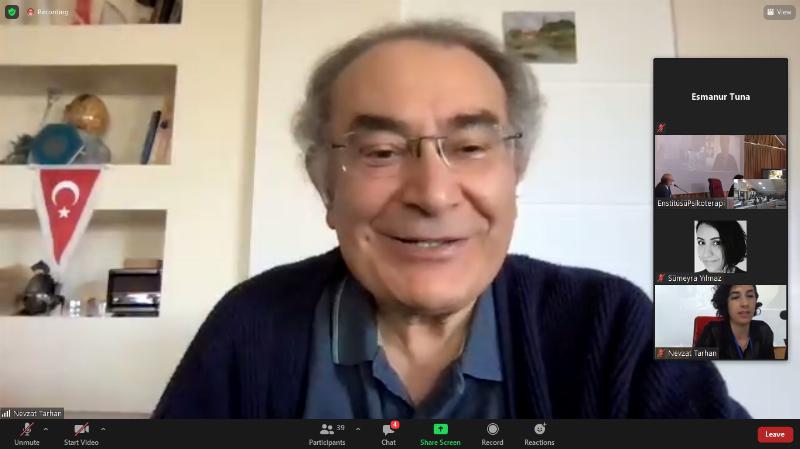
Speaking at the 5th National Holistic Psychotherapy Congress, Founding Rector of Üsküdar Üniversitesi, Psychiatrist Prof. Dr. Nevzat Tarhan made evaluations on “Leadership Psychology”. Emphasizing neuro-leadership, Tarhan stated that new truths emerged with the digital transformation in the 21st century. Tarhan said; “A major change occurred in the 21st century, resulting in a digital revolution. With the digital revolution, many truths changed, so we need to give new answers to old questions. In this new era, the answer to the question “What is success?” has also changed. With the digital revolution, 21st-century skills came to the forefront more. In such a situation, the types and content of leadership have also transformed.”
Content
Prof. Dr. Nevzat Tarhan: “With digital transformation, the definition and content of leadership have also transformed”
“What's important in leadership is being able to manage stress”
This year, at the 5th National Holistic Psychotherapy Congress, which lasted for three days, Prof. Dr. Tarhan spoke about leadership psychology, specifically emphasizing neuro-leadership. Tarhan said; “Neuro-leadership is a field related to human decision-making mechanisms. A person who cannot be their own leader cannot be the leader of others. Leadership is expressed with three different definitions: classical leadership, charismatic leadership, and scientific leadership. MRI studies on the brain revealed that the brain is not a silent organ. Our brain is actually an organ that acts as a tool for our behaviors, meaning the brain moves with us. Furthermore, the brain is closely related to our mental health. Studies have shown that hormones released in the brain under stress regulate the recall of recent information and positively affect memory stores. According to this research, it was found that anxiety caused by the necessary level of stress is needed for learning. In other words, it was understood that a small amount of stress is beneficial, but uncontrolled stress is harmful. An important pillar of leadership is being able to manage stress. Zero stress is close to non-existence and death, but controllable stress leads a person to goals and success. Learning without anxiety is difficult; a small amount of controlled anxiety is necessary.”
“A leader must have conscientious intelligence”
While talking about leadership, Tarhan stated that leadership that achieved military and political success like Hitler, but caused the death of 5.5 million people, is not true leadership; “Success is not the only measure of leadership.” Tarhan said; “Hitler was a formidable soldier, a painter, a very disciplined person. With the leadership model he exhibited, he mobilized masses and annihilated opposition. He was a genius in terms of physical, political, and social intelligence, but his conscientious intelligence was extremely low. He killed 5.5 million people, many of whom were Jewish, on the grounds of being an inferior race. Such cruel individuals become heroes when they succeed. However, success is not the measure of leadership. Leadership should have other measures and standards. A cruel leadership is not real leadership. A leader must have conscientious intelligence. Einstein was a very good scientist, but not a good leader. He has a Nobel Prize in Physics and possesses very high intelligence, but he was a person with problems in his marriage. His IQ was high, but his EQ, or emotional intelligence, was very low. A good scientist may not be a leader in every field, just as Einstein could not be a good leader in his family.”
“With digital transformation, 21st-century skills gained importance”
Drawing attention to the revolution brought by digital transformation in the 21st century, Tarhan stated that new truths emerged in line with the new system. Tarhan said; “A major change occurred in the 21st century, resulting in digital transformation, a digital revolution. With the digital revolution, many truths changed, so we need to give new answers to old questions. In this new era, we need to provide a new answer to the question “What is success?”. With the digital revolution, 21st-century skills came to the forefront more. These skills are unique to humans; for example, robots cannot perform them. The first of these is emotivism. Social emotions, skills, and learning are currently taking place on a neuroscience basis. The largest machine in the world is the internet, and this is provided by the principle of connectivity. Connectivity is even at the point where humans have a mind above the brain. Our brain does not work independently on its own. Thirdly; collaboration, teamwork, innovation, and entrepreneurship. If a person has mental flexibility in this era, is innovative and entrepreneurial, they can predict the future and catch precursors. True leadership is leadership that does not get caught in the storm; it takes precautions beforehand and foresees the coming storm. Therefore, predictability is very important in leadership.”
5 Basic Types of Intelligence: Logical, Emotional, Bodily, Conscientious, Social Intelligence
Emphasizing 5 different types of intelligence from a neuro-leadership perspective, Tarhan stated that these are logical intelligence, emotional intelligence, bodily intelligence, conscientious intelligence, and social intelligence; “These types of intelligence are accepted as five basic intelligences from a neuro-leadership standpoint. Logical intelligence predicts idealism, emotional intelligence predicts activism. Bodily intelligence emphasizes work discipline and realism. Conscientious intelligence is seen as being able to listen to one's inner voice, internal responsibility, accountability, and possessing ethical values. Morality uses reasoning. Wisdom, humility, and social intelligence are open to cooperation. For example, Hitler had high logical, emotional, bodily, and social intelligence, but his conscientious intelligence was quite low. In leadership, there are characteristics of various leadership types. For instance, what does a leader do when giving rewards or punishments? An elastic leader immediately extends a yellow envelope. A charismatic leader is overly sensitive towards those who make mistakes. They act on their intuitions and make quick decisions. Classical leadership performs assigned tasks best but does not do an extra step. But charismatic leaders take risks. They make excessive breakthroughs and implement a reward-punishment system. For cognitive leaders, reward is a priority, while punishment is an exception.”
“Different leadership types approach bureaucracy differently”
Tarhan stated that different types of leaders establish different relationships with bureaucracy; “A classical leader establishes a good system, creates bureaucracy, and doesn't push themselves. They don't think outside the box, perform the given task in the best way, are afraid to step back, and essentially act as a sheep herder. That is, they love herds, herd psychology, and obedience very much. Classical leaders currently in bureaucracy are those who do not undertake new tasks, do not take risks, and make the mistake of doing nothing. Charismatic leaders, on the other hand, can crush bureaucracy, and push bureaucracy aside on justified matters. They are reluctant to step back. Charismatic leadership is leadership that has modeled wolves. Charismatic leaders are also those who can take risks for the future of the flock if necessary. Scientific leadership acts on the rule “you can make a person do something by force, but you cannot make them believe by force,” offers options to convince bureaucracy, and is not afraid to step back. A scientific leader, like a goose herder, leaves their employees free but controls them every minute. Most importantly, they notice crises before they occur and guide people through persuasion.”
“If there is no strategy, small victories gained are meaningless”
Emphasizing the communication methods of leaders, Tarhan stated; “A classical leader builds good relationships with the people they work with. They don't take risks, they don't grow to avoid making mistakes. Charismatic leaders love the people they work with, establish good relationships, desire to fight in communication, grow fast, lose completely when they lose, and their own emotions are prioritized. They love football, want the ball to always be with them, and always want to be in the midfield. Scientific leaders, on the other hand, love the people they work with, establish good relationships, and prioritize empathy in communication, considering both their own and others' feelings. Scientific leadership thinks 8 moves ahead and makes its moves accordingly. There is strategic thinking in scientific leadership. Because if you don't have a strategy, the small victories and small successes you gain are meaningless; you will lose the war. A scientific leader thinks big and takes strategic steps. A scientific leader is visionary. A charismatic leader has more mission than vision; they do whatever the task is.”
Share
Update Date: February 28, 2026
Creation Date: September 28, 2021
Request a Call
Other News
- Social responsibility courses moved to the field
- Erasmus+ Orientation Week completed at Üsküdar
- Prof. Nevzat Tarhan: “Brain secretes ‘dark glue’ in social media lynchers!”
- Prof. Nevzat Tarhan: “Every segment of society should be able to say, ‘This constitution is my constitution!’”
- OHS releases guide for safe operation of industrial robots