

Two books by Prof. Dr. Nevzat Tarhan, who has reached a readership beyond borders with his written works, have taken their place on the shelves to guide the 21st century. With his books "Bilgelik Psikolojisi - 1" and "Bilgelik Psikolojisi - 2" published by Timaş Yayınları, Tarhan emphasizes that wisdom should not remain merely a verbal and abstract attitude, but rather be a part of our daily lives and a value of our life practice. In his wisdom series, Tarhan discusses wisdom, which he sees as the most fundamental value of the 21st century, and offers a solution for the century.
Content
Prof. Dr. Nevzat Tarhan's Wisdom Series to Guide the 21st Century…
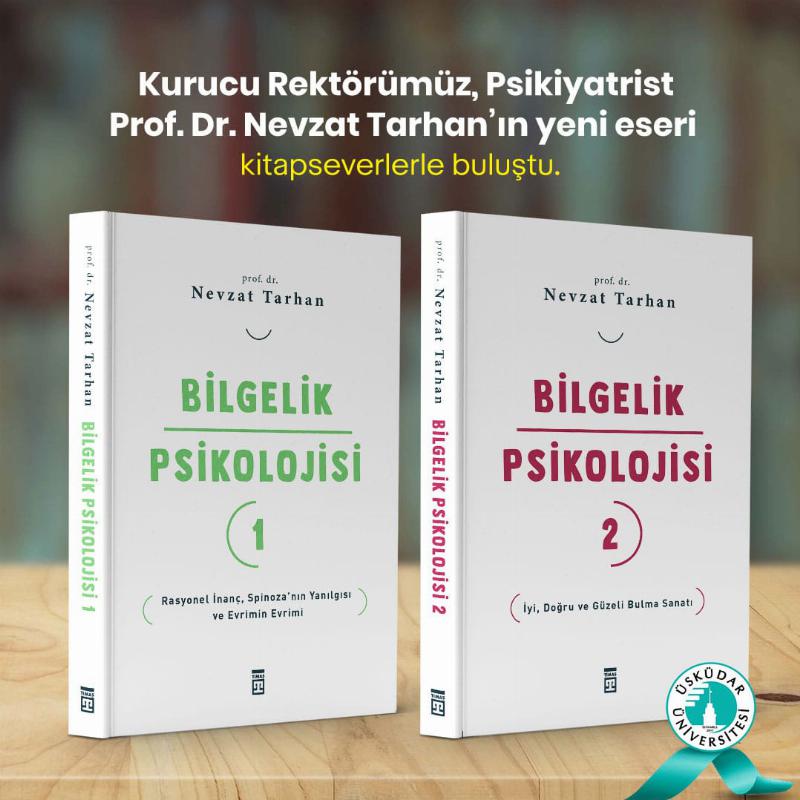
Two new works for 2022 from Prof. Dr. Nevzat Tarhan, Founder Rector of Üsküdar Üniversitesi, Author, Psychiatrist, whose books have sold millions and whose proceeds are donated to the Tarhan Foundation.
The books Psychology of Wisdom-1 and Psychology of Wisdom-2, published by Timaş Yayınları and meeting readers, have taken their place on the shelves, and interest in them has been intense from day one.
Setting out with the idea that wisdom should not remain merely a verbal and abstract attitude, but rather be a part of our daily lives and a value of our life practice, Prof. Dr. Nevzat Tarhan thoroughly examines wisdom, which he sees as the most fundamental value of the 21st century, with his two works titled Psychology of Wisdom 1-2.
The dilemma of Creation and Evolution is examined based on evidence…
In "Psychology of Wisdom 1," subtitled "Rational Faith, Spinoza's Error and the Evolution of Evolution," Tarhan explains how faith is based on common ground with rational intellect in light of the data reached by science in the post-quantum era. He also presents, with evidence-based data, how the scientific basis of the Higgs Boson-God Particle thesis, along with subjects such as the Creation and Evolution dilemma, shows that for science to consider creation has become a necessity from a scientific ethics perspective.
Delving into the origins of the doctrine of wisdom…
In "Psychology of Wisdom - 2," subtitled "The Art of Finding the Good, the True, and the Beautiful," Tarhan brings a wisdom-based perspective to the concepts of ego and self by referring to the original roots of the doctrine of wisdom, which the West defines as Positive Psychology. He provides comprehensive information on the dynamics of wisdom, its practical application in family, society, and leadership contexts, and its connection to Sufism.

Offering a solution for the century…
Emphasizing the need for a wisdom paradigm, guided by reason and accompanied by the concepts of conscience and accountability, for justice and peace to prevail on our planet, where a global pandemic reigns, author Prof. Dr. Nevzat Tarhan combines theory and practice in his Psychology of Wisdom series, offering a solution that can be a remedy for our century.
Wisdom is essential for global peace and justice!
Nevzat Tarhan, one of the first to introduce developments in neuroscience to the world of psychiatry in Turkey, traces wisdom, the most fundamental need of our current century, in this book, in light of the latest scientific advancements. Arguing that wisdom is essential for global justice and peace, Tarhan presents evidence-based suggestions on how to achieve an understanding of wisdom that unites mind and heart, particularly by demonstrating the similarities between the data provided by science in the post-quantum era and the theory of Creation.
Wisdom: The art of finding the good, the true, and the beautiful…
The book opens with a section answering the question, "Is a synthesis of religious sciences and natural sciences possible?", and continues with relatively difficult topics such as an evaluation of Spinoza, who advocates a godless ethical understanding, the brain and spiritual experiences, science taking creation into account, the scientific basis of the Higgs Boson-God Particle thesis, and the Creation and Evolution dilemma. The author, who defines wisdom as the art of finding the good, the true, and the beautiful, also analyzes in the complementary second book how we make decisions, how we manage our sense of control, our abilities to provide internal and external control, scientific accumulations, the emergence of the good-true-beautiful paradigm as the "Science of Goodness," and the doctrines of wisdom. When both are read together, an evidence-based doctrine of wisdom emerges in light of scientific data.
Share
Update Date: February 28, 2026
Creation Date: January 14, 2022
Request a Call
Other News
- The book that read today's digital threats in 2014: Being a Conscious Family
- Experts warn: 'Instead of memorizing letters, teach pencil grip, scissor use, and coloring'
- School fear and school love both start in the family!
- Family is not merely transforming, it is being battered under a serious assault
- Artificial intelligence opens the door to early diagnosis in autism!