

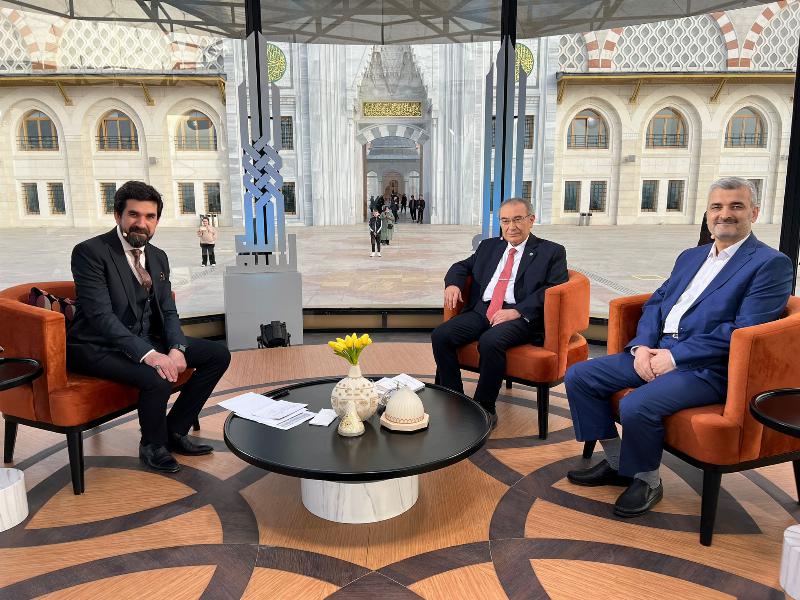
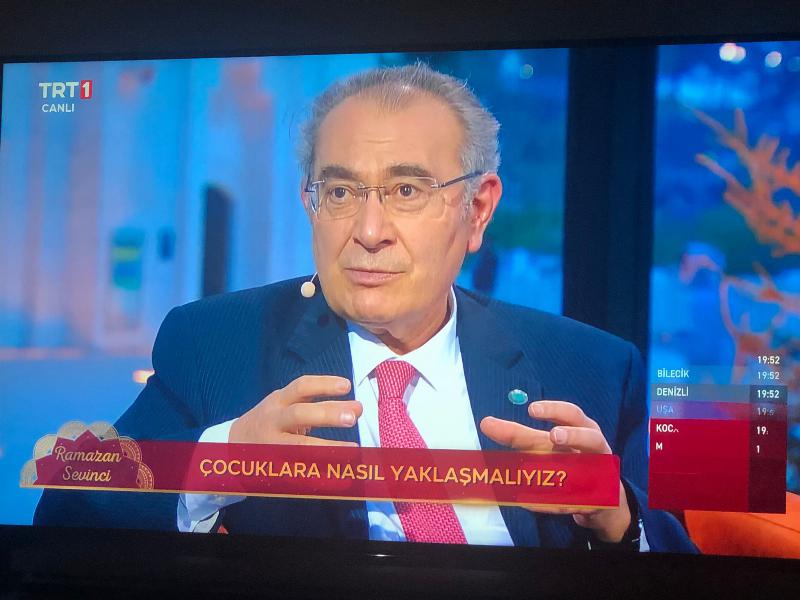
Üsküdar Üniversitesi Founding Rector, Psychiatrist Prof. Dr. Nevzat Tarhan, was the live broadcast guest on the “Ramazan Sevinci” program, presented by Serdar Tuncer and aired on TRT 1. Evaluating the changes caused by modernism, the effects of mind and heart in decision-making, and Generation Z, Tarhan stated that it is the heart that creates human beings and reason. Tarhan, who said, “When we exalted the mind too much, we forgot the gains of the heart”; “For us to be healthy individuals, it is essential that our emotions, mind, and perception work together. When making decisions, the heart must also be involved. The heart is the window of the room that opens to the sun; without a window, the room is dark. Without the sun, there can be no accurate information or correct action.”
Content
Prof. Dr. Nevzat Tarhan: “When we exalted the mind too much, we forgot the gains of the heart”
“Modernism harmed the sense of attachment by isolating people”
Tarhan emphasized that humans are created as social beings and modernism has harmed the sense of attachment by isolating people. Tarhan said; “By nature, humans are not programmed to live alone. In fact, various experiments are being conducted on this. A group of subjects is placed on an island. They are given no tasks, told to live together, and report what they experience. After three months, they measure incidents of violence. Then, they try another group of the same age and characteristics. They are given the task of keeping a fire burning continuously for three months, and it is observed that those with the fire-keeping task exhibit less violence. Humans are social beings, but they can express this better if they have a social goal. This applies not only to humans but also to other living beings. Humans have a genetic sense of attachment. A secure attachment needs to form between a mother and child. According to the concept we call 'object permanence' in psychology, the object of attachment varies at every stage of life. If there is no object permanence, the child cannot feel happy. Modernism, one of the biggest problems of our time, has disrupted attachment. It weakened people's social and familial ties, isolating them. People are paying the price of not forming attachments with loneliness. England and Japan established Ministries of Loneliness. Social isolation among young people leads to loneliness.”
“A restless family environment pushes young people to try other paths”
Tarhan, emphasizing the importance of social life and family life during childhood, stated that young people with weak family ties seek peace through dangerous paths. Tarhan said; “I want to answer the question, 'Why have our families and young people become like this?' When children do not feel happy and peaceful within the family, they turn to various behaviors to relax. This situation is referred to as 'Self-Medication'. As a stress reduction technique, some young people turn to entertainment, while others turn to drugs. Therefore, the goal in family life and social life should be the question, 'How can we create a warm atmosphere at home?' Modernism uses the concept of 'couple' in the family instead of the concept of 'refik-refika' (companion). The concept of couple is not sufficient to express this relationship. In the concept of refika, there is a goal, and companionship exists while moving towards that goal. Life is about being a refik-refika, a companion. If a person can establish a relationship with the logic of a companion, they do not think with two eyes, two ears; they think with four eyes, four ears. We define humanity with its 4 elements. These are the concepts of common sense (hissi selim), perception (idrak), mind (akıl), and heart (kalp). We sometimes call the heart 'gönül' (inner feeling) or 'vicdan' (conscience). For a human being to live a healthy life, their sense organs must function soundly. The issue of heart and mind is very important. The heart provides information on how perceived knowledge will manifest in a person, while the mind makes a judgment and can make a great discovery.”
“The heart is what creates humans and reason”
Prof. Dr. Nevzat Tarhan stated that the true curtain opening to truth, that which creates humans and reason, is the heart; “For us to be healthy individuals, our emotions, mind, and perception need to work together. We say, this issue will be resolved with education. A very great scholar can make a great discovery, a great religious leader can plunge societies into chaos, or a politician, when driven only by emotion and reason, can throw societies into chaos and shed the blood of dozens of people. Here, the heart must be involved. The heart is the window of the room that opens to the sun; without a window, the room is dark. Without the sun, there can be no accurate information or correct action. What we call common sense is also not information that arises from the feelings of society. For example, in Mussolini's Italy, the common sentiment of the people was fascism. In Germany, the common sentiment of the people was Nazism. But here, regarding what the modern era brought, Ibn Münevveh says, 'People weep for their dead, they grieve, but they do not grieve over the death of their hearts.' The heart, which is the window opening to the truth that will revive us, is what creates human beings and reason. We think that whoever earns a lot is intelligent and smart. We think that whoever knows good property is smart. However, that is the intellect related to this world. This intellect should not separate us from the other world.”
“Our brain makes decisions with a mental jury”
Tarhan made statements about the decision-making mechanisms in the brain; “There is consciousness above the mind. This consciousness perceives and distinguishes. The mind analyzes accordingly. The brain is expressed within that operating system. For example, the left brain is related to logic, reasoning, analysis, speech, and calculation. The right brain expresses aspects related to emotions, excitements, music, and art. A mental jury forms in our brain. There is a judge in the mental jury. One of its other four members says, 'What does the scientist say? This incoming information is not real.' The second becomes a moralist, a theologian. He says, this is good, this is bad. Then there is a business person who says profitable-unprofitable. There is another member who says aesthetic-not aesthetic. Using this jury is what makes a human being. When making decisions, it generates things it cannot foresee or know with assumptions and decides accordingly. The most studied topic in psychology is actually, 'How do we make decisions?' Separate mechanisms come into play for writing and eating. The human brain is such that, imagine a valley, it is bone dry in the middle of summer. But if you water one side of it, the watered areas become lush green. Whatever a person invests in, that area develops in their mind and teaches them. The human brain has an incredible capacity.”
“When we exalted the mind too much, we forgot the gains of the heart”
Prof. Dr. Tarhan, referring to the effect of abstract and concrete pleasures and negative and positive emotions; “We are in a time when we have greatly lost the balance between mind and heart. When we exalted the mind too much, we forgot or overlooked the gains of the heart. However, a revolution occurred in psychology in the 1990s. After this revolution, a book titled 'Descartes' Error' was published. In it, reason says, 'I think, therefore I am,' but it should be 'I feel, therefore I am.' Currently, the new perspective of emerging neuroscience is expressed as 'I believe, therefore I am.' That is, the brain generates thought, and we add emotion to that thought with the heart. Combining the mind with the heart is, in a sense, combining thought and emotion. When you turn this into a belief, you exist. So, the mind says something, then the brain says 'go this way' related to reasoning. The right brain says 'go this way' related to emotions. The prefrontal cortex says 'balance it.' It is important for a person to be able to correctly manage their decision-making mechanisms. Therefore, someone who cannot be a leader of themselves cannot be the leader of a family or a class. A person must be their own leader. Because we have negative and positive emotions within us. Negative emotions are carnal desires; basic physiological and psychological emotions such as eating, drinking, procreation, shelter, and protection. And there are abstract pleasures, known as heartfelt pleasures. Abstract pleasures are emotions through which a person can satisfy themselves with heartfelt feelings and high spiritual qualities. If a person can combine these two, they become proficient in self-management. Combining these two is not difficult at all; it's all about wanting it, willing it, and investing in it.”
“We cannot educate Generation Z with concepts of shame, sin, and prohibition”
Tarhan, dwelling on the difference of Generation Z from other generations, made striking statements about the negative effects of false religious teachings on this generation. Tarhan said; “Generation Z is a lovely generation. We should approach this generation not by being angry, but by opening their way forward. Generation Z is the generation of the future. This generation has expectations of freedom, more justice, innocence, peace, and beauty. Their goal is to increase good rather than dealing with evil. We can no longer educate this generation with concepts of shame, sin, and prohibition. Our biggest mistake is using these concepts incorrectly. Recently, a 14-year-old girl came. Rejecting her family's values, she said, 'I've decided to be an atheist.' We investigated and found that the child had always been raised with shame, prohibition, and sin. Now, when a child of this era is raised with shame, they say, 'Who cares about others' shaming, my life is important.' When raised with prohibition, they say, 'Your family's rules, parents' prohibitions don't concern me.' When it comes to sin, they ask, 'What happens if I do what's called sin, and what happens if I don't?' They were told, 'If your family is Muslim, that's a sin; that is, if you do something forbidden, they can force you to change. But if you're not Muslim, no one can force you to change; religion says so.' That's why the child started saying, 'I am not Muslim.' They choose religion to escape the concept of sin. In such a situation, the truth needs to be explained to children as, 'You need to do these things not just because they please you now, but because they will benefit you 5 or 10 years from now.' We will explain to the child with reasons, not by frightening them.”
Signed book gift to the broadcast team…
At the end of his program, Prof. Dr. Nevzat Tarhan signed and gifted the books Psychology of Wisdom 1-2, published by Timaş Yayınları, to host Serdar Tuncer and the broadcast team.
Share
Request a Call
Other News
- The book that read today's digital threats in 2014: Being a Conscious Family
- Experts warn: 'Instead of memorizing letters, teach pencil grip, scissor use, and coloring'
- School fear and school love both start in the family!
- Family is not merely transforming, it is being battered under a serious assault
- Artificial intelligence opens the door to early diagnosis in autism!