

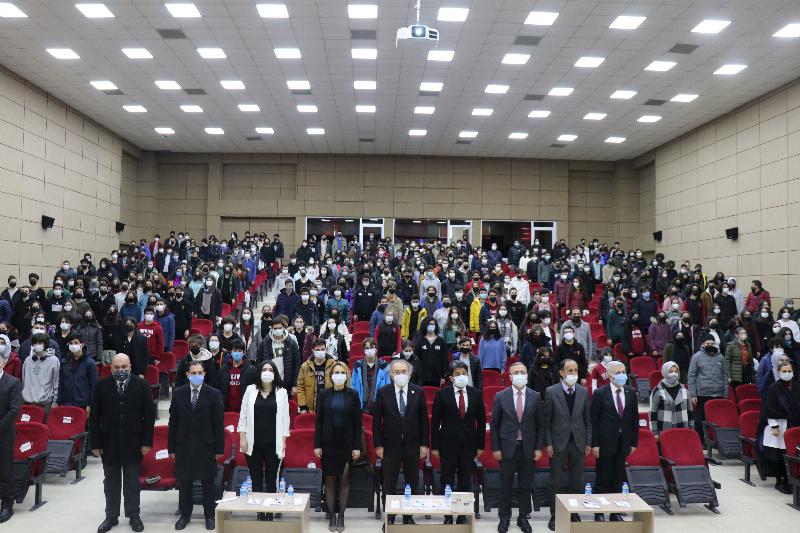
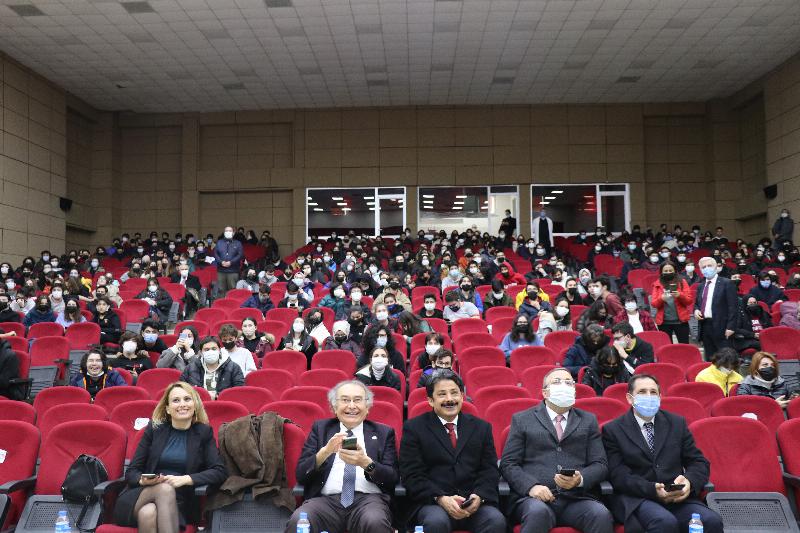
The opening program and the first seminar of the “Change Starts with Me - Social Media Awareness Project,” implemented in collaboration with Üsküdar University, Üsküdar District Governorate, and Üsküdar District Directorate of National Education, took place at Haydarpaşa Anatolian High School. In his opening speech, Üsküdar University Founding Rector Prof. Dr. Nevzat Tarhan stated that social transformation cannot occur without mental transformation and that one must start changing the world with oneself. Tarhan called on young people to ‘be the subject, not the object, of social media,’ adding, “Instead of spending energy on social media, try to become a software developer. Learning a programming language is currently no less important than learning English or any other foreign language.”
Content
Prof. Dr. Nevzat Tarhan: “We will start changing the world with ourselves”
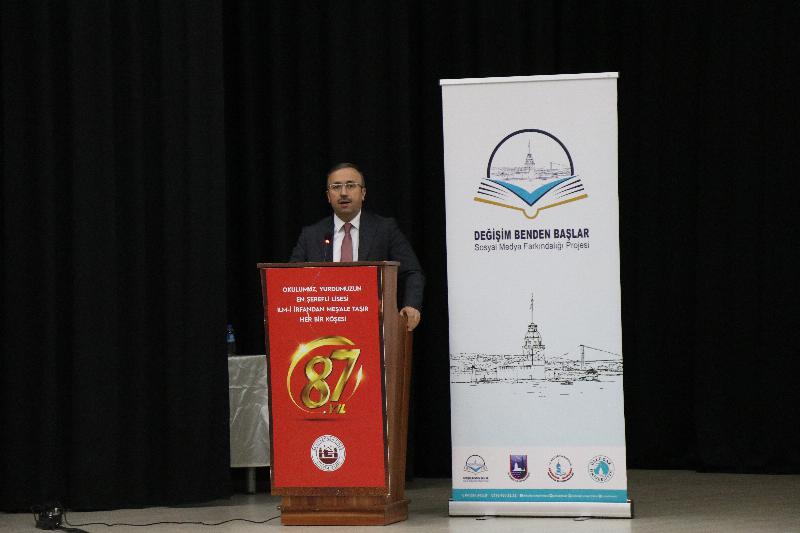
Sinan Aydın: “Society does not change unless the individual changes”
Üsküdar District Director of National Education Sinan Aydın, emphasizing that all changes and transformations are valuable if they come from within, stated within the scope of the ‘Change Starts with Me’ project; “Our project is one that we decided to carry out together with Üsküdar University, under the leadership of our District Governorate. We will try to realize this project with 1,500 students in eight high schools of different types. I would like to express my satisfaction at being involved in this project. I believe the phrase ‘Change Starts with Me’ is quite impactful. The dynamic of societal change passes through the individual plane. Society does not change unless the individual changes. This change is also very significant in terms of social media. If we say let’s live a life away from social media, there is no possibility or chance of that. According to our esteemed Birol’s foresight, half of the world’s education will be remote in the next 10 years, meaning the new education model will be hybrid. In that case, there is no possibility or chance for us to stay away from technology or social media. We need to use them properly. For us to be able to use them properly, these and similar studies are very valuable. That is, to reach our desired destination by using it without being its captive. As the District Director of National Education, I deem it my duty to say this. The title of our topic, ‘Change Starts with Me,’ reminded me of the words of Ibn-i Rushd; ‘If an egg is broken by an outside force, life ends, but if it is broken by an inside force, life begins.’ All changes and transformations are valuable if they come from within. There is no possibility for them to happen through things imposed from outside, or through suggestions and efforts made. I especially ask you to participate in this project with these sentiments. I believe that our esteemed colleagues looking at this project with this perspective will add value to the project.”
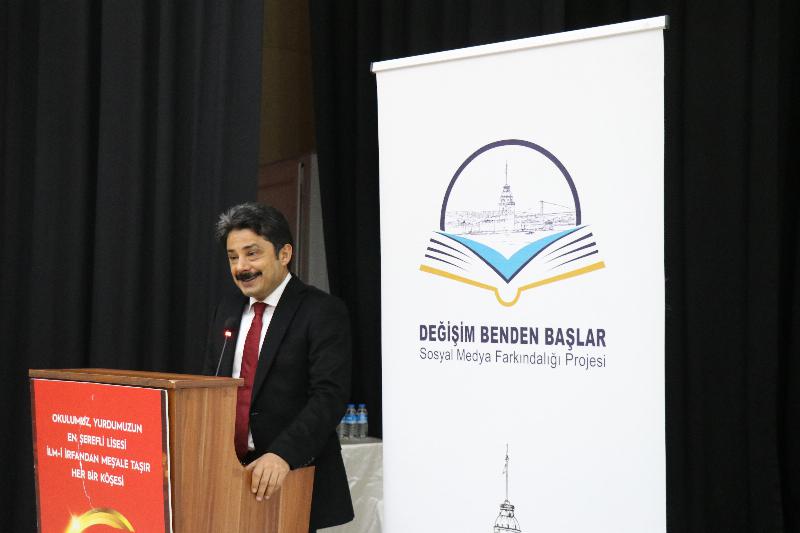
Murat Sefa Demiryürek: “In 15-20 years, we will be gone; responsibility will be yours”
Üsküdar District Governor Murat Sefa Demiryürek, mentioning that it is impossible to stay out of social media in our age and that social media should be used consciously; “My dear young friends, as our esteemed Director just stated, the purpose of the project, with the motto ‘Change Starts with Me,’ is both to open a communication channel with you regarding the use and effects of social media, from which it is impossible to stay out in our age, and to lay the groundwork for a scientific study on this topic. I came across this observation in a social sciences journal. I found it very accurate. “Twitter serves to detect your instant reactions, Instagram your life habits, Facebook your social circle.” it said. When you consider this and add WhatsApp status, LinkedIn, and other channels, there is a flow of information that can be measured in trillions of dollars, not millions or billions, especially from the perspective of International Intelligence Organizations. There is such a thing as a criminal record; it shows crimes, misdemeanors, and incidents involved. These records are cleared with amnesties issued by the state or by the expiration of the periods recorded in the registry. But now there’s something called a Google record. If you are not doing professional work, those records are not cleared and follow you for a lifetime. Young people, in 15-20 years, we will be gone, responsibility will be yours. That is why your accurate analysis, your presence in the right teams, and your correct judgments are very valuable not only for you but also for this country.”
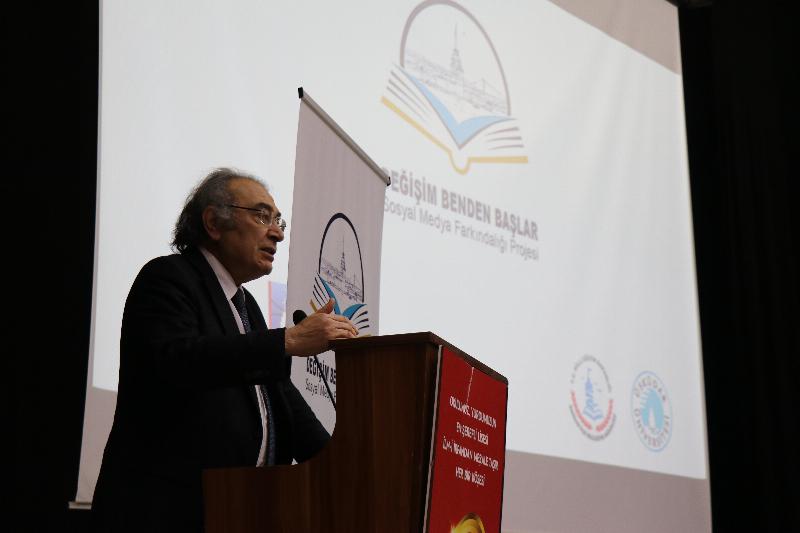
Prof. Dr. Nevzat Tarhan: “Without mental transformation, there is no social transformation”
Üsküdar University Founding Rector Prof. Dr. Nevzat Tarhan, addressing the idea that everything starts with the individual and that we must begin changing the world with ourselves; “Where there is no trust, people operate defensively and do not invest. The biggest reason for the success of the USA is that it is a society with high trust. People feel secure about their future. They invest, they take risks. If there is no legal security, we cannot provide this. In fact, when asked how we can understand if there is justice in a country, it depends on the answer you give. First, one must be sure that no one other than the doorman will knock on their door early in the morning, like being suddenly taken away. Why are people fleeing in Africa? Be sure, it’s because they are not safe. Second, to be sure that nothing out of the ordinary will be done when you end up at the police station. And third, to be sure that legal boundaries will not be overstepped when you go to court. When a person does not experience these three feelings of security, they are in a state of being unjust. And this means trust. The feeling of trust is also fundamental in microeconomics. Without mental transformation, there is no social transformation. Without social change, there is no economic transformation. And without economic transformation, there is no political transformation. Everything starts with the individual. We will start changing the world with ourselves. If we can change ourselves well and beautifully, we see that a psychological influencing power is formed around us. Our relationships with other people improve, we make positive comments, and we add meaning. In such situations, an individual has high social success, which is called social capital. For a person with developed social capital, monetary capital further increases that person’s influence.”
3Ts that simplify our lives: Telephone, television, and tablet!
Prof. Dr. Nevzat Tarhan, mentioning that the 3Ts are an open door to our homes; “Whenever social media is mentioned, we tend to think of it as a dangerous area, something wrong. But social media is now technology itself. We are now neutral, like an automobile. You serve the purpose for which you use it. Social media itself is a tool that speeds up and simplifies life, with 24/7 access. You can do many things by hiding your identity. Now, we talk about the 3Ts, the 3Ts that simplify our lives. What are these? Telephone, television, and tablet. These are the open doors to our homes. 10 years ago, when social media was not so widespread, people were especially advised not to have a TV in the bedroom, as the comfort of the bedroom is different. While it was suggested to have it in a certain area, now even the phone is there. A child is studying inside with a mobile phone in hand, and their father is watching remotely.”
“We need to be the subject, not the object, of social media”
Tarhan especially emphasized that young people should be producers, not just users, of social media; “Definitely do not share things on social media that you cannot defend. First, be honest with yourselves; our ancestors say ‘think three times, speak once.’ Do not believe everything you hear, and only believe half of what you see – that is the wisdom of Anatolia. This culture has not settled in social media. We need to establish a social media culture. It is important that we first do this within ourselves. Young people, we need to be producers of social media, not users. We need to be the subject, not the object. We need to be in a position where comfort is with you on social media. Not directed, not managed.”
“Learning a programming language is no less important than learning a foreign language!”
Prof. Dr. Nevzat Tarhan, stating that they prepared an important project in 2018 which they couldn’t implement but that the world is experiencing a digital revolution, said, “This was a deep learning project in this world. Super young people, super computers can do super things. For now, instead of spending energy on social media, try to become a software developer. Learning a programming language is currently no less important than learning English or any other foreign language. No matter what profession you are in, if you have programming skills, it will make a significant difference for you. İşkur (Turkish Employment Agency) did a good thing related to this. We partnered as a university. Currently, İşkur is offering software developer courses. There is a job guarantee after completion. The training has started. The government supports those who want to become software developers. If you learn this, you will start life one step ahead. In digitalization, you need to be like people who teach software on social media, not just users of social media.”
After the completion of the opening speeches, the first seminar took place. The guests of the seminar were Üsküdar University Faculty Member and Project Coordinator Assoc. Prof. Dr. Aylin Tutgun Ünal, and NPİSTANBUL Hastanesi Child and Adolescent Psychiatrist, Project Training Specialist Assoc. Prof. Dr. Çiğdem Yektaş.
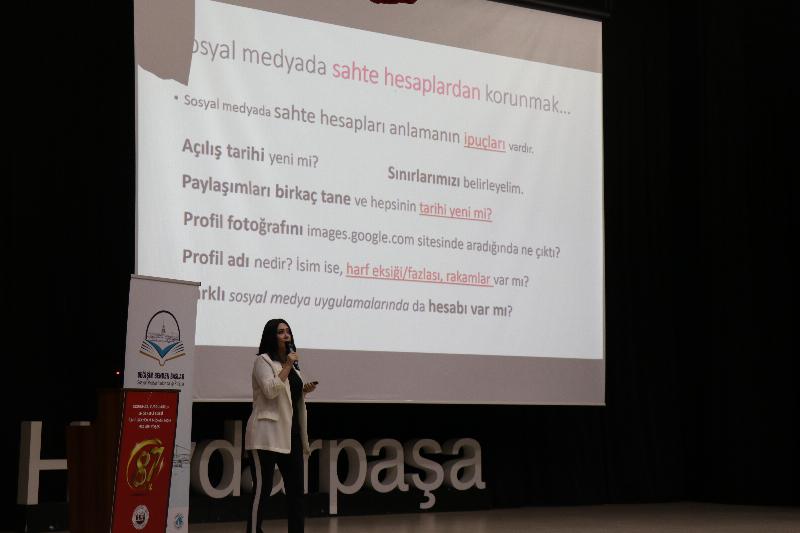
Aylin Tutgun Ünal: “Negative content spreads 6 times faster than positive content”
Project Coordinator Assoc. Prof. Dr. Aylin Tutgun Ünal, mentioning that we should question whether we have the right to share every mood on social media and affect people positively or negatively; “If the mood carried by content you share on social media is positive, people are affected when they see it on your social network. Their mood also improves without you realizing it. That is, they feel good. Conversely, if you imagine being very angry or writing a disaster message, when you write a disaster message, your mood spreads with a strong impact to your friend, your friend’s friend, and your friend’s friend’s friend, up to 3 degrees. Experiments show this. Globally, your emotion, your mood, has actually spread. Negative content spreads 6 times faster than positive content. Conversely, if you think that a post you make when you are sad negatively affects people’s mood 6 times faster, do you have such a right? Perhaps 5 minutes later or when I return home in the evening, I might have moved on from that mood, but that mood continues to spread. We need to be conscious users. Do we need to share every mood on social media? Do I have the right to negatively affect people’s moods? That is, when we sit down and think about it, we need to question whether we have such a right or not.”
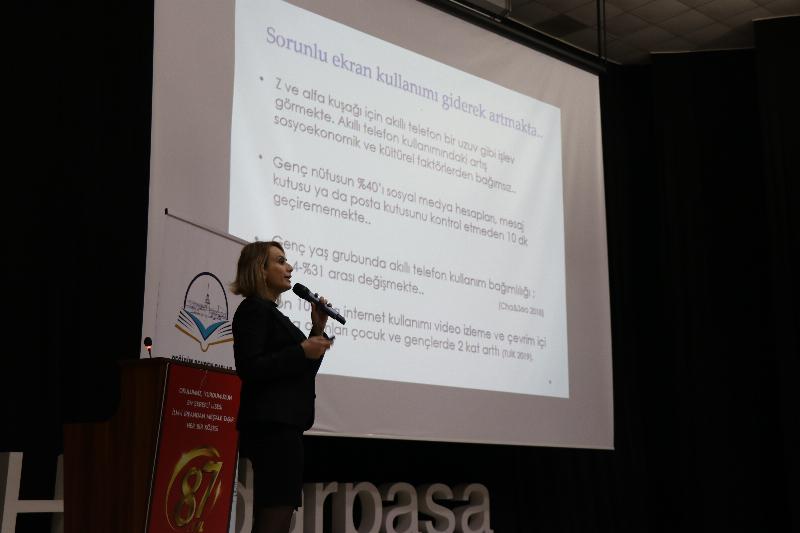
Assoc. Prof. Dr. Çiğdem Yektaş: “Smartphone usage addiction increased significantly with the pandemic.”
Child and Adolescent Psychiatrist, Project Training Specialist Assoc. Prof. Dr. Çiğdem Yektaş, emphasizing that social media or online environments are excellent tools for the brain; “40% of the young population can’t spend 10 minutes without checking their message box and inbox on social media accounts. With the pandemic period, smartphone usage addiction showed a very serious increase. Especially in the last 2 years, our need for socialization shifted to virtual environments due to the inability to have physical contact. In these social environments, we all formed a virtual identity. Not only our real-life identity but also our virtual identity became an important part of our real personality. With the shares we make or the pages we follow on these virtual identities, we actually show our character. Therefore, the shares and attempts we make there can contain quite a lot of information about our identity and personality. Especially if we experience failure in real life, online environments can become our escape from reality. We all have a reward system in our brains, but some of us have a brain structure that is a bit more reward-hungry, in need of more rewards, and where the need for reward is higher. Especially if you feel inadequate in daily life or experience similar negative things, the brain will seek an area that will create less trouble for itself, not bother it too much, and offer a reward. This is where social media or online environments are excellent tools for the brain. So, for adolescents and people experiencing such situations, the internet is actually like escaping from the difficulties of real life to virtual life. Of course, we all have the right to watch such relaxing and distracting content, but if there is usage that disrupts our school life and family life, if there is an increase in negative emotions when we are away from social media, then we need to pay attention.”
The program, hosted by Şaban Özdemir, concluded after students’ opinions were gathered via an online application (Kahoot).
Reporter: Ebranur Özdemir
Share
Request a Call
Other News
- The book that read today's digital threats in 2014: Being a Conscious Family
- Experts warn: 'Instead of memorizing letters, teach pencil grip, scissor use, and coloring'
- School fear and school love both start in the family!
- Family is not merely transforming, it is being battered under a serious assault
- Artificial intelligence opens the door to early diagnosis in autism!