

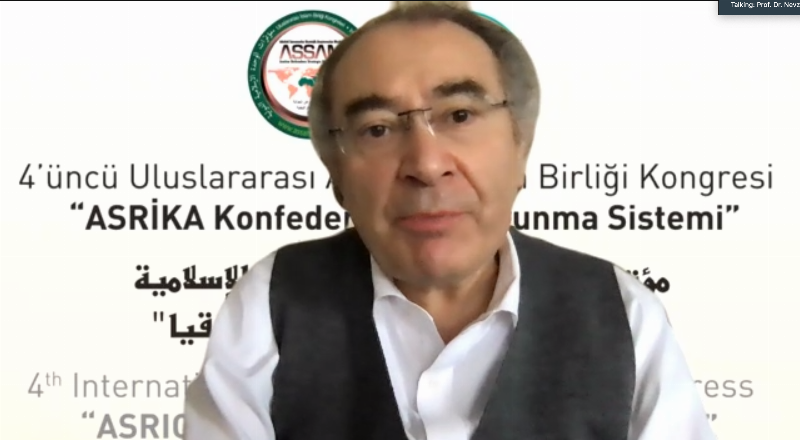
Üsküdar Üniversitesi hosted the 4th International ASSAM Islamic Union Congress. In his opening speech, Prof. Dr. Nevzat Tarhan stated that the Islamic world also has lessons to learn from the global Covid-19 pandemic that has affected the world. Tarhan said, “We need to build and convince minds and hearts. We should prioritize this direction.”
Content
Prof. Dr. Nevzat Tarhan: “We Need to Convince Minds and Hearts”
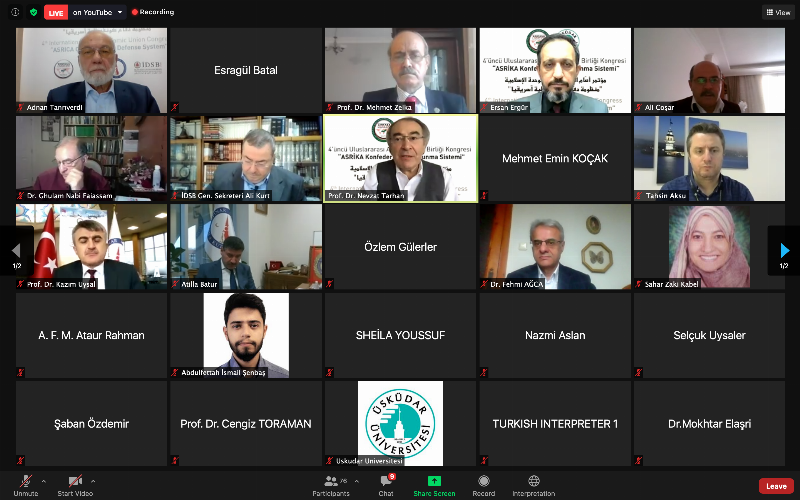
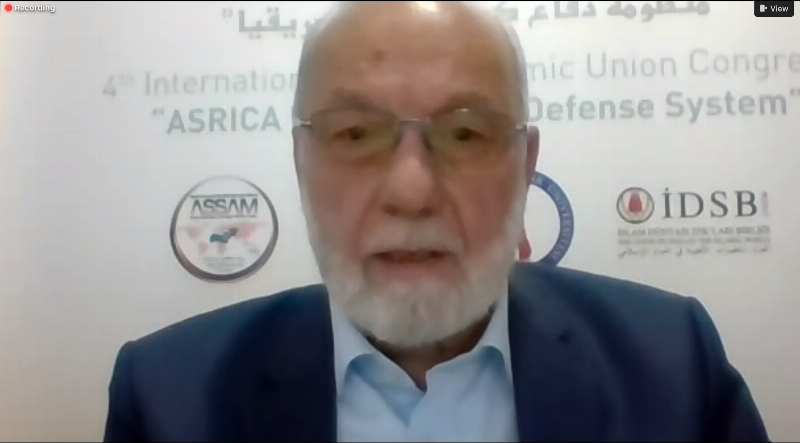
The 4th International ASSAM (Strategic Research Center for Defenders of Justice) Islamic Union Congress, hosted by Üsküdar Üniversitesi, was held under the title “ASRİKA Confederation Defense System.” This year, the congress was held online within the scope of pandemic measures. During the congress, scientists from countries such as the USA, Iraq, Egypt, Niger, Qatar, and Malaysia presented 27 papers.
Prof. Dr. Nevzat Tarhan: “We Have Lessons to Learn from the Pandemic”
Üsküdar Üniversitesi Founding Rector, Psychiatrist Prof. Dr. Nevzat Tarhan, in his opening speech at the congress, touched upon the effects of the pandemic process and gave messages about what lessons the Islamic world could draw from the pandemic. Prof. Dr. Nevzat Tarhan said, “You know, Almighty God constantly speaks to people… He speaks through the language of events, the language of happenings. We already know that this pandemic is not a coincidence. If we read the events correctly, we will learn the right lessons, correct our mistakes, and continue on our way. The pandemic created a feeling of fear in people. There is no physical and psychological comfort; people’s freedom has been restricted. Now, they cannot hug their child, cannot touch their mouth or face. There is no fast-paced life as before. Modern people, who seek pleasure, have lost all of this. On the one hand, we see that the Islamic world is now saddened; the Kaaba is solemn. Masjid an-Nabawi, Al-Aqsa Mosque, Suleymaniye Mosque are solemn. People cannot visit these places. Hagia Sophia was opened, which is a great service, but it is also the same. We cannot go as we wish. People have become isolated,” he said.
Prof. Dr. Nevzat Tarhan: “Calamities have reasons”
Prof. Dr. Nevzat Tarhan continued: “Fate wants to tell us something. There is talk of the virus’s characteristics, its rate of transmission, and the discovery of a vaccine. Any disease or calamity has material and spiritual causes. I am thinking about what lessons we can draw regarding the unseen spiritual causes of the pandemic. While speaking about these, I want to read a hadith. I am reading this source from Al Kafi, volume 4, page 145. The hadith is as follows: The Prophet Muhammad (PBUH) said, ‘When people collectively commit sins, Almighty Allah sends them an epidemic calamity so that they may take heed and repent. When they abandon the principle of commanding good and forbidding evil (Amr bil Ma'ruf wa Nahy anil Munkar), He puts them in a situation where they cannot leave their homes. When they forget to remember Allah, He spreads the fear of death among them so that they may not enjoy the world.’ The current situation should be considered as a message given 1400 years ago.”
Prof. Dr. Nevzat Tarhan: “Without transformation in hearts and minds, there is no social transformation”
Prof. Dr. Nevzat Tarhan stated that divine destiny tells people to change themselves first, saying, “Start changing the world with yourselves. We discuss theoretical goals; we turn them into documents. Let’s write down our dreams, our ideals, but I will have opinions on the methodology. The message derived from the pandemic also brought to mind some examples from the life of Prophet Muhammad. As you know, at the very beginning of his prophethood, Prophet Muhammad was offered, ‘Be the Emir of Mecca, abandon your cause, marry whoever you want, live as you wish, but give up your religion.’ The Prophet did not accept this offer. If he had thought strategically and worldly, he would have accepted the Emirate of Mecca, and after establishing his power, he would have said, ‘Everyone will be Muslim.’ Most likely, it would have happened. However, since it was not built upon hearts and minds, it would have ended with his passing after a while. Without transformation in hearts and minds, there is no social transformation. Without social transformation, there is no political transformation. Therefore, our first priority should be to remove the doubts in people’s minds and hearts and to correct them,” he said.
Prof. Dr. Nevzat Tarhan: “We need to build and convince minds and hearts”
Stating that there is no tissue incompatibility between democracy and Islam, Prof. Dr. Nevzat Tarhan said, “I also want to mention another example from the life of Prophet Muhammad. When he passed away, he did not designate any caliph. While on his sickbed, he stated which commander would go to war, but he did not mention it upon his death. This is actually a lesson for us. The message I derive from this situation is: ‘I am the last prophet. After me, you have reached a level where you can govern yourselves. That is why I am not pointing to any one of you.’ After the Prophet, Hz. Abu Bakr and Hz. Umar came to power through elections. When Hz. Uthman was elected, 6 candidates emerged. There is a demand for self-governance, but later, with the Umayyads, it proceeded as a monarchy for a long time. The question of whether the Islamic world can govern itself or not is important. Orientalists say: ‘Eastern people understand force. They cannot govern themselves. A dictator should be placed over them, and they should be governed that way. Democracy is too much and unnecessary for them.’ We will say that we, as a society, can govern ourselves by referencing the life of Prophet Muhammad. There is no tissue incompatibility between democracy and Islam. To achieve our goals, we need evolution, not revolution, first. Therefore, we need to build and convince minds and hearts. We should prioritize this direction,” he said.
Prof. Dr. Nevzat Tarhan: “We need to educate consciences during the pandemic period”
Tarhan stated that the Holy Quran has 4 principles, listing them as tawhid (oneness of God), prophethood, afterlife, and justice. Prof. Dr. Nevzat Tarhan said, “The Holy Quran speaks of justice. If our goal is justice, then our method in this era should be democracy. Democracy means convincing and gaining the acceptance of the people.” Prof. Dr. Nevzat Tarhan, stating that we need to educate consciences during the pandemic period, said, “We should not sit around waiting for a savior. The savior, messianic approach is the biggest enemy of the Islamic world. The expectation of a savior, the concept of an infallible imam, is the biggest weakness of the Islamic world. Instead of the approach that an infallible imam will come and save us, everyone needs to do something in their own field. If we do these, they will unite like small islands. There are small islands in deltas; over the years, those islands unite to become a large landmass,” he said.
Prof. Dr. Nevzat Tarhan: “We need to explain the truth more in this period”
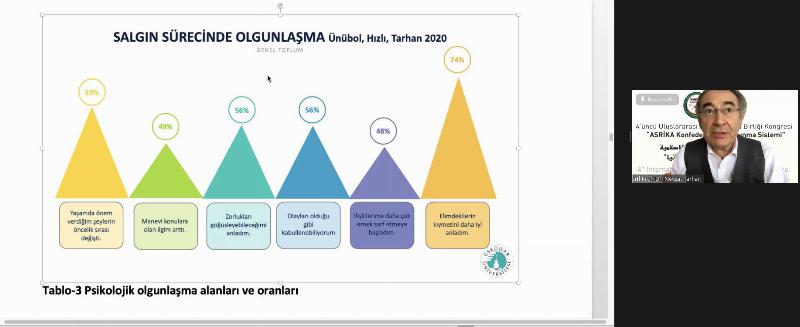
Stating that the pandemic dealt a serious blow to secularism, Prof. Dr. Nevzat Tarhan said, “It brought about results globally regarding people thinking about death and spirituality. We conducted a study at the beginning of the pandemic. This study concluded that there was a significant spiritual inquiry globally. We conducted a maturation survey with 6,300 people during the epidemic process. Questions were asked to determine perceptions, anxieties, fears related to the epidemic, and the level of maturation during the epidemic process. To the question ‘The priority order of things I value in life has changed,’ we received a 59 percent affirmative answer. To the question ‘My interest in spiritual matters increased,’ 49 percent, to ‘I understood that I can cope with difficulties,’ 56 percent, to ‘I can accept events as they are,’ 56 percent, to ‘I started to put more effort into my relationships,’ 48 percent, and to ‘I better understood the value of what I have,’ 74 percent answered yes. These are the changes that Allah’s heavenly teachings demand from us, and they cause the benevolent feelings within people to be activated. In this period, we need to explain the truth more. Our goal should not be to sit aside and dream, but to tell a few people around us that ‘life is not just about worldly life; we are not living in the world, we are passing through the world.’ We need to have a goal, an expectation, a plan, and an explanation regarding what happens after death. We need to activate thoughts and dreams that reduce the love of the world, where secularism is popular, and bring us closer to Allah and the afterlife. I first say this to myself and try to recommend it to everyone.”
Prof. Dr. Nevzat Tarhan: “Islam is built upon hearts and souls”
Prof. Dr. Nevzat Tarhan noted that there is currently a serious search for spirituality in the world due to the epidemic, stating, “We conducted this research in April, and compared to that time, the 3rd wave is being experienced. There is serious fear, and there are predictions that this will continue until 2024 despite the vaccine. Christianity began in the Palestinian territories but globalized in Rome and became a state. Prophet Jesus passed away at the age of 32. With the remaining 12 apostles, after 200 years, the entire world went through a global Christianization. The Roman Empire was governed by stone roads. Commercial, social, economic, and military mobility was on those roads. The saying of that time, ‘All roads lead to Rome,’ has now become ‘All roads lead to the internet.’ Thanks to the internet, we can now discuss what can be done for Islam. There is a mandatory digitalization. Therefore, we need to use this in conveying the message, but the current conveying of the message is not in words but in actions. We need to explain it by living it. First, we will live the truth and reality with the language of our actions for our families and loved ones. The world is open to Islam right now. So is the West. There are two types of West. The first is a political West against Islam, and the other is a West in need of Islam. Hz. Ali divides Muslims into ‘Muslims’ and ‘candidate Muslims.’ The rest of the world consists of candidate Muslims. We need to carry out activities that will convince their minds and hearts. The best method we will use is the discovery of the 21st Century. As we can understand from the life of Prophet Muhammad, Islam is not a religion of revolution but a religion of evolution. It is built upon hearts and souls,” he said.
Prof. Dr. Mehmet Zelka: “While 1.4 billion people worldwide are below the poverty line; 2 trillion dollars are allocated to defense expenditures”
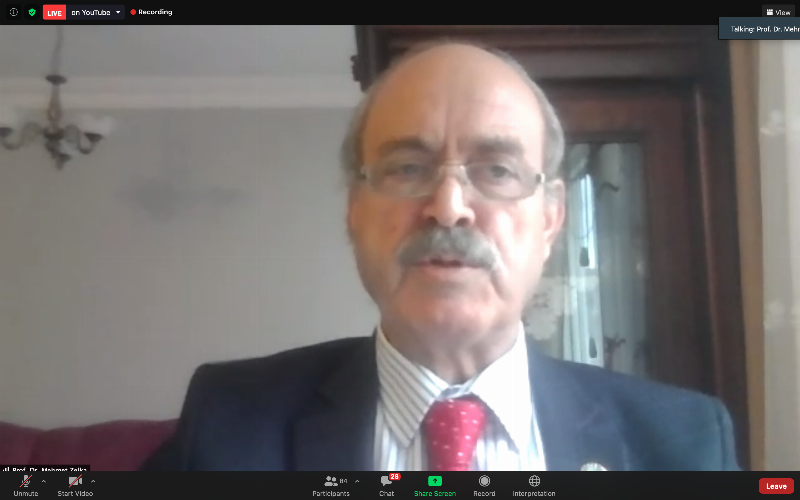
Üsküdar Üniversitesi Acting Rector Prof. Dr. Mehmet Zelka, in his opening speech, stated that despite the increase in material opportunities and life expectancy in today's world, global problems are constantly increasing due to the lack of institutionalization of justice, mercy, and fairness. Zelka noted that climate change, waste, poverty, security problems, and conflicts, along with imbalances in income distribution, lead to pessimism about the future. As a result, antidepressant use worldwide increased by 40% between 2010 and 2018, and the income distribution worsened, with the wealthiest 1% globally having an income twice the material wealth of 6.9 billion people. Zelka said, “While 1.3 billion tons of food are wasted worldwide, 1.4 billion people live below the poverty line, 840 million of whom live in extreme poverty. In this situation, 2 trillion dollars are allocated annually to defense expenditures worldwide.”
Prof. Dr. Mehmet Zelka: “Islamic countries should form a union”
Prof. Dr. Mehmet Zelka stated that the total cost of wars, conflicts, terror incidents, and acts of violence in the world to the global economy was calculated as 14.1 trillion dollars in 2018, and noted that defense expenditures in Middle Eastern countries alone amounted to nearly 12 trillion dollars in the last 20 years. Prof. Dr. Mehmet Zelka, emphasizing that Islamic countries should form a union, said, “It is only possible to reduce tension, disagreements, external interventions, and thereby increase security and establish a peaceful environment by Islamic countries forming a union and going into a joint defense and security structure within this union, establishing a Ministry of Defense, setting up defense presidencies in countries, creating the necessary institutional structure within this framework from a determined center, and determining and implementing joint defense and security policies through regular and periodic meetings.”
Adnan Tanrıverdi: “The ASSAM Congress aims to present a model”
Adnan Tanrıverdi, Chairman of the ASSAM Board of Directors, shared information about the congress, which was held for the fourth time this year, in his opening speech. Referring to the three congresses held in previous years, Tanrıverdi stated that the congress is a societal initiative and said, “Our aim is to present a model to decision-makers. The purpose of this congress is to determine the procedures and principles of the conceptual defense system to be established in 9 federal regions connected to the Confederation and in the national states connected to these federal regions, with a joint defense system to be operated from the Confederation Center. Islamic countries constitute 61 of the 193 states that are members of the United Nations organization, and their populations are Muslim. Of the world population of 7.632 billion, 1.85 billion are people from Muslim countries. The territories of 61 Islamic countries constitute 30.9 million square kilometers of the world's land area of 150 million square kilometers. Representing the backbone of the Islamic geography, Asia and Africa, ASSAM tries to put forward a term against Eurasia by calling them ‘Asrika continents.’ In other words, it identifies the helmet of Asia and Africa,” he said.
Adnan Tanrıverdi: “ASRİKA is a candidate to be the superpower of the future”
Adnan Tanrıverdi, drawing attention to the richness of resources in Islamic geography, said, “The Islamic geography, which holds 55.5 percent of the world’s oil reserves, 65 percent of its production, 64.1 percent of natural gas reserves, and 40 percent of its production, possesses a potential power, with its geopolitical position, common civilizational values, and historical accumulation, by combining its opportunities, efforts, and goals, to be a candidate for the future superpower in the Asrika, or Eurasian, geography. Despite this, the Islamic world consists of countries that are most interfered with in these lands and occupy the United Nations the most. These countries are in a position of need, where terrorism and anarchy are never lacking, resources are managed by foreign powers, human rights and freedoms are violated, income distribution is distorted, political, social, and economic instabilities prevail, and they demand the aid and support of external power centers to solve their internal problems,” he said.
Adnan Tanrıverdi noted that the purpose of the series of congresses is to ensure that the necessary institutions for the Islamic countries to unite under one will, and the legislation these institutions should have, are put forward as a model. He said, “The series of International ASSAM Islamic Union congresses has been planned and implemented. The main topic of the first International ASSAM congress held in 2017 was the determination of the administrative forms, organs, and legislation for the Islamic Union; the second, held in 2018, was the determination of the procedures and principles of economic cooperation for the union from Istanbul; and the third, held in 2019, was the determination of the procedures and principles of defense industry cooperation.”
Adnan Tanrıverdi: “An ideal model will be developed for the ASRİKA Confederation of Islamic Countries”
Adnan Tanrıverdi also touched upon the work to be carried out at the 4th International ASSAM Islamic Union Congress titled “ASRİKA Confederation Defense System” and said the following:
“The aim of our congress is to determine the procedures and principles of the conceptual defense system to be established in 9 federal regions (natural, as envisioned) connected to the confederation and in the national states connected to these federal regions, with a joint defense system to be operated from the confederation center. The congress will examine the geopolitical situation of ASRİKA Islamic countries, the defense organizations of global powers and their activities in Islamic countries, the military bases of global powers, private military companies, the organizations they use, and proxy wars, as well as the defense organizations of Islamic countries. Furthermore, the military forces of Islamic countries (Land-Sea-Air-Air Defense-Special Forces-Cyber Aviation-Space Forces), the origin of war weapons and vehicles in the inventories of Islamic countries, as well as the Ottoman era defense organization, the examination of defense alliances worldwide, the ideal defense organization of the ASRİKA Confederation of Islamic Countries, the regional defense organizations of the Confederation Ministry of Defense, and the defense organizations of national states affiliated with the Confederation Ministry of Defense will be processed, examined, and evaluated, and at the end of the congress, an ideal model for the ASRİKA Confederation of Islamic Countries will be developed. Subsequently, we aim to put forward a model that will gather Islamic countries under one will by the end of 2023, by addressing common foreign policy in the coming year, a common justice system in the year after, and common public order and security issues in the year after that, i.e., in 2023.”
Speaking in the opening session moderated by Ersan Ergür, Vice Chairman of the ASSAM Board of Directors, Prof. Dr. Kazım Uysal, Rector of Kütahya Dumlupınar Üniversitesi, highlighted the importance of unity and solidarity in the Islamic world and thanked the organizers and participants of the congress. Lawyer Ali Kurt, Secretary-General of the Union of Islamic World NGOs, stated that all Muslims worldwide should be united in the face of injustices and unfairness they suffer and that cooperation is a necessity. Prof. Dr. Elman Nesirov, Member of Parliament for Azerbaijan's ruling party and Advisor to the President on Energy Policies, also thanked Turkey for its great support in Azerbaijan's struggle to liberate Karabakh.
Dr. Fehmi Ağca participated with two presentations
Dr. Fehmi Ağca, Faculty Member of the Department of Political Science and International Relations (English) at Üsküdar Üniversitesi Faculty of Humanities and Social Sciences, and Director of PAMER, also participated in the congress with two separate presentations. Dr. Fehmi Ağca presented “Defense Organization and Management in the Ottoman State” and “Turkey’s Territorial Waters and Continental Shelf Rights in the Aegean Sea and Eastern Mediterranean within the Framework of International Law.”
Papers were also presented at the congress under the moderation of Prof. Dr. Cengiz Toraman, Prof. Dr. Ensar Nişancı, Prof. Dr. Yakup Bulut, and Prof. Dr. Atilla Batur.
Papers presented within the scope of the congress;
- ASSAM Board of Directors Chairman, Ret. General Adnan Tanrıverdi / ASRİKA Islamic States Union Defense Organization (Conceptual Model)
- QATAR - Prof. Dr. Ali Karadaği / Foundations and Principles of Defense Cooperation for Islamic Unity
- MALAYSIA - Sheila Yousuf / Investigation of Worldwide Defense Alliances NATO; Commonwealth of Independent States; EU Defense and African Union Defense Organization
- JERUSALEM BANGLADESH - Wisam A. Samarah, A.F. M. Ataur Rahman / Defense Expenditures, Economic Growth, and a Stable Islamic World
- Asım Öztürk / Importance of the African Union for Islamic Unity in the Context of Collective Defense
- CHAD - Dr. Ahmed Ojley Abdülvahİd / Military Bases in Islamic Countries (Chad Example)
- BOSNIA AND HERZEGOVINA - Assoc. Prof. Dr. Admir Mulaosmanović / An Ideal Defense Organization Model for the ASRİKA Confederation “ASRİKA Rapid Intervention Forces”
- Assoc. Prof. Dr. Mehmet Naci Efe / Analysis of the Defense Industry of Islamic Countries and Policies to be Formulated
- IRAQ Hossam Rashid Hadi Al-Rubaie / Towards a Geopolitical Theory of the Islamic World
- EGYPT - Sahar Zaki Kabel / Political Geography of Islamic Countries
- Dr. İbrahim Karataş / An Analysis on the Necessity for Islamic Countries to Cooperate in Domestic Weapon Production
- Dr. Fehmi Ağca / Defense Organization and Management in the Ottoman State
- NIGER - Mansour Elh Amani / Defense Organizations of Global Powers (USA, Russia, China, UK, France) and Their Activities in Islamic Countries
- Prof. Dr. Mehmet Zelka, Prof. Dr. Cengiz Toraman, Prof. Dr. Hüseyin Altay / Organizational Structures in Military Organizations in the Information Age: Recommendations from a Management-Organization Perspective
- Mehmet Emin Koçak / Special Forces Standard and Cooperation Among Islamic States for Islamic Unity
- Asım Öztürk / Supra-Regional Collective Defense Architecture of the Islamic Union in the Context of Collective Defense
- EGYPT - Dr. Muhtar Elashri / Geopolitical Assessment of Asrika Islamic Countries
- Oğuzhan Akyener / Effects of Climate Change on International Security Policies and the Islamic World
- Prof. Dr. Yakup Bulut, Dr. Soner Akın / Defense Policy of the African Union Organization and Its Cooperation with the EU
- Ersan Ergür / Examination of Defense Alliances Worldwide; NATO
- PAKISTAN - Shadid Hashmat / Examining NATO as a Political and Defense Alliance
- USA - Dr. Ghulam Nabi Faiassam / Global Peace and Conflict Resolution: A Kashmir Case
- Dr. Levent Kenar / Threat of Coronavirus and Biological Weapons to the Islamic World
- Burkina Faso - Dr. Compoure Boukary / Determination of Procedures and Principles for a Common Defense System for Islamic Unity
- Dr. Fehmi Ağca / Turkey’s Territorial Waters and Continental Shelf Rights in the Aegean Sea and Eastern Mediterranean within the Framework of International Law
- TRNC - Assist. Assoc. Dr. Emete Gözügüzelli / Blue Diplomacy Between Turkey and Islamic Countries (Turkish Seas and Legal Rights in the Eastern Mediterranean)
- ASSAM Vice Chairman (Ret.) Colonel Ali Coşar / Impact of Emerging New Conditions on War Doctrines and Concepts “The Need for Renewal of War Law”
Adnan Tanrıverdi / Concluding Evaluation Session (Moderator Prof. Dr. Mehmet Zelka)
Share
Update Date: February 27, 2026
Creation Date: December 12, 2020
Request a Call
Other News
- The book that read today's digital threats in 2014: Being a Conscious Family
- Experts warn: 'Instead of memorizing letters, teach pencil grip, scissor use, and coloring'
- School fear and school love both start in the family!
- Family is not merely transforming, it is being battered under a serious assault
- Artificial intelligence opens the door to early diagnosis in autism!