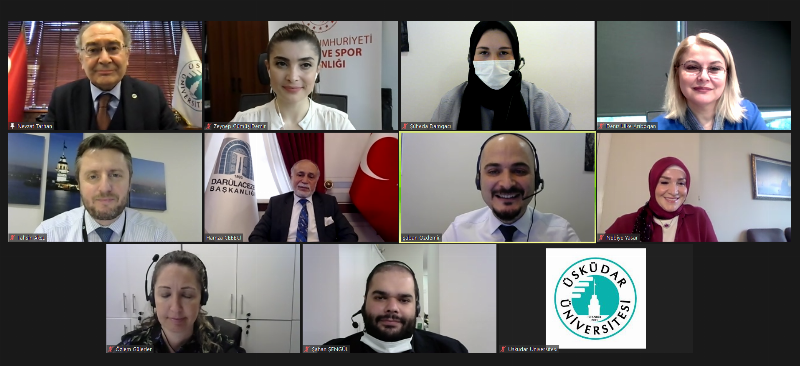
The opening of the 'My Support Is With You Everywhere Darülaceze Volunteers Project' was held during an online ceremony within the scope of pandemic conditions. The project, which will be carried out under the leadership of the Therapeutic Brain Mapping and Neurotechnology Association to provide volunteer-based social support for individuals over 65, will last six months. The project, which will involve 42 volunteer students studying at Üsküdar Üniversitesi and 60 Darülaceze residents, aims to contribute to making volunteerism more widespread in social life than it currently is, to raise awareness and sensitivity among young people regarding their social responsibilities towards society, and to offer opportunities for elderly individuals, who are among disadvantaged groups, to benefit from art, social life, and innovative idea activities.
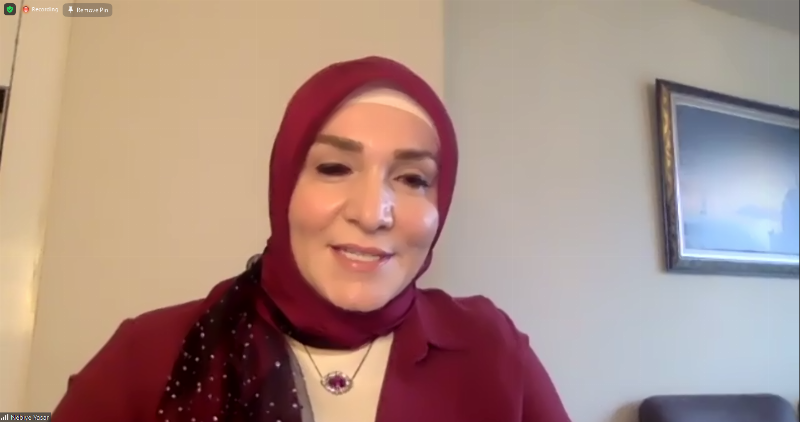
Assist. Prof. Dr. Nebiye Yaşar: “Intergenerational interaction is also very important for the sustainability of social culture”
Project Consultant, Director of Üsküdar Üniversitesi Young Brains Academy, Assist. Prof. Dr. Nebiye Yaşar, who made the opening speech of the program, stated in her speech that the project has two target groups: one being young people and the other being wise elderly individuals over 65. Noting that old age is a period where life is questioned but learning and development continue, and there are opportunities for discovery, Assist. Prof. Dr. Nebiye Yaşar said, “In reality, old age is a period when experiences and wisdom gained throughout life reach their peak. Values are transferred through interaction among members during the socialization process. Intergenerational interaction in the socialization process is also very important for the sustainability of social culture. The accumulated knowledge of the elderly and traditional cultural elements are at risk of being lost due to rapid social change. By transferring the elders' accumulations to younger generations through such beautiful projects, we can prevent the loss of cultural accumulations and values.”
Assist. Prof. Dr. Nebiye Yaşar: “The place of the elderly in our culture is a position of respect”
Stating, ‘Young people are our future, and our elders are our source of wisdom,’ Assist. Prof. Dr. Nebiye Yaşar said, “A society that does not care for its elderly and does not benefit from their experience is an immature society. Aging is like climbing a mountain. As you ascend, fatigue increases, breath shortens, but the view widens. The place of the elderly in our culture is a position of respect. They are our lighthouses illuminating our path. Children who grow up in a home with elderly people are closer to wisdom, experience, and a sense of belonging. A home with elderly people is like a school where traditions, culture, and values are learned. We are producing projects to prevent depriving our new generations of these experiences and wisdom.”
Assist. Prof. Dr. Zeynep Gümüş Demir provided information about the project
Subsequently, Project Coordinator Assist. Prof. Dr. Zeynep Gümüş Demir from Üsküdar Üniversitesi's Faculty of Humanities and Social Sciences also provided information about the project. Expressing their satisfaction in realizing the project, Assist. Prof. Dr. Zeynep Gümüş Demir noted that the project consists of the following modules and workshops: “Adaptation to Old Age and Active Aging Training Module,” “Technology and the Elderly Training Module,” “Our Values Training Module,” “Art Therapy Workshop,” “Advanced Age Writers Workshop,” “Short Documentary Workshop,” and “Music Workshop” applications.
Prof. Dr. Deniz Ülke Arıboğan: “During the pandemic, the world turned into a laboratory environment”
Prof. Dr. Deniz Ülke Arıboğan, Rector's Advisor at Üsküdar Üniversitesi and Dean of the Faculty of Humanities and Social Sciences (İTBF), stated that as İTBF, they were very happy to have carried out such a project with the Ministry of Youth and Sports and the Darülaceze Presidency. Emphasizing that this project actually addresses very important and valuable points and was implemented at a very special moment in history, Prof. Dr. Deniz Ülke Arıboğan said, “We are facing a very large human trauma that occurs once every 100 years. For the first time since the early 1900s, we are in the midst of a severe pandemic process, and the entire world has turned into a laboratory environment. In this laboratory environment, we observed the difference in resilience between communities that managed to live as a family and those that remained as individuals.”
Prof. Dr. Deniz Ülke Arıboğan: “A bridge is being built here between generations”
Prof. Dr. Deniz Ülke Arıboğan noted that it was understood how high the resilience of communities that care for their elderly and live with them and their families is. She added, “It was also very important that this is not one-sided, and the issue is not just about survival, but also for the younger generation to remain psychologically resilient, to continue their existence as happy people, as people living lives that hold meaning. Because, in fact, we had to withdraw from the real world we live in and go online. Our experiences diminished, and our children became unable to experience. For this reason, spaces were created within families where children and young people living with their elderly, with older generations, could live real lives by interacting with them and benefiting from their experiences. A bridge is being built here between generations. When we say ‘My support is with you,’ the issue is not only about young people providing support to the elderly, but we are actually talking about the elderly perhaps providing support to the young. We see how meaningful a life elderly people can lead and how long they can continue it by transferring their experiences to young people and creating projects together.”
Prof. Dr. Deniz Ülke Arıboğan said, “The main problem is no longer that human life expectancy reaches 90 or 100 years. The main problem is for a person to succeed in living for 100 years meaningfully, productively, remaining within the system, knowing they exist without feeling alone, being conscious of it, and making a contribution. To ensure that life can be sustained meaningfully. That's why, with these kinds of projects, under the leadership of Darülaceze, it is actually possible to present a new paradigm.”
Darülaceze President Hamza Cebeci: “This project will provide very significant benefits to all participants”
Darülaceze President Hamza Cebeci stated that they had achieved positive results with the "Positive Aging Interaction Group Project" they previously implemented with Üsküdar Üniversitesi, and Darülaceze residents were very satisfied, adding that this project would also provide very significant benefits. Hamza Cebeci noted that in such joint projects, the interests of stakeholders are not at stake, but rather service to humanity. He said, “This work will both greatly benefit Darülaceze, and the young people who will take part and have a role in this program will directly benefit from the experiences here. I thank Üsküdar Üniversitesi for this valuable project. We hope the project will conclude successfully.”
Prof. Dr. Nevzat Tarhan: “The elderly are the lighthouses of life. We confined these lighthouses indoors”
In his speech at the ceremony, Üsküdar Üniversitesi Founding Rector, Psychiatrist Prof. Dr. Nevzat Tarhan, stated that the project is a very important and meaningful one. Prof. Dr. Nevzat Tarhan, indicating that injustice was done to elderly individuals during the ongoing pandemic, said, “During the pandemic, the over-65 age group was severely overlooked. It's a group where we, as a society, acted with good intentions during the pandemic, but we made a mistake by trying to protect them. Therefore, I was very happy and excited that there is a project related to this group. Why did that happen? Because I cried out at the time, but our cries were not really heard. It implies a meaning like discrimination against the elderly. There is a saying in Anatolia that elderly people are the lighthouses of life's path. We took these lighthouses and confined them indoors. Outside, people, young people, were left without lighthouses. We shut down the lighthouses. We told those over 65 not to go out for 24 hours; we treated them like children or as if they needed a guardian.” Prof. Dr. Nevzat Tarhan then reminded that restrictions were somewhat eased in the subsequent period and stated that the elderly guide society and future generations with their experiences.
Prof. Dr. Nevzat Tarhan: “Super-agers become productive in advanced age”
Prof. Dr. Nevzat Tarhan said, “Among elderly individuals, a perception emerged like, ‘We have no contribution here. We are an age group that is a burden on people; it's best to withdraw from society, wait for death on the sidelines.’ However, currently, science offers us three definitions regarding old age. First, passive aging: retired individuals aimlessly waiting for death in cafes, here and there. These elderly people are aging rapidly, even faster today. The second group is active aging. After retirement or reaching 65, these individuals have a purpose; they pursue meaning, and these people become productive individuals for meaning in their lives until the end of their lives, forming a productive group. The third group is super-aging. For example, Celal Bayar was a super-ager; when he turned 100, he went on a visit and asked that person for a book, then inquired about the book two or three months later. He asked why he hadn't brought the book, and the person looked at him in surprise. ‘Do you think I forgot because I'm 100 years old now?’ he said. Because he was a super-ager, super-agers make their best productions after the age of 80. Mimar Sinan was a super-ager; he created his greatest works after 80. Goethe was like that; if I'm not mistaken, he wrote his greatest work after 80. Yunus Emre wrote his Risaletü’n-Nushiyye after the age of 80. Therefore, as people become wiser, they produce something, but they produce tremendous things.”
Prof. Dr. Nevzat Tarhan: “If the energy of the youth combines with the wisdom of the elderly, life success emerges”
Prof. Dr. Nevzat Tarhan, noting that examples of wisdom are also found in nature, said, “In a wolf pack, there are three wise wolves in front. Behind them are forty or fifty young wolves, and at the very back, there is a single leader wolf. The wise wolves in front know where danger comes from, they know the best way to cross, and they transfer their experiences to the other wolves. I learned that this situation also exists with deer. When reindeer sense danger, they look at the senior, older reindeer among them. Wherever it looks, they all flee in that direction. This situation also exists in evolutionary psychology. This information is passed on to new generations. This information resides in older ages. Young people have energy, and elderly people have wisdom. This energy and wisdom need to unite; if this wisdom unites, life success emerges. Therefore, telling the elderly, ‘You are retired, go home and be imprisoned,’ is contrary to scientific categories.”
Prof. Dr. Nevzat Tarhan, pointing out the increasing elderly population in developed countries worldwide, stated that the world is aging and that the elderly should teach their wisdom to younger generations.
Prof. Dr. Nevzat Tarhan: “Being open to new experiences is the greatest medicine for the elderly”
Prof. Dr. Nevzat Tarhan stated that people who are connected to life and science do not age easily, saying, “Neuroscience says this: The human brain does not age as it gets older. The human brain ages unless it learns new things. Therefore, learning new things and being open to new experiences is the greatest medicine for the elderly, their greatest need, and it will make them very happy. Another thing that makes the elderly most happy is when you ask, ‘What do you think about this? Father, what do you think, grandfather, what do you think? Uncle, I couldn't solve this, can you help me?’ If you bought that elderly person a kilo of gold, they wouldn't be as happy. Therefore, young people, mothers, fathers should not say, ‘Grandma, what do you need?’ Instead, they should say, ‘I have a problem. What would you like me to do about this?’ Rest assured, the elderly will rejoice like children. That's why grandfathers and grandchildren get along well; one needs to ask and learn, and grandfathers need to tell and transfer their experience. The two needs find each other. The middle generation doesn't see this, can't read it. The middle generation wants to get something, earn something, achieve something as soon as possible. However, someone needs their opinion to be asked, their ideas to be taken. As for the other, let them tell their military memories twenty times; listen. Let's make them feel they are not alone,” he said.
Prof. Dr. Nevzat Tarhan: “Valuing the elderly is learned later”
Prof. Dr. Nevzat Tarhan stated that we love the elderly very much as a culture, saying, “I see those whose elderly parents are hospitalized. They rub their parents’ feet. This doesn't exist in other cultures. Let's not lose this. But mothers and fathers also treated their children this way in their time. If you caress and kiss a baby's hands and feet, you reap what you sow in life. This is the rule of the world; it is learned. If it's not learned, it's lost. Wisdom is learned later. Valuing the elderly is learned later,” he said.
Prof. Dr. Nevzat Tarhan: “There is a neurobiology of morality”
Prof. Dr. Nevzat Tarhan, also touching upon the neurobiology of morality, drew attention to a recent tweet by Nobel laureate scientist Aziz Sancar, stating, “Aziz Hoca says, ‘If I show respect to someone, I don't do it because it's shameful or sinful. If I don't lie, it's not because it's shameful or sinful. If I do good, it's not because it's shameful or sinful. I do this because I am human, and I will continue to do so.’ Aziz Hocam, there is a concept called the neurobiology of morality. According to the neurobiology of morality, all these characteristics are not innate; they are learned later. Your mother and father, the society you grew up in, taught you this and sent you to America. That's why you know these things. You didn't learn these in America; this doesn't specifically come from your genes. Generations teach this, but today's young generations are not so lucky. These are not taught to young generations. We are currently writing modules for teaching these. We are writing, and we must write, modules related to teaching these societal teachings and human values. Our cultural ties have weakened. Cultural transmission has weakened. There is a need for scientific transmission of this. It needs to be put into the education system. How do we establish relationships with these human values, with the elderly, with society, with family, and with oneself? You learn these later. You learn them through social learning. The brain learns these socially,” he said.