

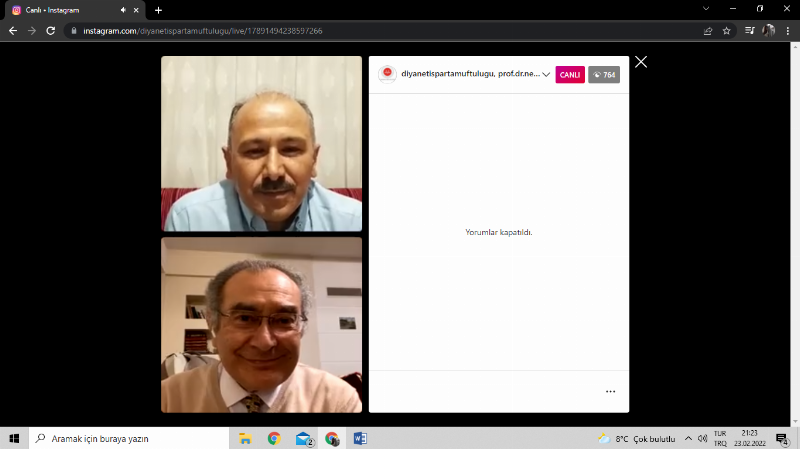
Üsküdar University Founding Rector, Psychiatrist Prof. Dr. Nevzat Tarhan was a guest at the program titled 'Violence is Incompatible with Human Dignity,' organized by the Isparta Provincial Mufti's Office. Emphasizing the issue of violence in society and family, Tarhan said; 'If there is a gas leak in a house, a spark can blow up the house. That tension exists in society; it can explode at any moment with a spark. Violence in the family happens similarly. It doesn't happen suddenly when everything is cheerful and going well.'
Content
Prof. Dr. Nevzat Tarhan Warned! "That tension exists, it can explode at any moment with a spark"
"We have a serious record concerning violence against women"
In the program, held online and moderated by Provincial Preacher Şaban Yılmaz, Prof. Dr. Nevzat Tarhan spoke about the need for a root cause analysis regarding violence against women and how our society was not like this before; "We are first in the world for violence against women. America is second. I researched and confirmed this regarding violence against women. In close friend-type relationships, thirty-eight out of one hundred women experience violence. It's around 36 in America and 35 in New Zealand. The statistics indicating that one in three women in Turkey experience violence are robust statistics. Therefore, it is a surprising figure; there was even a human rights violence symposium. The human rights institution also has these violence issues on its agenda. There, I presented, 'Why does violence exist in our society?' Why does a society that raised Mevlana, a society that raised Yunus Emre, resort to violence? We are first in the world, not just Europe. We said New Zealand is third. Then come Denmark, Spain, Norway, and the Netherlands. Among the top ten societies for violence against women, we are the only Muslim one, but in child violence, America is prominent, in terms of children arrested for violent crimes. The USA is significantly ahead. All of this shows that our society has a serious record, especially concerning violence against women. Here, we need to conduct what we call a root cause analysis on this issue. There's a psychological dimension, a cultural dimension. Society wasn't like this. We have a culture that says 'don't harm a rose.' The one who says 'don't harm a rose' also says 'don't harm your spouse.'" he stated.
"If there is a gas leak in a house, a spark can blow up the house"
Prof. Dr. Nevzat Tarhan: "Is Turkey undergoing a sociological transformation? As I research the reasons for this, there are many incidents of violence I want to focus on. In 2007, the parliament convened to discuss the issue of violence. We were invited there and spoke. In 2015, the parliament convened again, and we spoke. Last year, there was another meeting, and I participated in the commission; something interesting happened there. I was subjected to verbal violence by women. The woman who attacked me there, who sent tweets at me, was an HDP doctor and female MP with parliamentary immunity. I experienced verbal, physical, and social media violence because of her. Violence has many dimensions and underlying causes, but recently, there's a general tension in society. When there's general tension, it's like this: If there's a gas leak in a house, a spark can blow up the house, and that tension currently exists in society. Society can explode at any moment with a spark. Violence in the family happens similarly. It doesn't happen when everything is going well and cheerfully. That's why Americans call domestic violence 'domestic violence' rather than violence against women. But it's more accurate to use the term 'domestic violence.' Because there is violence against men, albeit less, and most significantly, violence against children, as much as there is violence against women. In the USA, this is very high. 80% of those who come to the emergency room are due to domestic violence. Violence is not just Turkey's problem; it's a global issue. 'Why has this violence increased? Why has bloodlust increased? Why has evil increased?' In the 2000s, the Forensic Psychiatry Unit of New York University developed a test called 'Psychiatry's Ability to Define Evil.' Its name is the 'Moral Disengagement Scale.' We tried to adapt this scale in Turkey. They said, 'You need to write your own scale; it changes in Turkey.' We are trying to do that, stating it needs to be written in a socio-cultural context. It's the same for domestic violence. We need to create a scale for identifying violence. It's necessary to identify individuals prone to violence beforehand, take precautions before violent incidents occur, and deal with risk groups." he expressed.
"The virus behind violence is the virus of selfishness"
Tarhan stated that the virus of selfishness, once it enters a person, has the characteristic of imposing one's own truths, and that individuals raised with fear cannot speak openly and transparently; "When we look at all types of violence – domestic violence, violence against children, violence against women, violence against animals – we see a serious virus behind it. The virus behind violence is the virus of selfishness. The virus of selfishness has a tremendous magnifying effect on violence. For example, a selfish person says, 'I know best,' 'what I say goes,' 'the final decision is mine,' a man raised in this patriarchal society, and now women are also asserting their rights. They don't let themselves be suppressed; even children question things. This is actually a good thing. When a woman questions, and some men say no, or don't approve, high-ego men say; 'Oh no, I'm losing control over my wife.' Control becomes high. There's news that a man went to kill his wife despite being under protection every day. We see this in crime news pages without exception. Why have we become like this? Selfishness opens the door to all evils. The moment the virus of selfishness enters, it develops the characteristic of imposing one's own truths, saying, 'what I say goes.' It becomes dominant, oppressive. If power is not in its hands, it becomes passive. It plots intrigues and tries to control the other party. This situation is more prevalent in families, women, and girls raised in a culture of fear. Because they are raised with fear, they cannot speak openly and transparently. Leaders say 'a' or 'b' and try to gain influence over the other party by plotting intrigues. In close relationships and experiences, the feeling of trust is damaged. The other party starts questioning each other, people come feeling uneasy, expecting to be questioned again. In these incidents of violence, it is the egocentric feeling of 'I must be in control.'" he said.
"Live examples lead to the spread of the greatest violence"
Tarhan emphasized that Mesopotamian culture is a culture that glorifies violence and that this culture is not part of the Islamic tradition; "When a man shouts, he feels relieved. When a woman cries, she feels good. In such situations, a reciprocal relationship emerges. Every incident needs to be analyzed, but what I observe in these incidents is that violence is more common as a problem-solving method and a method of seeking rights. In violence, we always blame the media and computer games. If a father abuses his mother at home, even if the child doesn't approve at that moment, they say, 'I'm doing the things my father gets angry about.' They model it by seeing it. Live examples lead to the spread of the greatest violence. This is not our Islamic tradition; Mesopotamian culture has always been like this. In Mesopotamian culture, there is one article in the Hammurabi laws. There was a teacher responsible for beatings. This was in the laws. They used beating as a problem-solving method. It happened in ancient times. The application of this shows us that in societies, Mesopotamian culture is a culture that glorifies violence. It decides to use violence for obedience. It is not in the Islamic tradition; it is not the prophetic way. There isn't even raising one's voice in the style of our Prophet. He was a prophet of compassion towards his wives and loved ones. His adopted son Anas is late, and he says to him; 'You got lost in play again, didn't you?' He also shows his mistake, saying it with meaning. He states that he is aware of his mistake and does not approve of it. He immediately says that he has a childlike side without breaking his spirit. If it were us, we would shout. All of these things didn't exist in that period. When did they start? All of these started with the corruption of morality." he stated.
"In male-female relationships, there is no competitive relationship, there is a complementary relationship"
Prof. Dr. Nevzat Tarhan, speaking about how male and female brains work differently; "We have a genetic predisposition to violence. Men, for example, are more prone to violence. That is, when faced with something, a man reflects his emotions through the language of anger. A woman, on the other hand, expresses her emotions by crying when she experiences stress. The female brain and the male brain work differently. When a man is angry, he is actually sad. He is shouting and yelling because he is sad, not to crush the other person. In such situations, current feminist teaching on anger says; 'If he shouts at you, you shout back at him, if he throws plates, you throw plates back at him. Don't let yourself be suppressed.' This turns male-female relationships into male-female wars. This further increases violence. However, in male-female relationships, there is no competitive relationship, there is a complementary relationship. I mean, if you're in a boat, and he rocks the boat, would you rock it too? The boat will capsize, you will be overturned. When talking to an angry person, and that angry person is usually a man. His war strategy is different. He is using his emotional brain. In that case, his war strategy is trying to draw you into his war jungle. What's in his jungle? There's 'I'll put you in your place if I hit you,' 'what I say goes,' 'shouting and dominating.' When you shout with him, you enter his jungle. So, what will you do? You will activate his thinking brain, not his emotional brain. For example, if your spouse starts shouting at you, you will say; 'Would you please speak a little slower, I want to understand you.' Usually, it's the woman who says this. Now, since it's not possible to shout slowly, when he lowers his voice, he can't shout slowly, so he immediately stops and starts listening. He leaves his emotional brain and activates his thinking brain. When he activates his thinking brain, he comes to your battlefield." he stated.
"The first harm of anger is to oneself"
Prof. Dr. Nevzat Tarhan stated that what is important is not expressing anger, but processing anger. Tarhan; "During anger, the brain secretes acidic chemicals. The greatest harm of anger is to oneself. What does a person's brain do when they are angry? We call them the five horsemen of darkness: grudge, anger, hatred, jealousy, hostility... With these emotions, the brain produces a chemical mixture. They mix with the blood, increase vascular resistance, and raise blood pressure. Intestinal spasms occur, the immune system is suppressed, and dormant cancer cells in the body become active. If this lasts for a few hours, the body quickly compensates, but if a person constantly experiences this, damage occurs in the body. Therefore, what we need to do here is the ability to manage our nervous system. In other words, the first harm of anger is to oneself. We need to know very well how to approach it in moments of anger. Anger is a human emotion; let's not be bothered by its onset. We need to convert anger into energy and process this anger. Suppressing anger doesn't solve it, and expressing anger doesn't solve it either. We had the late Professor Ayhan Songar. One day, while driving, he got terribly angry at someone in traffic. After coming home, he said; 'Someone made me very angry, and I said whatever came to my mind.' They asked, 'Didn't the man respond when he heard you?' He said, 'Of course, I said it with the window closed.' This is also a method, you see. Therefore, what's important here is processing anger, not expressing it." he said.
"Narcissistic individuals often experience a lot of anger"
Tarhan, emphasizing the need to leave private space for the other party in family relationships; "A parent has a child, but the child does not belong to them. The child is not their property. They are a separate human being. A separate individual. Especially after the age of 10, the child enters early adolescence. And friends, in such situations, start to become more important than parents. If parents have high egos, there is hidden selfishness behind violence, hidden arrogance. The virus of arrogance greatly increases violence. It calls itself a narcissistic injury. When told 'no,' they get seriously angry. Narcissistic individuals, for example, often experience a lot of anger... They don't want to say no. In the home and family, it's one thing for parents to nurture their child, but it's another to see their child as their property. The biggest characteristic of selfish people is their high sense of control. 'Power is mine, control is mine, dominance is mine, what I say goes.' I know someone with this feeling, who has even brought jealousy to that point, someone with a high sense of control, who wakes their spouse up at two-thirty in the morning. This person, a man, wakes his wife and asks her: 'Who were you seeing in your dream?' Can you imagine, he wants to control her dreams too. The other party feels like they are in prison. Eventually, it explodes somewhere, of course. That's why in family relationships, it's necessary to leave them free space, private space. In close relationships and life, trust is fundamental, suspicion is an exception. For trust to exist in a family, we used to say 'love' in families, now we say 'haven of trust.' If love increases trust, it continues. If trust doesn't increase, love goes away. Distrust is currently modernism's biggest nightmare and problem." he expressed.
"If love and trust are formed, children emulate adults"
Prof. Dr. Nevzat Tarhan, speaking about the need to establish horizontal relationships with children; "There is a need for dialogue with children, not monologue. What was in monologue? One side always tries to educate the other. In family relationships, the role of parents should not be that of a consultant. This is called 'meşveret' (consultation). There should be consultation. It's necessary to be able to talk mutually, to be interactive. Hz. Ali also had a great saying from 1400 years ago; 'Play with your children until they are 5, be their friend until they are 15, and consult with them after 15.' Being a friend until 15 is misunderstood as being a sycophant; it means being a companion. What does a companion do when going towards a goal? They share what they eat, drink, wear, their troubles, their problems. There are wonderful companions; they have memories like military service. Being a companion to a child on the path of life, that's what it is. Otherwise, if you turn every morning you see your child into a life lesson, every morning into a sermon, every breakfast into a conference, the child will block their ears. One child was taking lessons from his teacher in the garden. The child suddenly said; 'One hundred.' His father asked; 'Son, why did you say one hundred?' He said; 'Dad, the hundredth ant went into the hole.' The child wasn't listening to his father; he was counting ants. That's why if you do it by scaring them, the child won't listen. What needs to be done here is to establish a horizontal relationship with the child. We say, when establishing that relationship and even talking to the child, don't stand; speak at their eye level so that the other party feels empathy, feels self-confidence. If love and trust are formed, children emulate adults. That also happens with dialogue. Being a parent means experiencing stories with your child, writing stories. It means creating life events, experiences, writing life scenarios together. Writing these together. When the child reaches a certain age, those life scenarios will be developed and continued with new actors in the child's life. That's why let's write beautiful life stories into our child's developing brain, their mind map. And in those life stories, let the parents also be actors. Don't let others be in the child's life story; you should also be there. Do it together, there is a need for shared experiences, shared conversation. The rule of 'love, value, share.' Through this, you will create many stories together." he stated.
Share
Update Date: February 28, 2026
Creation Date: February 24, 2022
Request a Call
Other News
- The book that read today's digital threats in 2014: Being a Conscious Family
- Experts warn: 'Instead of memorizing letters, teach pencil grip, scissor use, and coloring'
- School fear and school love both start in the family!
- Family is not merely transforming, it is being battered under a serious assault
- Artificial intelligence opens the door to early diagnosis in autism!