

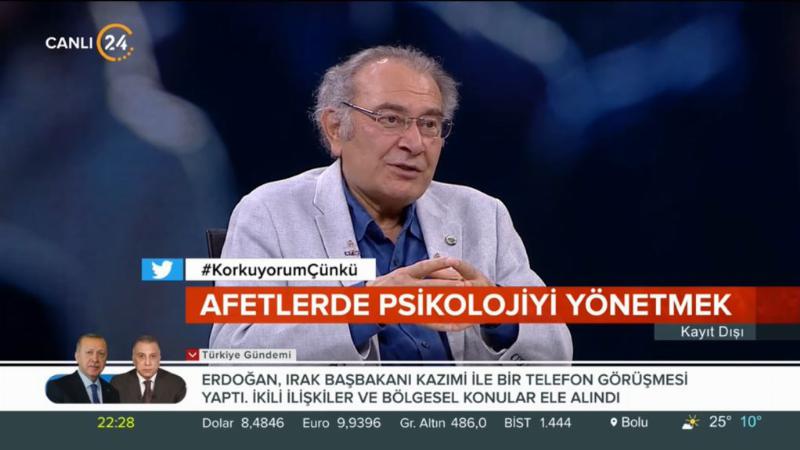
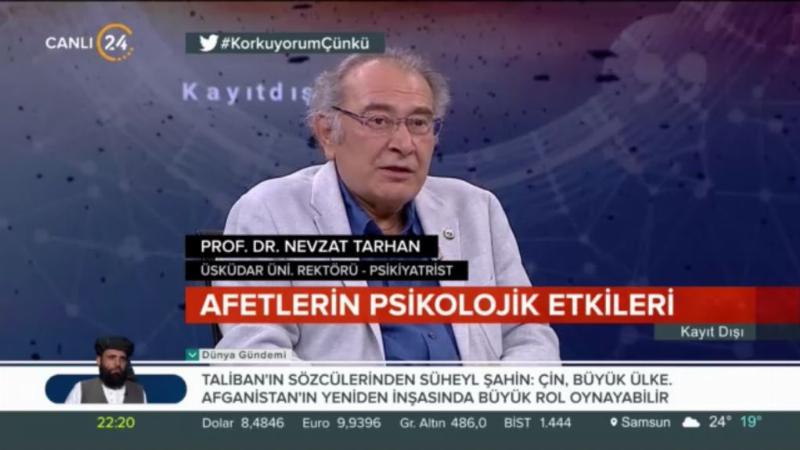
Üsküdar Üniversitesi Founding Rector, Psychiatrist Prof. Dr. Nevzat Tarhan was a guest on the ‘Kayıt Dışı’ program broadcast on 24 TV. Prof. Dr. Nevzat Tarhan, making evaluations on the topic of ‘Disaster Sociology and Psychology’, emphasized the importance of preparing before a disaster, stating; “Those who are prepared for a crisis manage the process more easily because they have mental plans related to the crisis. For example, if an individual has a plan and training on what to do in an earthquake, they know what to do better. This gives that person confidence and reduces their fears. Therefore, uncertainty is the greatest danger in disasters. In situations of uncertainty, the person doesn’t know what to do and suddenly enters into a feeling of life and death.”
Content
Prof. Dr. Nevzat Tarhan: “Uncertainty is the greatest danger in disasters”
“The comfort zone suddenly changes in a disaster, and the safe zone becomes unsafe”
Prof. Dr. Nevzat Tarhan stated that individuals prepared for disaster psychology tolerate any disaster better; “There is a good saying for disasters: ‘expect the unexpected’. If a person expects the unexpected in a disaster, that is, if they are prepared for the disaster, the disaster passes more easily. It is tolerated better psychologically. However, if they are not prepared for the unexpected and have no prior preparation for a crisis, the disaster is experienced more traumatically. A disaster means a person stepping out of their comfort zone. The comfort zone suddenly changes in a disaster, and the safe zone becomes unsafe. One becomes, so to speak, a person without a roof. When a healthy person encounters a disaster, they first experience a shock period, followed by a protest period, meaning the process continues with denial and inability to accept the disaster. Afterwards, the acceptance period begins, which should be completed within 8 weeks for a healthy person. If not completed, many diseases such as post-traumatic stress disorder emerge.”
“Uncertainty is the greatest danger in disasters”
Prof. Dr. Nevzat Tarhan stated that making plans before a disaster and receiving training in this area contributes to managing the disaster process; “The effect of trauma manifests differently in children and adults. Those who are prepared for a crisis manage the process more easily because they have mental plans related to the crisis. For example, if an individual has a plan and training on what to do in an earthquake, they know what to do better. This gives that person confidence and reduces their fears. Uncertainty is the greatest danger in disasters. In situations of uncertainty, the person doesn’t know what to do and suddenly enters into a feeling of life and death. They confront death, which they had never thought about before, and suddenly lose their loved ones. Disasters are events that break the mold in human life; people unexpectedly experience losing the order they are accustomed to.”

“Humans have two integrities: physical and psychological”
Prof. Dr. Nevzat Tarhan emphasized that instead of fearing disasters, one should prepare before them; “Managing the process in a disaster is very important. The main point here is not to fear the disaster, but to be prepared for and manage it before it happens. Turkey has accumulated considerable experience in natural disasters over the last 15 years. Very good work has been done in this area. These need to be continuously implemented and used in education. The balance of individuals exposed to a disaster is first disrupted. Humans have two integrities: physical and psychological. When our physical integrity is disrupted, it causes body pain. When our psychological integrity is disrupted, fear, a feeling of disintegration, and anxiety occur. A person’s ability to manage this anxiety and fear varies depending on their level of psychological maturity, but secondary traumas are more common in disasters. Especially in children, the feeling of losing a loved one can cause trauma. In a disaster, the human brain first secretes excessive cortisol. Cortisol blocks the brain, and the brain becomes desensitized. At that moment, the brain shuts itself off to all mental stimuli. If this does not happen, schizophrenic disintegration occurs. That is, the brain breaks down, and at that moment, the person's psychological integrity is disrupted. If a person's spiritual maturity is high and they have received training related to disasters, they can easily overcome that period and become able to cope.”
“The emergence of Covid is also a natural disaster”
Prof. Dr. Nevzat Tarhan stated that nature is taking revenge on humanity; “The natural disasters we are experiencing today; floods, fires, etc., show that nature is taking revenge on humanity. It is as if we are paying a price for all the damage we have done to nature, humanity is paying a price. The emergence of Covid is also a natural disaster. The pandemic we are experiencing is a natural disaster. We disrupted nature's natural balance, a virus from animals unusually passed to humans and became a part of our lives. Therefore, if we do not overcome this with environmental awareness in the future, we will experience more natural disasters.”
“Expecting no natural disasters is not realistic in the natural flow of life”
Prof. Dr. Nevzat Tarhan stated that disasters are events that should be naturally accepted in the flow of life; “Chaos is a part of perfection. The emergence of chaos theory shows that natural disasters are expectable. Therefore, expecting no natural disasters is not realistic in the natural flow of life. Those who provide an explanation for death do not lose their emotions in disasters. In such events, the most affected part of our mental health is the feeling of control. People feel they lose the feeling of control in disasters. In disaster situations, the area of the brain related to control is disrupted. Uncertainty arises in their lives, and they cannot see their future. It is necessary to make patients who are in shock during a disaster and cannot accept their losses feel that they are not alone and are safe.”
“Disasters trigger the crisis related to loneliness even more”
Prof. Dr. Nevzat Tarhan stated that crises cause awakening in human life; “If people attribute the right meaning to disasters, they can endure them. Here, strong belief is very important; solid foundations help a person manage the disaster. While loneliness is a major psycho-social problem of this era, disasters trigger the crisis related to loneliness even more. People began to see in this way that they cannot be happy alone, they realized each other's importance. As Üsküdar Üniversitesi, when the pandemic started, we conducted research on 6318 people under the name of perception, anxiety, fear, and psycho-social maturation related to the pandemic. There, we prepared a post-disaster psycho-social maturation and post-traumatic growth scale. We asked 6 questions from the post-traumatic growth scale, and 60 percent of the society showed post-traumatic growth by saying, ‘I started to understand the value of what I have and to value my loved ones more.’ I think traumas can have such a positive effect on society.”