

Üsküdar Üniversitesi Founder Rector, Psychiatrist Prof. Dr. Nevzat Tarhan was a guest at the ‘Online Psychology Summit’ organized by Alfa Etkinlik Organizasyon. Tarhan, making evaluations on “Leadership Psychology”, emphasized that ideal leadership in the 21st century is scientific leadership. Tarhan said; “In the digital age, scientific leadership should be dominant. But if you content yourself only with scientific leadership and do not draw from others, you cannot make quick decisions. True leadership is being able to use the three types of leadership – classical, charismatic, and scientific – appropriately.”
Content
Prof. Dr. Nevzat Tarhan: “True leadership is using all three types of leadership appropriately”

“The connection between leadership and neuroscience led to the redefinition of leadership”
Tarhan stated that with Industry 4.0, many concepts have been rewritten, and the concept of leadership has also been part of this change. Tarhan said; “With Industry 4.0, a lot of information is being rewritten. One of the transforming concepts is leadership. The psychology of leadership, the dynamics of leadership are being rewritten with this century. One of the most important factors in leadership is being able to make healthy decisions. If this is achieved, qualities such as predicting the future, mobilizing masses, and teamwork emerge. The emergence of the connection between leadership and neuroscience led to the transformation of leadership. One of the most important skills in the new definition of leadership is 21st-century skills. These skills can be listed as emotivism, connectivism, innovative personality, and objectivism. In the 21st century, emotional and social skills led to neuroscience-based learning. Now, where and how the brain works, all of these are knowable. In our age, brain functions come to the forefront with different characteristics. For example, entrepreneurship, mental flexibility, decision-making are prominent.”
“Those who can use five types of intelligence make healthy decisions”
Emphasizing five types of intelligence, Tarhan highlighted the importance of each intelligence type. Tarhan said; “There are five types of intelligence: logical intelligence, bodily intelligence, social intelligence, emotional intelligence, and conscientious intelligence. Neuroproduction intelligence is very important in leadership. Logical intelligence can be defined in a wide range as being realistic, being able to dream, generating ideas, predicting the future, believing in oneself, and trusting oneself. Those with high logical intelligence are idealism-oriented. Those with high emotional intelligence are; activists, hopeful, optimistic, strong in empathy, courageous, more fun, trusting people, seeing things positively, and possessing high self-motivation. While logical intelligence enables healthy decision-making, emotional intelligence provides the impulse to implement this decision by motivating the person. Bodily intelligence, on the other hand, ensures work discipline and controls individuals’ desires and impulses. Conscientious intelligence leads to listening to one’s inner voice, acting with a sense of accountability, and a consciousness of responsibility towards the creator. Individuals with high conscientious intelligence are ethical, wise, humble, and honest people. Another type of intelligence is social intelligence. Through social intelligence, qualities such as being open to cooperation, being trustworthy, conducting risk assessment and crisis management, and progressing actively and solution-oriented are utilized. If an individual possesses these 5 types of intelligence, that person can make healthy decisions. They manage their desires, impulses, emotions, bodies, social relationships, and conscientious intelligence in a balanced way. All these are features related to the function of the frontal lobe of our brain.”
“Without succeeding at being a good person, every success is incomplete”
Tarhan, drawing attention to trust in leadership, emphasized the importance of being a good person as a third rule, stating that being intelligent and hardworking is not enough in life. Tarhan said; “In the leadership circle, trust is at the center. After that come values, competition, and experience. Leadership that inspires trust paves a healthy path. Relationships should be transparent and open, and an environment of trust should be created. Being intelligent and hardworking, which are important characteristics in leadership, is not enough. As a third characteristic, one must be a good person. A type of leadership that uses emotional and conscientious intelligence emerges with leadership that inspires trust. Not only academic success but also life success is important. Studies presented with neuroscience show that the new leadership type is scientific leadership. In this type of leadership, especially, the most important thing is to be one's own leader. Anyone who cannot achieve this cannot be the leader of a class, family, company, society, or a state. For this reason, a person must first be their own leader, be open to criticism, and see criticism as a gift for self-development. This type of leadership is one that aligns with neuro-leadership.”
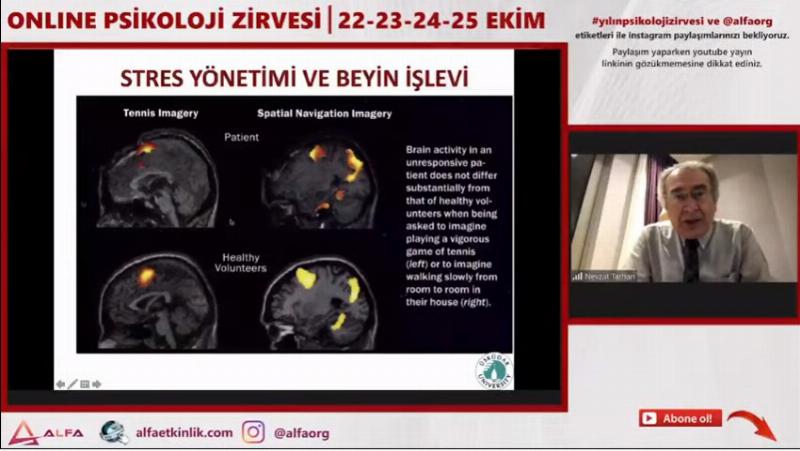
“The leadership suitable for the digital age is scientific leadership”
Tarhan, emphasizing that ideal leadership in the 21st century is scientific leadership, said; “In the digital age, scientific leadership should be dominant. But if you content yourself only with scientific leadership and do not draw from others, you cannot make quick decisions. True leadership is being able to use all three types of leadership appropriately. Leadership should be able to change according to circumstances. The type of leadership used during wartime should not be the same as after the war ends. If the leader succeeds in this, crisis management is done more healthily, and the next step is predicted more easily. Highlighting leadership types that receive applause and appreciation, which is a leadership situation driven by short-term thinking, can only save the day. For long-term goals, it is necessary to be planned. Therefore, scientific leadership is the leadership approach of this era.”
“Leaders are made, not born”
Tarhan, stating that leadership is a learned trait, emphasized that one who cannot be their own leader cannot be the leader of others. Tarhan said; “Leadership is something learned, not genetic. There is no great difference between being one's own leader and being the leader of a company. In such situations, if a person has set a goal, and has a mission, vision, and quality values, they can confidently walk on the path of leadership. Of course, how intelligence is used is an important factor in leadership. People who know their own limits can be true leaders. Everyone is born with the potential for leadership, but some develop these, while others prefer to follow. The important thing is to understand that being a leader is not about dominating. True leadership is striving for team success.”
“Narcissism is a leadership illness”
Tarhan stated that narcissism is a leadership illness, explaining that a narcissistic leader, by gradually bringing themselves to the forefront, falls victim to narcissistic blindness over time, and leadership ceases to exist. Tarhan said; “Narcissism is a leadership illness. As narcissistic leaders achieve success, narcissistic gratification emerges. They begin to see themselves as special, important, and superior, and over time, narcissistic blindness appears. In such a situation, leadership begins to collapse. Narcissistic leaders see themselves as the center of the world, cannot be humble, and feed on praise. When they do not receive praise, they feel very bad. There is a dormant narcissism, a narcissistic potential, within all people. When conditions are met, humanity tends towards narcissism. Leadership is a factor that can change a person's personality. A person who becomes a leader enters a serious test from that moment on.”
“This era is not the time to preach the truth, but to represent the truth”
Tarhan, stating that scientific leadership has gained importance today, said; “Being open to criticism is very important in scientific leadership. Because we realized this, we developed four mottos for democratic functioning when establishing Üsküdar Üniversitesi. The most important of these were the decisions to be open to criticism and liberal. In a liberal perspective, there is no understanding of forcefully imposing one's ideas. When communicating with people, instead of giving orders, one should offer options; instead of giving advice, one should set an example. This era is not the time to preach the truth, but to represent, or live, the truth. Two things are very important in leadership: a person must ensure consistency between their words and their essence. A leader who does this inspires trust. The most valuable capital and currency in leadership is trust. When a person cannot be their own leader, they cannot be the leader of their home as a parent or spouse. Leadership is a learned process, not genetic; anyone who strives in this regard can become a leader.”
Share
Update Date: February 28, 2026
Creation Date: October 25, 2021