

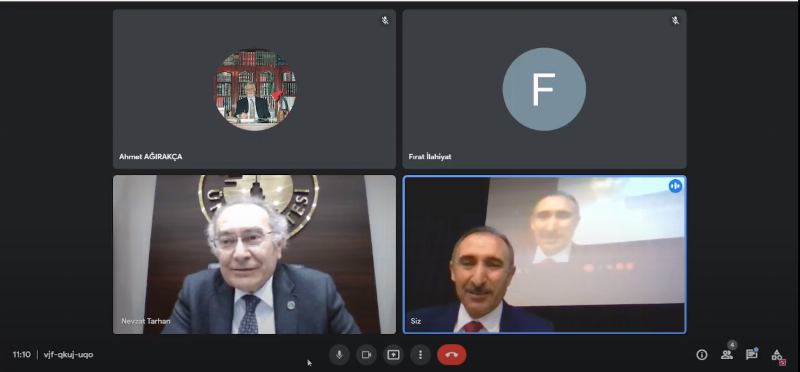
Üsküdar Üniversitesi Founding Rector, Psychiatrist Prof. Dr. Nevzat Tarhan, was the online guest of the International Religion and Civilization-I Symposium, themed 'Religion and Health', organized by the Faculty of Theology of Fırat University. Making evaluations on the topic “Disease Medicine, Health Medicine and Islam”, Tarhan said: “There has never been a period in human history where harmony was so forgotten, where people lived as if death and the afterlife did not exist, and adopted this as a general culture. Therefore, the most important diseases of this age are worldliness and egocentrism.”
Content
Prof. Dr. Nevzat Tarhan: “The most important diseases of the age are worldliness and egocentrism”
“Protection and prevention are much more important and prioritized than diagnosis and treatment”
Speaking at the panel titled “Islam and Health”, moderated by Fırat University Rector Prof. Dr. Fahrettin Göktaş, held at Fırat University Atatürk Cultural Center, Prof. Dr. Nevzat Tarhan drew attention to the importance of early diagnosis and awareness in illness. Tarhan said: “First of all, I want to make a distinction between disease medicine and health medicine. Diagnosis of diseases is important here. Because illness is understood in relation to the diagnosis and treatment of diseases. Currently, when we say medicine, this is always what is understood. However, when we say medicine, there is also health medicine. Here, efforts are made to protect against diseases and prevent them. Protection and prevention are much more important and prioritized than diagnosis and treatment. Because treatment is generally high-cost and more laborious. Diagnosis is the same, treatment is the same. There are certainly things to be done after diagnosis and treatment, but they are more limited. The main thing to do is to provide early diagnosis in this regard. In fact, there is a famous heart surgeon related to this, Michael DeBakey, in Houston, America. Michael DeBakey. He published a book titled 'How to Prevent Heart Disease and How Not to Get It?', which sold one and a half million copies at that time. When he was around 90 years old, he gave an interview. A question was posed there: 'Is there anything you wish you had done differently, or any regrets?' Michael DeBakey answered this question by saying, 'I have performed heart surgery on one thousand five hundred people so far, and I have helped them recover. But if I had the knowledge I have now, I would have wanted to write this book in my 30s. Because if I had written it, I would have contributed to one and a half million people who read this book not becoming heart patients. This was more important. This is what I currently regret.' Taking inspiration from this, as a university, in our faculties of medicine and dentistry, we aimed to focus much more on preventive medicine as a strategy to avoid such regrets in medicine. Because protection and prevention mean identifying risk groups and ensuring they do not get sick. Early diagnosis plays a much more important role in this regard.”
“If a person lives correctly, human life can extend up to 120 years”
Prof. Dr. Nevzat Tarhan, mentioning that human life can be extended or shortened according to one's lifestyle, said: “How can a healthy society live without getting sick? I want to address this question. Research shows that 60-70% of diseases are related to lifestyle errors, such as diet and sleep hygiene mistakes, and many factors related to mental health, like a person's inability to manage stress. Our lifespan is genetically coded, but if a person lives correctly, human life can extend up to 120 years. For example, there are Type A individuals. We refer to them as people who live incorrectly, under high stress, who are impatient and hasty. There is a metal tip at the end of a shoelace to prevent it from fraying. These individuals have such a telomere in their DNA structure. This telomere determines the lifespan of DNA. In stressed individuals, it divides and shortens quickly. The opposite is true for calm, composed individuals. For instance, consider cold-blooded plants and animals, like elephants and tortoises. They generally live for 200-300 years. But when we consider warm-blooded animals like cats, dogs, and lions, their lifespans do not exceed 10-15 years. This is closely related to the issue we are discussing. In other words, this situation is entirely influenced by lifestyle.”
“The most important diseases of this age are worldliness and egocentrism”
Prof. Dr. Nevzat Tarhan, speaking about the impact of the brain's frontal region on civilization, said: “So, why have disease medicine, health medicine, and preventive measures in mental health and general treatment become so important? Because if there were no frontal lobe, there would be no civilization. The frontal lobe is the front region of the brain. And there is also the back region of the brain. A schizophrenic brain does not use the frontal region of the brain at all. It dreams in the back region of the brain. It lives a encapsulated life within those dreams. In schizophrenia, the frontal region of the brain is completely deactivated. The frontal region of the brain is actually the area that codes us to create civilization, and in this way, 3 critical variables have emerged in our age. The first variable is secularism, meaning a person becoming dominated by high emotions. The second is narcissism. That is, egocentrism becoming a personality trait. Success, civil comfort, arrogance, and the disease of grandiosity bring about narcissism in this way. I am saying these in a philosophical sense, please do not interpret them politically. For secularism, the dictionary of the Turkish Language Association writes 'dünyacılık' (worldliness). That is, there has never been a period in human history where harmony was so forgotten, where people lived as if death and the afterlife did not exist, and adopted this as a general culture. Therefore, the most important diseases of this age are worldliness and egocentrism.”
“We need to teach people moral values”
Prof. Dr. Nevzat Tarhan, speaking about thought patterns according to moral values, said: “The development of moral reasoning and the teaching of moral reason according to concrete values exist in children. They say what they see is right, and what they don't see is wrong. Generally, they think according to outcomes and imitate what is visible. The thought pattern that says 'I don't believe in something I haven't seen' is called thinking according to concrete values. Thinking according to abstract values, on the other hand, means considering intention and putting oneself in someone else's shoes. A sense of responsibility develops the concept of enduring hardship for the future of social order. After the age of 7, these children develop the concepts of considering intention, putting oneself in someone else's shoes, a sense of responsibility, social security, and enduring hardship for the future. Thinking according to high values, here, means considering fairness. When it comes to values like compassion and respect, instincts show resistance, alleviate suffering, nourish goodness, and strive not to corrupt goodness. In this way, it prevents evil. Therefore, we need to teach people moral values.”
Share
Update Date: February 28, 2026
Creation Date: October 08, 2021
Request a Call
Other News
- The book that read today's digital threats in 2014: Being a Conscious Family
- Experts warn: 'Instead of memorizing letters, teach pencil grip, scissor use, and coloring'
- School fear and school love both start in the family!
- Family is not merely transforming, it is being battered under a serious assault
- Artificial intelligence opens the door to early diagnosis in autism!