

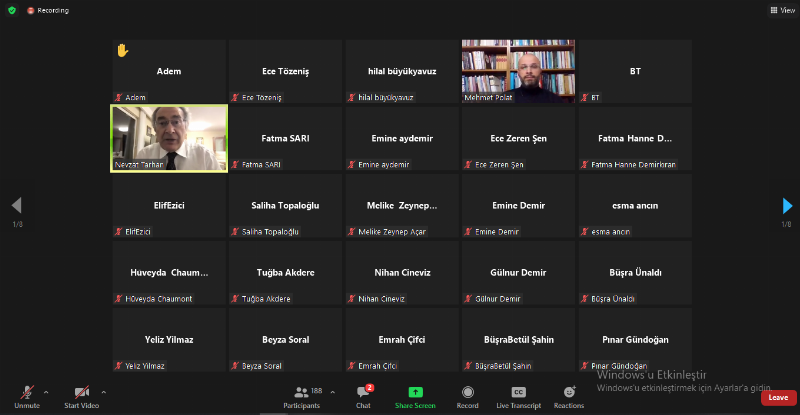
Üsküdar University Founding Rector, Psychiatrist Prof. Dr. Nevzat Tarhan was the live broadcast guest of Tenzile Erdoğan Girls' Anatolian Imam Hatip High School. Making evaluations under the title “Being a Conscious Young Person,” Tarhan offered advice to Generation Z and parents. Emphasizing the importance of allowing young people to make mistakes during adolescence, Tarhan stated, “Parents should not panic when children make mistakes. If a child has grown up in a good family environment and loves their home, even if they use drugs, they will find the right path after a while. In such situations, parents should not burn bridges. In psychology, adolescence is defined as a 'normal schizophrenia period.' During adolescence, 'craziness' is normal; we will grant young people the right to make mistakes. The biggest mistake is lying; it is the mother of all evils. We need to teach children this.”
Content
Prof. Dr. Nevzat Tarhan: “Adolescents Should Be Allowed to Make Mistakes During Adolescence”
“In an era where cultures are disappearing, we must teach young people decision-making skills”
Tarhan stated that many cultures in the world will soon disappear due to the culture industry, emphasizing the importance of making correct decisions in such a period; “Decision-making mechanisms should be taught to young people at an early age, enabling them to make their own decisions after adolescence.” Tarhan added; “Currently, not only in Turkey but all over the world, many cultures will disappear within 50 years. The entertainment culture and industry, especially by influencing the young generation, has created its own culture. Although we focus on the negative aspects of popular culture, it also has some positive features. For example, we can access information that we would obtain by scanning hundreds of libraries and archives with a single click. In this age of high freedom and information mobility, we must correctly use the decision-making, filtering, and sifting mechanisms in the human mind. In the past, children could learn this naturally within the family, at school, and in society. Now, we need to transmit our values to these children, who are the offspring of social media. Adolescence, a period where emotions are more prominent than reason, is a time when actions are driven by feelings and desires. At the end of this period, using the 'Socrates' Filter' method developed by Socrates, young people should have the will to adopt and use information if it is real, true, and beneficial. Young people, by the end of adolescence, must gain a mental jury to make correct decisions.”
“The education system is training soldiers for the capitalist system”
Tarhan stated that the education system raises people in line with capitalist ethics, emphasizing that the meaning of life is not taught in schools. Tarhan said; “The current education system is a system that raises citizens for capitalist ethics. The meaning of life is not taught in schools; instead, soldiers are trained for a popular culture that accepts without questioning. Answers to 'why' and 'what for' questions, which seek answers to our reason for existence, are not given. Even at middle school level, existential questions are asked, similar to how Prophet Abraham questioned the existence of God and ultimately reached Monotheism. We need to teach this generation our own values, our own culture. Therefore, we will not be afraid to put faith into the laboratory. There is an in-silico laboratory where thought experiments are conducted. Software and mathematical modeling are done in a computer environment. As a result of these experiments, mathematics tells us that there must be an external creator.”
“Visionary young people are raised in Imam Hatip Schools, which provide a synthesis of reason and religion”
Tarhan stated that the synthesis of reason and religion has been achieved in Imam Hatip High Schools, and that this two-winged education raises a visionary generation. Tarhan said; “For the first time since the Ottoman Empire, the synthesis of reason and religion, meaning two-winged education, was achieved in Imam Hatip high schools. They combined reason and heart, that is, science and religious sciences, and thus young people with broad visions began to emerge. These young people are both keeping up with the times and developing through questioning. One of the biggest reasons why radical religious movements could not take root in Turkey is these high schools. These Imam Hatip-style approaches, where religious sciences and natural sciences are taught together, and the proud stance of religious opinion leaders in Turkey on this matter, did not give way to radicalism. Therefore, to protect young people from popular culture and its dangers, we need to provide them with a two-winged perspective.”
“We need to present our traditions to Generation Z with a new perspective”
Emphasizing the need to focus on the positive rather than negative aspects of Generation Z and to develop them, Tarhan stressed that old traditions should be presented to the new generation in today's context. Tarhan said; “Generation Z is a generation with highly egocentric and conformist characteristics. Actually, youth has always been like this. Another characteristic is that while past generations encountered evil early on, this generation dislikes evil, deceit, and intrigue. This generation loves innocence. Therefore, they are egocentric, conformist, but very lovable. If that's the case, and they are a generation that expects innocence, then let's teach them these aspects of the truths we possess. For example, nature and greenery are very important to them. If we look at them traditionally, we cannot understand them. We must present our old values to them by dressing them in today's clothes. If we bring old values with old-time clothes to today, they will not adapt. Just as we don't wear clothes from 100 years ago, there's no point in making young people wear those clothes now.”
“Adolescents should be given room to make mistakes during adolescence”
Emphasizing the importance of allowing young people to make mistakes during adolescence, Tarhan stated that a child raised in a good family, even if they go astray, will find the right path. Tarhan said; “Parents should not panic when children make mistakes. If a child has grown up in a good family environment and loves their home, even if they use drugs, they will find the right path after a while, realizing they have wronged their family. In such situations, parents should not burn bridges. The scientific counterpart of 'understanding one's situation' is 'empathy'. In psychology, adolescence is defined as a 'normal schizophrenia period'. That is, acting like a schizophrenic is considered normal. In this regard, I was very surprised when I heard the Hadith: 'Adolescence is a branch of madness.' During adolescence, 'madness' is normal; we will grant young people the right to make mistakes. The biggest mistake is lying; it is the mother of all evils. We need to teach children this. Families need to give as much importance to lying as they do to prayer.”
“Technology: The open door of the family”
Tarhan stated that technology and social media interfere with the family environment from the outside in our age, emphasizing the importance of the bond between child and parents continuing unbroken. Tarhan said; “Technology and social media are the open door of the home; children access age-inappropriate content from smartphones. Turning off or blocking the internet is not a solution. This way, the problem is not solved; instead, anger towards parents develops. With blocking, the child will do what they set their mind to anyway. This education is a long-term task. The child must first love their home. Families should think about how they can make young people love the morality of the Prophet and the morality of the Quran. When one loves, hearts are under the command of Allah. Let's teach the child what is good and beautiful. Let feelings of respect and love awaken in the child. When it's fear-focused, it pushes the child away; let's be compassion-focused. There is no greater benefit than love because it is in compassion. The method of this era is compassion. Parents should not withhold compassion from their child. The child should say, “My mother and father will not cast me aside.” The emotional bond between the child and the family should not be broken. The young person needs to bond with their parents; otherwise, they will bond with other things. If we show respect for the child's rights with love and compassion, that child will not become a child of wrongs.”
Share
Request a Call
Other News
- Prof. Nevzat Tarhan: “Every segment of society should be able to say, ‘This constitution is my constitution!’”
- OHS Releases Guide for Safe Operation of Industrial Robots
- Prof. Nevzat Tarhan: “Social media is digital fast food”
- 2026-2027 Academic Year orientations completed
- Asst. Prof. İdil Arasan Doğan explained the importance of early intervention in living with dementia