

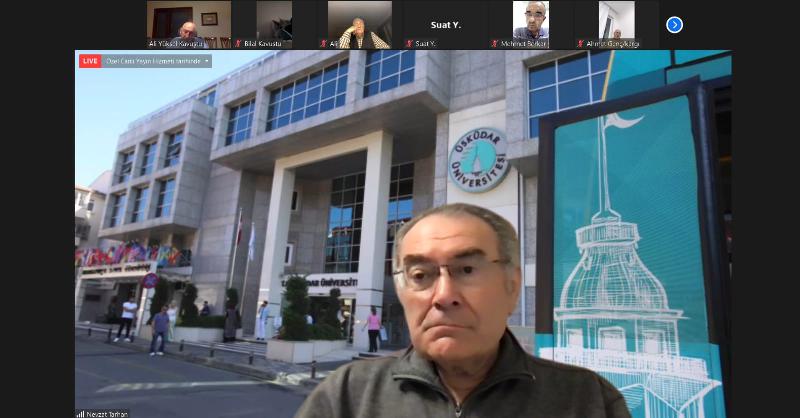
Psychiatrist Prof. Dr. Nevzat Tarhan, Founding Rector of Üsküdar Üniversitesi, was the guest of the monthly meetings organized by the Ankara Culture and Education Foundation. Making evaluations in the context of “The Illness of Suspicion,” Tarhan stated that suspicion harms human relationships. Tarhan emphasized that individuals who approach with suspicion can end up alone, adding that suspicion causes people to make mistakes and give responses they will regret.
Content
Prof. Dr. Nevzat Tarhan: “Suspicion Harms Human Relationships”

“We Cannot Represent Islam Well”
Tarhan stated that although our name is Muslim, Islam is not present in our way of life, and spoke about the necessity of self-criticism. Tarhan said; “Currently, we wear masks in the hospital, but outside of that, we are comfortable. There was a department in the hospital; now we have taken normal patients into that department. It's not present in intensive care anymore either. It's not one hundred percent, but we have returned to ninety percent normal. I estimate that in the West, especially among what thinkers call 'fields of intelligence,' these individuals, influenced by the pandemic, have begun asking questions like, ‘We are not masters of nature; this life has meaning.’ And I predict they will find Tawhid (Oneness of God). They will find Tawhid, they will find the last prophet, but whether they will become Muslim is doubtful. Because we cannot represent Islam well. Currently, there is a serious issue; political Islam has increased people's fear worldwide. Islamophobia, on the other hand, is most prevalent in Turkey right now. For this reason, many religious people are currently hiding their religiosity. Let them look to Islam, to the Quran, instead of Muslims; hopefully, they will find it there. Mehmet Akif said; ‘I went to the West, there is Islam but no Muslims; I came here, there are Muslims but no Islam.’ Currently, our name is Muslim, but it is not in our way of life. It is not even present in people who claim to be religious. We need to self-critique. Are we representing it well? This is not a time for proselytizing, but a time for representation. I read a Hadith (saying of the Prophet); it says, ‘If you want your children to obey you, treat them justly.’ Justice should flow like a torrent where Muslims are present. If it doesn't, if it's not in the family, the child does not obey.” he stated.
“If There Is No Justice, There Is No Obedience and Peace”
Tarhan, emphasizing the great importance of being just, underlined that what is right must be done. Tarhan said; “If we are not just at home, if we are not just at work, if those in power are not just, there will be no obedience and peace. There is a good saying; ‘He who holds power, if not just, is a tyrant.’ Holding power is his responsibility; when he fails to do so, he becomes a tyrant. Because you have power, property, wealth, money. When you are not just, it is enough as a sin for you. That is why true religious people have avoided leadership and the rights of others. In such a situation, Allah does not help the unjust. Disbelief continues, but oppression does not continue; it does not carry over to the next world. Hz. Osman was a great companion, one of the Ten Promised Paradise. However, in his later years, he distributed war spoils only to his relatives. The people were angered, saying there was tremendous injustice. Hz. Ali warned him; ‘Why are you doing this?’ he asked. They said; ‘You should be just, shouldn't you?’ ‘Am I not the Caliph, I want it this way,’ he said. He becomes a martyr, but the greatest discord in Islamic history begins. If a person without an Islamic identity commits injustice against someone who says ‘I am a believer,’ it doesn't sting as much, but if a person who claims to be religious commits injustice, it stands out greatly. Therefore, destiny does not help. Justice should not be thought of merely as a PR tool. As a result, divine help (of destiny) is withdrawn. For divine help to come, we must behave in such a way towards society that a sense of obedience, love, and affection arises in the community. Destiny has a plan; we do not know it. We will do what is right and wait. In such a situation, many things are discussed within the privacy of the family so that discord does not arise,' he used the expressions.
“Suspicion Harms Material and Spiritual Sociability”
Prof. Dr. Nevzat Tarhan, drawing attention to important illnesses related to human servitude (duty to God); “Today's topic is, in a way, related to the illness of suspicion in humans. It is mentioned as the fourth illness in Mesnevi-i Nuriye. The first is despair, the second is self-admiration (vanity), the third is pride, and the fourth is suspicion. So, what are these illnesses illnesses of? One who cannot succeed in good deeds and obedience fears punishment. He falls into despair. It (the text) declares four types of illnesses and shows the state and remedy of treatment. These are indeed among the important illnesses related to one's duty of servitude. He has agreed upon it as a type of illness related to human relations and the duty of servitude. If suspicion, yes, man is obliged to have good thoughts (about others). Man should consider everyone superior to himself. He should not extend the ill-manners, bad character, and ill-will within himself to others by means of suspicion, should not include others in it, should not project it onto others, and should not condemn, find fault with, or blame others for some of their actions whose wisdom he does not know. Therefore, disliking some states of the great predecessors whose wisdom we do not know is suspicion. Suspicion, on the other hand, harms material and spiritual sociability, it harms social life. In other words, he sees suspicion as a social illness. It represents both material and spiritual aspects,' he said.
“There Is a Sleeping Pharaoh Within Each of Us”
Tarhan, speaking about how a person lives in constant fear when they cannot feel the sense of accountability; “Someone with a God complex thinks they possess true power. They believe they have control, they believe they dominate everything. I even remember a businessman saying; ‘I manage a one-billion-dollar budget, but I cannot manage my blood pressure.’ He wants to control everything so much that he says; ‘What I cannot control means it is not mine.’ This is, in a way, God forbid, stealing a role from Allah. He steals a role, develops a God Complex. He enters into that complex. This time, there are things a person can and cannot control. There are things within his power, and things beyond his power. To know its limits, there is reason and judgment. When he does this, he knows his limits. He knows this by the rule ‘He who knows his limits, knows his Lord.’ Here, because he sees himself as much more powerful, he sees himself as a god on Earth. When this happens, he feels no sense of accountability to anyone. When he doesn't feel a sense of accountability, he then lives in constant fear. For example, even when setting off to go for surgery, he has to consider every possibility. Thinking of every possibility – ‘Will the doctor make a mistake here, will the wrong medicine be given, will something happen during anesthesia?’ – he becomes uneasy thinking about everything. A thinking person, someone who wants to control everything, who has a God complex, cannot trust, thinking ‘I know everything, people make mistakes.’ Because they cannot trust, they become uneasy. They told Hz. Mevlana (Rumi). Someone was condemning Pharaoh, saying he was so cruel, so tyrannical, cutting the tongues of people, of working laborers, doing this and that, inflicting such tortures. Hz. Mevlana then said to him; ‘If you were given the same opportunities he was given, would you not also become a Pharaoh?’ There is a sleeping Pharaoh within each of us; as soon as it finds an opportunity, it immediately shows its nose; this needs to be known,” he stated.
“They See What They Haven't Seen Through Analogy and Representation”
Tarhan, making evaluations on how the self (ego) does not own itself, nor does it own its body; “He steals a role from Allah, says ‘I know, I will do it,’ and begins to see himself as a god on Earth. This is the first truth in the illness of suspicion. This subtle truth continues, and with its full clarity and manifestation, it appeared to me that: The ego, which springs forth from the water of heedlessness, is a unit of comparison to understand the attributes of the Creator. Because people know things they haven't seen through analogy and representation. This is seeing what one has not seen with the eye of reason. Analogy and representation mean solving through analogy in psychology. To persuade someone, you create a metaphor, a figurative analogy; you take something figurative there, and by making an analogy, you see the truth, like this. In this manner, they see what they haven't seen through analogy and representation. For example, a man makes a division to understand the power of Almighty God. He understands the matter by drawing an imaginary line, saying ‘from here to here is within my power, beyond that is within His power.’ Then he breaks down the imaginary line and surrenders everything to Him. Because the self (ego) does not own itself, nor does it own its body. Necip Fazıl has a beautiful saying; ‘We cannot even hold the breath we take in, so how can we hold onto this life of ours?’ Think about it, we feel compelled to exhale even the breath we take in; we don't even own that. Thus, a person who knows their limits surrenders to Him. Because the self (ego) does not own itself, nor does it own its body. The body is merely a marvelous divine machine,' he used the expressions.
“There Is Currently a Suicide Epidemic”
Prof. Dr. Nevzat Tarhan stated that the reason for the suicide epidemic is people's inability to find meaning in suffering and getting tired in this life. Tarhan said; “Human dreams are limitless; there is a very vast world. This world is built upon four pillars: acts of conduct, feelings of hope, relationships, and connections; its needs operate upon these, but while doing these, you also have a body. Your body does not control you; your body is not sufficient because it decays, it fades away. You are serving a body that will fade away like this. There's a famous person named Alain Delon. I read a statement by that eighty-something-year-old actor. ‘This old age is a terrible thing; I want euthanasia,’ he said. Euthanasia, meaning going to the doctor and saying; ‘Give me medicine and kill me. I can't stand the diseases of old age,’ because he always wants a strong body. He wants no illness, he wants to live as he pleases. Life has lost its meaning, so his life has lost hope like this; connections are useless, he can't meet his needs, he can't walk. ‘I can't carry on anymore. Let me die and be free,’ he says. Since he cannot think beyond death, for him, it ends when he dies. At least he is deceiving himself that way right now. Therefore, life has no meaning… For example, the biggest reason for suicide epidemics in the West, especially among young people, is: ‘I have experienced everything, tasted everything, I own everything. I don't get any joy from life. If I live ten, twenty more years, I will die and cease to exist. So, what's the point of disappearing now?’ he says, and commits suicide. In Belgium and the Netherlands, trains reportedly stop every hour because someone commits suicide. The reason is that they cannot feel meaning in suffering and getting tired in this life. There is a suicide epidemic,” he said.
“Whatever Is Discussed Most at Home Is the Sacred of That Home”
Tarhan, speaking about how whatever is discussed most in a home becomes the sacred of that home; “You look at people in the world, what is their most sacred value? What topic is most discussed in a home? Is it possessions, property, money, fame, or success? Whatever is discussed at home, that is the sacred of that home. I won't forget a mother who raised her only child without a father. The child loses his father at 3-4 years old. The child makes a marriage that neither of them wanted. And it was a religious family, they had actually raised their children well, but the two eldest made marriages that neither of them wanted. Upon this, the poor woman was seriously depressed. She came to therapy asking why this happened. I met the children too and saw she had raised good children, but she loved her children so much that out of love, she tried to control everything about them. What they ate, what they drank, what they wore, whom they would marry, what they would do; the children, in response, told their mother ‘It's my life, I want to decide,’ and got married as they wished. The marriages were not very bad marriages, but they were not as the mother wished. Upon this, the mother came saying; ‘Why did this happen? I didn't feed them anything unlawful, why did this happen to these children?’ The mother finally said this, she found the solution herself. She said; ‘I actually found the reason, I loved my children more than Allah.’ When she said that, because she was well-intentioned, Allah put that thought into her heart. When the truth was like that, she said; ‘It's their life; I did my duty, I should not overstep my bounds.’ That is, in a way, controlling everything, even of her children, is like a God complex. When you act as if stealing a role from Allah, you suffer in this world too,” he said.
“The Reason for the Deterioration of Human Relationships Is the Illness of Suspicion”
Tarhan, addressing the point that one should not believe something heard directly without researching it; “Some people, paranoid individuals in war, always categorize people as friends and enemies. When this comes up, they evaluate whether it is a friend or an enemy. They divide and categorize people into those who are friends to me and those who are enemies to me. Such a person very easily succumbs to suspicion. They do every action with suspicion, which is why there is a saying in Anatolia; ‘Don't believe what you hear, and believe half of what you see.’ It is a saying that has become a tradition in Anatolia. You will not believe without researching or advising. When someone brings a rumor, when you hear something from someone, you will not believe it immediately. For example, a developed person, when hearing something, thinks about what was said. But an undeveloped person thinks about who said it. When one thinks ‘who said it,’ they are prone to suspicion. This situation is more common in Eastern societies. He has rented out his mind, his leader. When he hears something, he thinks ‘what does the leader say?’ However, in developed societies, what the leader says (in terms of content) is important. Therefore, it is necessary to approach spoken words with a question mark before following them. Otherwise, we cannot escape suspicion. When that happens, we end up alone. The reason for the deterioration of human relationships is this illness of suspicion. It leads to mind-reading because its subject brings about intention-reading. Believing ‘this person said this about me’ means believing assumptions. It means believing without verification. It causes mistakes, makes people give reactions they will regret,” he stated.
“The Illness of Suspicion Causes People to Make Mistakes”
Prof. Dr. Nevzat Tarhan underlined that our responsibility is not for the other party to behave well, but for us to behave well. Tarhan said; “You need to self-critique. If you focus on ‘they are making these mistakes to me,’ you cannot reach your goal. Ask yourself if you are causing what you complain about. Perhaps you are instigating or triggering the very thing you complain about. Some mistakes are made unknowingly, with good intentions. In this case, if the other party's temperament is truly bad, you should not be the one provoking or triggering it. You will do what is right and wait. Your responsibility is not for them to behave correctly; your responsibility is for you to behave correctly. If you think focusing on their behavior, you will continue to make mistakes. Instead, think about what I need to do. If they speak well, good; if they speak ill, that's their problem. Let me be honest, let me be open and say it. In close relationships, you will neither suppress yourself nor allow yourself to be suppressed. In such situations, your spouse gets caught in the middle, children get caught in the middle. Therefore, if you spend 50 out of 60 minutes dwelling on their faults in your mind, then you are unknowingly ruining this relationship. So, first, self-critique and continue to behave correctly. The method you have used so far has not worked; you need to develop another method. While you have found an opportunity to do good, do good. Let them be ashamed. If not, let them realize it. That is, it is necessary to respond to good with good, and also not to commit injustice. Of course, these are easy to say, but if you act with your emotions, you cannot do it; however, here, for the sake of the family, for the sake of the children, one needs to ask the question: what needs to be done? The illness of suspicion causes people to make mistakes,” he used the expressions.
Share
Update Date: February 28, 2026
Creation Date: May 20, 2022
Request a Call
Other News
- The book that read today's digital threats in 2014: Being a Conscious Family
- Experts warn: 'Instead of memorizing letters, teach pencil grip, scissor use, and coloring'
- School fear and school love both start in the family!
- Family is not merely transforming, it is being battered under a serious assault
- Artificial intelligence opens the door to early diagnosis in autism!