

Founder Rector of Üsküdar Üniversitesi, Psychiatrist Prof. Dr. Nevzat Tarhan, was a guest of the Young Vision program organized by the Youth Saadet Istanbul Women's Branch. Making important evaluations under the title “From Conscious Youth to a Conscious Society,” Tarhan underlined that change begins with the individual. Tarhan said; “As Tolstoy said, ‘Start changing the world by starting with yourself.’ If we want to change the world, we must first be our own leaders. One who cannot govern oneself cannot govern others. By managing our impulses, we will first be free from our own desires. This is true freedom. Freedom is not the notion of 'tear down walls, break chains, live as you please' as advocated by modernism.”
Content
Prof. Dr. Nevzat Tarhan: “Start Changing the World by Starting with Yourself”
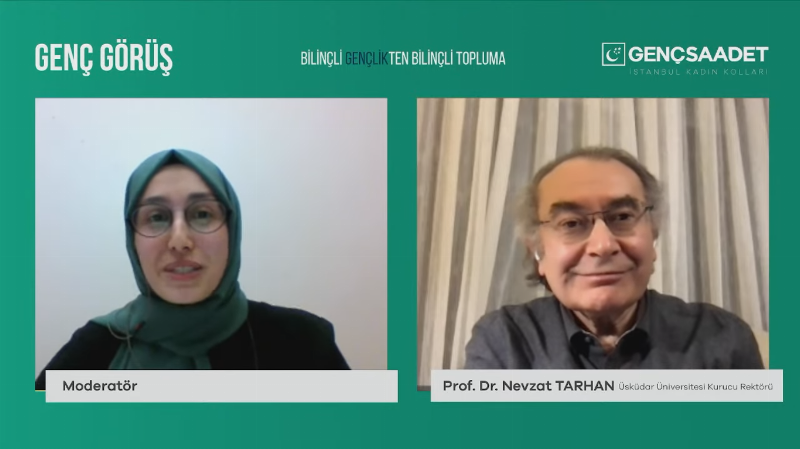
“Modernism Played an Obstructive Role in Young People's Journey of Self-Discovery”
Starting his speech by drawing conclusions from young individuals' journey of self-discovery, Tarhan made striking statements about modernism's perspective of sanctifying the individual. Tarhan stated that the global system, due to its viewpoint that sees the individual as sacred and society as problematic, advocated starting to change the world from society, thus condemning the individual to selfishness and egoism. Tarhan continued his speech with these words; “Modernism had been an obstructive force regarding young people's self-discovery until recently. Modernism urged young people to first change the world and others. According to this understanding, the idea that 'the family is not sacred, you are sacred' was taught to the individual. There was a modernism that turned individualism into selfishness. To the question 'What makes a person happy?', it would say 'Material things make a person happy.' This began to change significantly in the last 15 years with the accumulation of scientific knowledge. Areas of the human brain that process emotions were identified. It was seen that regulating emotions is actually a brain function. Later, the science of well-being, under the name of positive psychology, emerged as a scientific discipline.”
“Those who display themselves more than three times a day are diagnosed as narcissists”
Referring to the importance of living with conscious awareness on life's journey, Tarhan said; “At the top of the goal pyramid will be concrete goals; you must answer the question, ‘What kind of person do I want to be?’ After that, desires like 'I want to have a house, a car, be wealthy, earn a doctorate' are intermediate goals. For example, when you embark on a journey, you first plan where you will go in your mind. The same applies when you embark on life's journey. One needs to know where they are, that is, conscious awareness. In old terminology, it means being conscious, not oblivious, being aware. You live with the illusion that everything will go well in life. However, as a life philosophy, one should be prepared for the worst but expect the best. Modernism and Western civilization suggest living by ignoring the worst, the negative. With such an approach, people become selfish and conflict with their families and social circles. Ultimately, they become lonely. The biggest psycho-social problem in the West is loneliness. The reason for this is egocentrism. Currently, social media platforms are most affecting this situation. In fact, I even find the term 'social media' incorrect. It's not a social platform, but a virtual platform because there's a fake sociality. The platform doesn't activate all areas of emotional and social skills in the brain. It only activates what is suggested. If you are the object, not the subject, of social media, you are being used. But if you are the subject, if you have a goal, an ego ideal, you serve towards that goal. For example, the American Psychological Association states that a person who displays themselves more than 3 times a day is a narcissist.”
“It Must Be Accepted That This Generation Is a Digital Generation”
Emphasizing the differences of the new generation, Tarhan stated that this should not be forgotten when communicating with young people. Tarhan said; “Young people have vulnerable points. One is the expectation of justice. This generation hates authoritarian behavior. In the past, due to the culture of obedience, a passive, insecure 'stop, think, obey' type of youth was raised. But today's youth is not like that. This youth has an expectation of freedom. In our era, the winds of globalization are blowing. Generations X, Y, Z are a reality. There's no point in opposing this. One is the radio generation, the other is the television generation, the latest generation is the social media generation. Now the metaverse generation is coming. If an English speaker and a French speaker came together, would they understand each other? No. Now adults and young people speak different languages. Older ages are closed to change. Young people are more open to novelty and change; we must accept this. We must accept that this generation is a digital generation. Being traditionalist is different from being rooted in tradition. Traditionalist people cannot get along with young people. If you want to be people of the same universe, you will be friends. The elder tries to change the younger, and the younger resists. If the elder does not approach authoritatively, does not try to change the young, does not try to give a negative sermon, but establishes a relationship, the young person immediately opens up. Children are ours but do not belong to us, they are not our slaves. It is necessary to accept that they are separate individuals.”
“Life is a bittersweet journey”
Stating that it is not possible to talk about definitive judgments in life, Tarhan said; “Life is not a state, but a journey, a process. One cannot say 'I am a successful or unsuccessful, good or bad person.' Because this takes time and becomes clear at the end of one's life. Quality and success are the accumulation of a person's experiences. There are certainly mistakes and 'if only's in experiences. It's impossible not to have 'if only's; what's important is to say 'what did this teach me?' If a person says 'what did this teach me,' that life event becomes a past gain. The future has not yet arrived, the past has passed, but it has left something for today along with experiences. A person is the result of their positive and negative experiences. What's important is to learn something from negative experiences, look to the future with the experience gained, and do justice to today. The 'live the moment' experience taught by modernism is actually 'live in the moment,' not 'live the moment.' Dwelling on the past, mistakes, and 'what if's and 'if only's are what make a person most unhappy. On a table, there is everything: bitter, sweet, salty. In life, there is everything: bitter, sweet, salty. Life is such a table. When a ship sets sail, if its destination is clear, the winds help it; if not, the winds destroy and scatter the ship. A ship with a clear destination charts its course, takes precautions, and tries not to get caught in the storm.”
“Using Emotional Expressions is Very Important”
Tarhan offered advice to young people and parents; “I advise young people, do not try to change your parents. Young people should speak freely with their parents but maintain boundaries of respect. They should neither oppress nor be oppressed. The ability to say no to parents is very distinct. In positive psychotherapy, we teach a 'you language,' 'I language' method. 'You language' is a judgmental and accusatory way of expressing oneself and evokes a defensive feeling in the other party. 'You language' is the biggest cause of conflict in communication. Even if a child makes big mistakes, parents should not burn bridges with their child, nor build walls against them. They should express their love to their children. We frequently encounter this with our clients. Children do not hear emotional expressions from their families. We work on emotional expression with the family; being able to talk about and share love is very important. You may not speak, but there are emotional languages; you can express it through them. For example, giving gifts is an emotional language. There is no need for artificial words like 'I love you'; sacrifice is an emotional language, serving behavior when you are sick is an emotional language. For instance, engaging in dialogue, talking, is an emotional language. According to the golden mean rule, in relationships, the child will take one step, the parents will take one step, and they will meet in the middle.”
“Start Changing the World by Starting with Yourself”
Tolstoy has a saying, 'Start changing the world by starting with yourself.' Tolstoy also took this from heavenly teachings. Thus, we have come to the point where we started: if we want to change the world, we must first be our own leaders. If you want to be a leader, teacher, businessman, businesswoman, etc., first be your own leader. One who cannot govern oneself cannot govern others. We will manage our own desires and impulses, and we will be free from our own desires. This is true freedom. Freedom does not mean tearing down walls, breaking chains, living as you please. Freedom is being free from your own desires and impulses, from the desires of your ego, from your whims and fancies. Prophet Muhammad says, 'The greatest wrestler is he who overcomes his own ego.' The ego is like a wild horse; it needs to be controlled. If you manage the wild horse as a jockey, it will take you where you want to go, but if you cannot manage it, you will go wherever the horse wants. We all have a wild horse within us; if we tame that wild horse, life will enable us to reach beautiful places.” He concluded his words with these statements.
REPORTER: ESMANUR TUNA
Share
Update Date: February 28, 2026
Creation Date: January 18, 2022
Request a Call
Other News
- The book that read today's digital threats in 2014: Being a Conscious Family
- Experts warn: 'Instead of memorizing letters, teach pencil grip, scissor use, and coloring'
- School fear and school love both start in the family!
- Family is not merely transforming, it is being battered under a serious assault
- Artificial intelligence opens the door to early diagnosis in autism!