

Psychiatrist Prof. Dr. Nevzat Tarhan stated that experience and observation are the first stage in the journey leading humanity to truth, adding, “The second stage in the journey to truth is thought experiments, in other words, reasoning methods.” Tarhan noted that skepticism is the most important and necessary thing for the advancement of science and the emergence of truth, saying, “If you do not question while conducting an experiment, you cannot reach the truth.” Tarhan stated that doubt means leaving an open file in the brain, adding, “For example, smoking is harmful. If you are doubtful, you cannot quit smoking. But if you firmly believe that smoking is harmful, then you quit.”
Content
Prof. Dr. Nevzat Tarhan: “Skepticism is necessary for the advancement of science”
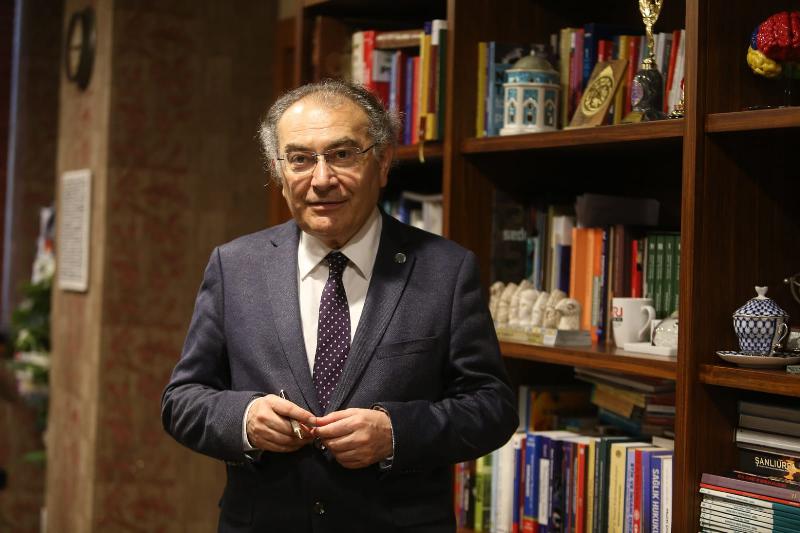
Üsküdar Üniversitesi Founding Rector Psychiatrist Prof. Dr. Nevzat Tarhan made evaluations on “scientific skepticism.” Prof. Dr. Nevzat Tarhan stated that skepticism was one of the fundamental concepts at the beginning of the Age of Enlightenment, adding, “Skepticism is when a person questions what they believe and what they accept.”
Prof. Dr. Nevzat Tarhan noted that Martin Luther, a monk living in Europe in the 16th century, opposed the wrongful practices of the Catholic Church and took the first steps in the formation of the denomination known today as Protestantism, saying, “He is a very important figure in terms of both human and Christian history. The church at that time was selling land in heaven. Everyone was going and paying money to buy land in heaven. The church had become incredibly rich. Martin Luther approached this with skepticism. He went to court and said, ‘Nobody needs to buy land in heaven; I have bought all the lands in hell.’ He sort of raised question marks in people’s minds regarding skepticism. Of course, they could not prove that such a thing did not exist. After that, doubt entered people’s minds. Slowly, a reaction against the church was formed.”
Skepticism is necessary for the advancement of science
Prof. Dr. Nevzat Tarhan stated that people previously believed without questioning, and therefore made donations to the church without questioning, saying, “The church had become a tool of exploitation. Powerful people therefore never liked skepticism. Yet, skepticism is the most important and necessary thing for the advancement of science and the emergence of truth. If you do not question while conducting an experiment, you cannot reach the truth; that is, you need to engage in Socratic questioning.”
Sincere skepticism is always beneficial
Tarhan noted that the concept known as 5W1H is essentially Socratic questioning, saying, “Who said it, what was said, where, when, how, why? This is a questioning method. Within it lies the effort to find the truth. If people’s intention is to find the truth, and if they are sincere in their intentions, skepticism works. Sincere skepticism is always beneficial. Insincere skepticism creates new dogmas. Skepticism is referred to as 'Septicism.' Its opposite is dogmatism.”
Skepticism states, 'There is no such thing as absolute'
Tarhan stated that skepticism, also referred to as “Septicism,” argues that it is impossible to reach the absolute, saying, “Skepticism states, ‘There is no such thing as absolute. You must doubt everything.’ Existentialist philosophy emerged this way. This time, the person who doubts everything falls into uncertainty. Within uncertainty, chaos emerges, and they become unhappy. People fall into depression. You plunge people into chaos because they cannot find meaning. However, if the purpose is to seek visible or invisible truth, we need to create data to test information.”
Tarhan noted that the etymological meaning of Hagia Sophia in the Byzantine church is ‘Aya’ meaning high and ‘sophia’ meaning wisdom, saying, “So it means high wisdom. It seeks wisdom. The symbol of the church is actually a journey of seeking wisdom. Fatih Sultan Mehmet, knowing this very well, did not change the name of Hagia Sophia after the conquest of Istanbul. This means that seeking truth is the fundamental motivation.”
Systematic doubt is used to reveal the truth
Prof. Dr. Nevzat Tarhan stated that while the northern generation of Islamic understanding accepts scientific skepticism, skepticism is rejected in the southern generation of Islam. Tarhan noted that Descartes spoke of the concept of “systematic doubt,” saying, “'Systematic doubt' is used to seek the truth. What happens here? You use doubt to reveal a certain truth. You are not using it for any other purpose. There is sincere doubt. Intention is very important; if one acts with the intention of sincerely seeking truth, skepticism works. But if you are employing a deliberate, planned doubt to demolish certain things, certain dogmas, and create your own dogma, or to establish your own power and dominance, this is understood as ‘power using doubt.’ Systematic doubt is the path to truth. It is also the path to happiness. At one end there is septicism, at the other end, dogmatism.”
Prof. Dr. Nevzat Tarhan stated that proponents of dogmatism say, “Beliefs are not weighed on the scales of reason; you either believe or you don’t,” and that they do not subject belief to methods of reasoning, adding, “In Septicism, skeptics say it is impossible to reach the absolute. The balance between these two is important.”
There are four stages to reaching the truth
Prof. Dr. Nevzat Tarhan stated that there are four stages to reaching the truth, saying, “First, there is experiment and method. This is positive science. You experiment, you observe, you find. Just like the discovery of the law of gravity. If you say, ‘I don’t believe in the law of gravity, I approach it with skepticism,’ you would appear ridiculous.”
Prof. Dr. Nevzat Tarhan pointed out that post-materialist science discussions began in America in 2014, saying, “The University of Arizona and Columbia University published a joint manifesto. That manifesto states, ‘Materialism does not explain everything. Therefore, there is a need for an alternative, post-materialist scientific understanding.’ This is a manifesto related to proving the transcendental. It advocates explaining unseen reality through reasoning methods. There is visible reality, and there is invisible reality. Skepticism used to say, ‘The unseen is not reality.’ However, there is invisible reality.”
The search for truth must continue for thought to progress
Prof. Dr. Nevzat Tarhan noted that the moment you stop searching for truth, the progress of thought stops, saying, “To prevent the progress of thought from stopping, continuous questioning is necessary. The important thing here is to create a questioning-based thinking style, asking ‘How do I reach definite knowledge now, how do I find the truth?’ Socratic questioning, as we call it, asks questions like why it happened, how it happened.”
The path to truth consists of two stages
Prof. Dr. Nevzat Tarhan referred to Mevlana Jalaluddin Rumi’s saying, “Whatever you speak, your words are only as much as the other person can understand,” and commented, “This is entirely critical thinking. It does not say to immediately believe what you hear; whatever you say, it is what the other person understands. Therefore, our philosophical schools need to be reinterpreted. Heraclitus, who advocated skepticism, says, for example, ‘You cannot step into the same river twice.’ This means that in the journey to truth, experience and observation are the first stage. The second stage is thought experiments, in other words, reasoning methods.”
The theory of relativity was discovered through thought and experiment
Prof. Dr. Nevzat Tarhan noted that Einstein discovered the theory of relativity through thought and experiment, saying, “Einstein says, ‘When I throw a stone, I can find where it will land based on the stone’s time and space measurements and its throwing speed.’ He asks the question, ‘If I throw this stone on a train, how can I find where it will land?’ and here he develops the theory of relativity with the concept of time. Then the formula becomes relative. You cannot think independently of time. He reveals the famous ‘E=mc²’ formula by saying, ‘If the world is rotating, the movement you make on the rotating world then creates relativity with the universe.’ In a way, a revolutionary discovery emerges. The relationship of time and space with the universe, and their relationship with matter, become apparent.”
In silico experiments are also a method of seeking truth
Prof. Dr. Nevzat Tarhan noted that skepticism should be used in the journey of seeking truth, stating that the third stage of seeking truth is In silico experiments. Prof. Dr. Nevzat Tarhan said, “In silico experiments are a method of seeking truth conducted in laboratories using mathematical models. This is how quantum emerged. A meteorologist named Lorenz was conducting weather prediction studies on a computer in the 60s. During his work, Lorenz took a coffee break, then wanted to continue from where he left off. He saw that there was serious chaos because he hadn’t saved the information. He said, ‘I can’t start from scratch anymore, I’ll continue tomorrow.’ He then observed that his predictions were much better. Based on this, he said, ‘It means that error is a part of perfection.’”
Evils are a part of perfection
Prof. Dr. Nevzat Tarhan noted that quantum physicists put forward the “Butterfly Effect” theory, and said the following:
“There is such a chaotic order in the world that the Butterfly Effect can disrupt the entire order, and chaos emerges. What I call chaos is a part of perfection. Evils and errors are a part of perfection. David Hume, one of the postmodernist debaters of skepticism, says, ‘If God exists, why do these evils exist? Since evils exist, then I doubt the existence of God. If these evils cannot be rectified, God is impotent; I cannot call him God.’ He questions with doubt. Philosopher Alvin Plantinga, on the other hand, has the proposition that ‘God is omnipotent, omniscient, and a purely good being.’ This proposition does not logically lead to a conclusion that God would not create things capable of evil. For freedom to be tested, there must also be the possibility to do what is wrong. If an individual always does what is right because they cannot do what is wrong, then this individual is not free.”
Damasio’s book, a beautiful result of critical thinking
Prof. Dr. Nevzat Tarhan noted that neuroscientist António Damásio’s book, “Descartes’ Error,” written in the 90s, is a beautiful example of critical thinking, saying, “Descartes had said, ‘I think, therefore I am.’ Damasio’s book is a beautiful outcome of critical thinking. Why did Descartes say that? He saw reason as the sole reality. But with the development of neuroscience in the 90s, it was understood that human emotions are also a scientific category. Our brain has areas that process emotions. Damasio said, ‘I feel, therefore I am,’ instead of ‘I think, therefore I am.’ Currently, after understanding the brain’s operating system, we have arrived at the point of ‘I believe, therefore I am.’”
Our brain acts on what it believes
Prof. Dr. Nevzat Tarhan stated that the fourth stage of seeking truth is belief. Prof. Dr. Nevzat Tarhan noted that Neurologist Prof. Dr. Oğuz Tanrıdağ wrote a book titled “I Believe, Therefore I Am,” saying, “Because our brain acts on what it believes. You add emotion to a thought; when a thought is combined with emotion, it becomes a belief. When we repeat a belief, it becomes a habit. When we repeat that, it becomes a personality. You start doing it automatically. That’s why our brain behaves according to what it believes.”
Tarhan stated that doubt means leaving an open file in the brain, saying, “For example, smoking is harmful. If you are doubtful, you cannot quit smoking. But if you firmly believe that smoking is harmful, then you quit. We administer a treatment to convince the brain that smoking is harmful. In treatment, erroneous beliefs are identified, and after questioning these erroneous beliefs, correct beliefs are put in their place. Ultimately, scientific skepticism is a treatment method. Therefore, we can fearlessly use skepticism in every field, including religion, and all ideas must be tested. Everyone who advocates for truth should be readily prepared to undergo the test of thought.”
Share
Update Date: March 01, 2026
Creation Date: May 28, 2022