

Üsküdar Üniversitesi Human Rights Studies Application and Research Center (İHAMER) and the Human Rights and Equality Institution of Turkey (TİHEK) discussed environmental problems from different perspectives at the ‘Right to Environment for Future Generations’ Panel. Üsküdar Üniversitesi Founding Rector, Psychiatrist Prof. Dr. Nevzat Tarhan, stated that issues such as increasing disasters and floods, global warming, and climate change are related to the disruption of the justice-interest balance. Prof. Dr. Tarhan said, “When the scale of interest outweighs, justice is disrupted. Because the powerful gain more ground, the narcissist expands their own area more.” Tarhan pointed out that there is currently a serious empathy erosion, and humanity thinks only of its own interests, never considering others. He said, “Perhaps we won't realize it now, but when we destroy nature, we will actually be harming our children and grandchildren. Nature, animals, and people also have rights. The philosophy of the strong crushing the weak destroys all these rights. This is actually the biggest enemy of environmentalism.”
Content
Prof. Dr. Nevzat Tarhan: “There is a serious empathy erosion…”
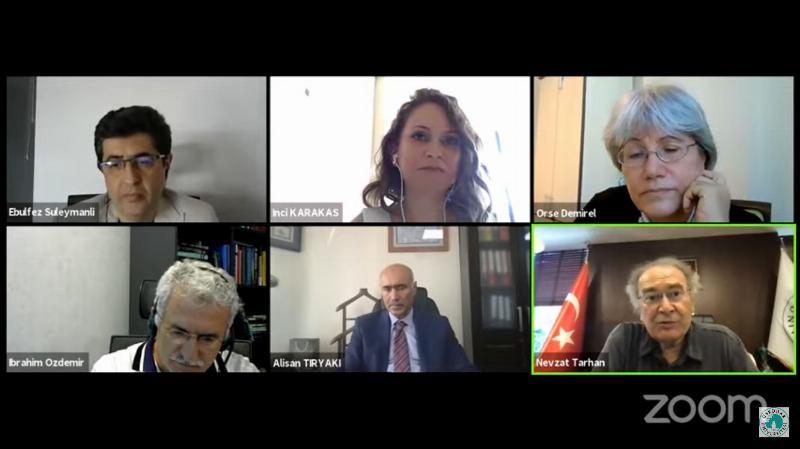
“Environmental problems are related to the disruption of the justice-interest balance”
The ‘Right to Environment for Future Generations’ Panel, organized by Üsküdar Üniversitesi Human Rights Studies Application and Research Center (İHAMER) and the Human Rights and Equality Institution of Turkey (TİHEK), was held online due to pandemic measures.
Prof. Dr. Ebulfez Süleymanlı: “Humans have the right to live in a healthy ecosystem”
Prof. Dr. Ebulfez Süleymanlı, Director of the Human Rights Studies Application and Research Center (İHAMER) and Head of the Sociology Department, who moderated the panel, stated that the disrupted ecological balance, a natural consequence of environmental problems that have reached global proportions affecting the entire world today, seriously threatens the lives of humans and other living beings. Prof. Dr. Ebulfez Süleymanlı said, “However, we can say that the right to live in a healthy ecosystem is defined as a constitutional or legal right by more than 100 states, including Turkey. The right to environment is an extension of the most fundamental human right – the right to life – within the whole, and is closely linked to the right to develop one’s material and spiritual existence.”
Prof. Dr. Ebulfez Süleymanlı: “Environmental problems can only be solved with solidarity”
Prof. Dr. Ebulfez Süleymanlı stated, “As environmental problems and their impacts increase, especially today, we now understand very well in the context of increasing environmental issues that all human communities must act together in solidarity for the right to environment, which is a newly regulated and expanded right, and for a more livable world. Because environmental problems can only be solved when all people come together and act in solidarity. Otherwise, individuals or countries unfortunately do not have the means to overcome a problem of this magnitude. The right to environment concerns not only the current generations but also, and even more so, future generations. Therefore, future generations hold an important place among the beneficiaries of the right to environment.”
Prof. Dr. Nevzat Tarhan: “We included environmental degradation in the ‘Global Well-being Manifesto’”
Üsküdar Üniversitesi Founding Rector, Psychiatrist Prof. Dr. Nevzat Tarhan, said that Üsküdar Üniversitesi published a “Global Well-being Manifesto” for the post-pandemic period. Prof. Dr. Nevzat Tarhan stated that they translated the manifesto into English and officially sent it to over 500 universities worldwide, adding, “We also received positive feedback as a result of the manifesto. One of the topics we covered in the manifesto was the damage humanity inflicts on nature and the environment due to human greed, and how nature is taking revenge on humanity. In the manifesto, we underlined that our future and our beautiful blue planet should be more peaceful, more sustainable, more just, and more livable. Our blue planet is giving serious signals. Even the hole in the ozone layer had shrunk when people did not leave their homes.”
Prof. Dr. Nevzat Tarhan: “Humans are rude guests to nature”
Emphasizing that humans are not a product of nature, but selfish guests who treat nature roughly, Prof. Dr. Nevzat Tarhan said, “Humans oppress the environment. Unfortunately, it was the English philosopher Francis Bacon who opened the door to competition between humans and the environment. Bacon overturned traditions related to the environment by saying, ‘humans and nature are in competition, let’s conquer nature, this is not destroying the environment, humans are superior beings and we have the right to dominate the environment.’ He encouraged competition by stating that the teachings of ‘respect for nature’ heard from Native Americans and religious doctrines also prevented the emergence of a superior human. This created a highly anthropocentric philosophy of life. The anthropocentric philosophy of life led to the destruction of nature.”
Prof. Dr. Nevzat Tarhan: “By destroying nature, we are actually harming our grandchildren”
“Nature, in the medium and long term, is a part of our lives,” said Prof. Dr. Nevzat Tarhan, continuing his words:
“Perhaps we won't realize it now, but when we destroy nature, we will actually be harming our children and grandchildren. Science is the doctrine of predictability. Science will reveal predictability. Policymakers will also take their responsibilities accordingly. However, policymakers think, ‘How do I win the next election?’ Globally, there is a political dynamic that thinks, ‘medium and long-term results do not concern me.’ Due to this dynamic, there is insatiability, competition, rivalry, and ruthlessness. Justice is gone; our relationship with nature is not fair. Our relationship with ourselves, our social environment, and our family is also not fair. Nature, animals, and people also have rights. The philosophy of the strong crushing the weak destroys all these rights. The biggest enemy of environmentalism is actually this mental transformation.”
Prof. Dr. Nevzat Tarhan: “The justice-interest balance has been disrupted”
Prof. Dr. Nevzat Tarhan said, ‘We need to consider our aggressive policy towards nature and conduct studies that foresee 50-100 years into the future,’ and continued his words as follows:
“The increase in natural disasters and floods, and the prominence of global warming and climate change, are related to the disruption of the balance of justice and interest in the world. When the scale of interest outweighs, justice is disrupted. Because the powerful gain more ground, the narcissist expands their own area more. A narcissistic cell and a narcissistic human are very similar. A narcissistic cell is a cancer cell. A cancer cell has irresponsibility, boundlessness, and a desire for growth. With its desire to grow, it constantly wants to multiply by engulfing neighboring cells. It secretes special hormones into the vessels leading into it, widening them, consuming more oxygen and glucose. A cancer tissue exceeding 3 mm can be used in early diagnosis because it is measurable. Humans are currently using nature ruthlessly. There is currently a serious empathy erosion. Humanity never thinks of others, only of its own interests. Such a human type has emerged.”
Prof. Dr. Nevzat Tarhan: “Empathy should be established with living beings in nature”
Prof. Dr. Nevzat Tarhan pointed out that after the Covid-19 pandemic, the world is moving towards a narcissism pandemic. He said, “Where there is selfishness, there is no peace. Currently, consumer frenzy and selfishness are the diseases of this era. Both harm nature. Behind both lies a mental transformation, a wrong philosophy of life. As someone interested in human psychology, I believe we must emphasize this dimension of the environment. If mental transformation does not improve positively, no one will embrace what is said globally. First comes mental, then social, followed by economic and political transformation. When discussing the right to environment, we absolutely need to be able to empathize with other living beings in nature. It is particularly beneficial to emphasize that we need to create an environmental culture and awareness in this regard.”
Human Rights and Equality Institution of Turkey (TİHEK) Second President Alişan Tiryaki: “Protecting environmental values is a moral duty”
Human Rights and Equality Institution of Turkey (TİHEK) Second President Alişan Tiryaki pointed out the importance of protecting the environment and addressed the shortcomings in the implementation of the Environmental Law, which came into force in 1983. Alişan Tiryaki said, “Protecting environmental values on behalf of future generations is not only a moral duty but also requires global solidarity due to it being the common heritage of humanity.”
Prof. Dr. İbrahim Özdemir: “We have responsibilities towards future generations”
Üsküdar Üniversitesi Head of Philosophy Department Prof. Dr. İbrahim Özdemir made evaluations within the framework of environmental rights for future generations. In his speech titled “Do We Have a Moral Responsibility Towards Future Generations in the Context of Environmental Rights?”, Özdemir stated that environmental problems have many sociological, psychological, and theological dimensions, and that all laws and institutions related to the environment were formed through the criticism of environmental movements against governments' policies. Özdemir touched upon environmental pollution, especially mucilage, stating that the main question is whether there will be an environment left for future generations, and said, “Here's the question: How will our children remember and commemorate us in 2050, 2060, 2070? Will they remember us with gratitude and thanks? Will they be able to say, ‘Thank you very much to my grandparents. They left behind pristine seas, rivers, lakes, and forests with fish in them,’ or will our children walk around with masks due to air pollution? Our children cannot even drink water from streams right now. That's why we need to make a decision. This is a moral decision. We have responsibilities towards future generations. We have a responsibility to leave them clean air, water, seas, and rivers.”
Lecturer Orse Demirel: “The right to environment is a right to solidarity realized through democracy and participation”
Üsküdar Üniversitesi Head of Social Security Department Lecturer Orse Demirel, in his presentation titled “The Right to Environment in Light of European Court of Human Rights Decisions,” stated that the right to environment is a right that gains institutionalization within the concept of human rights. Demirel, providing examples from the European Court of Human Rights’ approach to environmental rights, said, “The right to environment is a right to solidarity realized through democracy and participation. When the philosophy of unlimited growth and consumption, which occurs at the cost of destroying nature and all humanity with it, is replaced by a culture and understanding that views the environment as both the source and the limit of development, the foundation for democracy awareness and the right to environment will also be established.”
Lecturer İnci Karakaş: “Damage to the environment is also a crime against human rights”
Üsküdar Üniversitesi Environmental Health Program Head Lecturer İnci Karakaş, in her presentation titled “The Relationship Between Environment and Human Rights,” made evaluations in the context of environmental awareness, what needs to be done to foster environmental awareness, environmental pollution, and the relationship between environment and human rights. Karakaş said, “Every damage inflicted on the environment is also a crime against human rights. Therefore, minimizing environmental pollution should become a legal necessity required to ensure human rights, as well as a social responsibility.”
Üsküdar Üniversitesi Sociology Department student Sibel Yıldırım stated that she has taken part in various social responsibility projects as an environmental activist and discussed her work. The panel was also broadcast live on ÜÜ’s official YouTube account.
Share
Request a Call
Other News
- The book that read today's digital threats in 2014: Being a Conscious Family
- Experts warn: 'Instead of memorizing letters, teach pencil grip, scissor use, and coloring'
- School fear and school love both start in the family!
- Family is not merely transforming, it is being battered under a serious assault
- Artificial intelligence opens the door to early diagnosis in autism!