

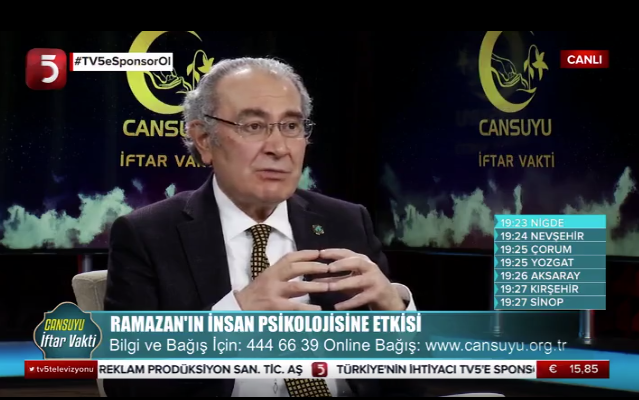
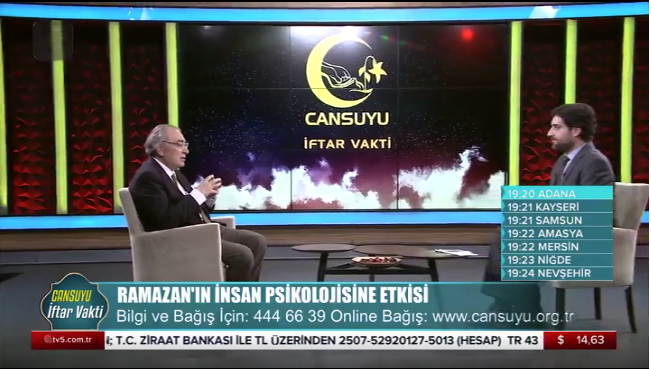
Üsküdar Üniversitesi Founding Rector Psychiatrist Prof. Dr. Nevzat Tarhan was a live guest on TV5's 'Cansuyu İftar Vakti' program. Making evaluations on the topic of 'Ramadan and Its Psychological Effects,' Tarhan drew attention to the feeling of *nefis* (ego/self) in humans. Prof. Dr. Nevzat Tarhan said; "Allah has given us a *nefis* that has the characteristic of defying Him. This is humanity's test. If a person tames that *nefis*, then the wild horse becomes a domesticated horse. The month of Ramadan is also a good opportunity for us to tame our wild emotions within and guide us to the right path. No one should say 'I have tamed my *nefis*!' Because the taming of the *nefis* continues until the last stage of life. Therefore, the month of Ramadan is a time to recognize the Pharaoh within us and to tame the wild horse within us."
Content
Prof. Dr. Nevzat Tarhan; "Ramadan is a time to recognize the Pharaoh within us and to tame the wild horse within us"
“Islam taught through fear leads to hypocrisy”
Emphasizing that Islam is the religion of *tawhid* (Oneness of God), Prof. Dr. Nevzat Tarhan spoke about contemporary Muslimhood. Prof. Dr. Nevzat Tarhan said; "Islam needs to be built upon hearts. Islam taught through fear leads to hypocrisy. For example, if you look at today's religious families, they perform all the formal aspects of religion. But within them, there are lies, intrigues, deceit, and disregard for the rights of others. These are formal, 'wardrobe Muslimhood' without ethics. This is a tradition. You have forgotten to establish a heartfelt connection with Allah and are only focused on economy, power, and authority. The Holy Quran mentions *tawhid* fifty-five percent of the time. Allah's priorities and our priorities are not the same. Allah's priorities are different, our priorities are different. Allah says 'go ahead and live,' and makes the Islamic World pay a price. We have not aligned our priorities with Allah's priorities (obligatory acts, necessary acts, and *sunnah*)."
“Man should not steal Allah's role in the world”
Drawing attention to the concept of *nefis* in humans, Prof. Dr. Nevzat Tarhan spoke about the effects of the month of Ramadan on personal development. Prof. Dr. Nevzat Tarhan said; "More important than therapies for a person's development is self-knowledge. Knowing one's limits. Knowing the boundaries between one's own power and the power of the Creator. Man should not steal Allah's role in the world. One should not say 'I have the power, I have the authority, whatever I say happens.' One of Mevlana's students severely criticized Pharaoh. Thereupon, Mevlana asked his student, 'If you were given the opportunities given to Pharaoh, would you not have become Pharaoh?' Exactly so. There is a small Pharaoh lying within all of us. Allah has given us a *nefis* that has the characteristic of defying Him. This is humanity's test. If a person tames that *nefis*, then the wild horse becomes a domesticated horse. That *nefis* leads us to our goal. The month of Ramadan is also a good opportunity for us to tame our wild emotions within and guide us to the right path. No one should say 'I have tamed my *nefis*!' Because the taming of the *nefis* continues until the last stage of life. Therefore, the month of Ramadan is a time to recognize the Pharaoh within us and to tame the wild horse within us."
“Worldly life is a simulation; the real world is in the afterlife”
Highlighting the purposes of worship performed during Ramadan and the awareness created thereby, Prof. Dr. Nevzat Tarhan said; "Controlling the eating impulse in this world is a skill. Ramadan, in turn, is a great opportunity to learn this skill. People eat to satisfy the pleasure of eating. However, during the month of Ramadan, they strive for a high ideal, a transcendent reason. Because the month of Ramadan stands before the eating impulse. One asks, 'I have the power to take everything, to eat everything, I own everything, but why can't I use it, why can't I eat, why did Allah give me this worship?' Because you are not their owner, you are not their master. They are entrusted to you. This world is not a place of satiation. Worldly life is a simulation, and the real world is in the afterlife. Therefore, in this world, there are only samples of real pleasures. The originals are in real life... We mistakenly believe this worldly life is real life, not a simulation."
“To be within Allah's treasury of mercy and not be aware of it is a great misfortune”
Making evaluations regarding the concept of despair in Islam, Prof. Dr. Nevzat Tarhan said; "To fall into despair, to lose hope in Allah's mercy, means you are merciless. In the 1940s, a saintly person (Allah dostu) fell into prison. They put him in the ward with the most hardened criminals. He was chained like this. After a while, a prisoner there asked the saint, 'I killed this, I did that, am I destined for heaven or hell?' The saint's answer changed the prisoner's life. He said, 'What happens if you take a handful of soil and throw it into the sea? It dissolves and disappears. Your sins that you've described are like that. Those sins are like a handful of soil in the sea of Allah's mercy.' The prisoner was shocked. A few weeks later, he was asking whether to kill bedbugs or not. They released the man from his chains like that. We are also an example of this. For a person to be within Allah's treasury of mercy and not be aware of it is a great misfortune."
“The month of Ramadan is a good opportunity for people to treat their narcissism”
Defining narcissism and expressing the perspectives it creates against Islam, Prof. Dr. Nevzat Tarhan said; "Narcissism is a person's sanctifying themselves against their ego. Therefore, the biggest organ of a narcissistic person is their ego. Such people worship themselves, they admire themselves. The month of Ramadan, however, is a good opportunity for these people to treat their emotions, their narcissism. If a person wants to be a therapist, they withdraw into solitude for one or two years to treat their own narcissism. During that process, they recognize their own narcissism. They see their strengths and weaknesses, their ambitions, their insatiability, their flaws, and they tame them. Only then can they be beneficial to others. This is what Islam does through the taming of the *nefis*. For example, such narcissistic people are also uncomfortable prostrating as a servant of Allah. They say, 'How can I prostrate?' Because prostration is where the *nefis* is humbled to the ground. The hunger and iftar during Ramadan are also like that."
Share
Request a Call
Other News
- Social responsibility courses moved to the field
- Erasmus+ Orientation Week completed at Üsküdar
- Prof. Nevzat Tarhan: “Brain secretes ‘dark glue’ in social media lynchers!”
- Prof. Nevzat Tarhan: “Every segment of society should be able to say, ‘This constitution is my constitution!’”
- OHS releases guide for safe operation of industrial robots