

Prof. Dr. Nevzat Tarhan, stating that the spiritual dimension of the month of Ramadan should not be missed, noted that individuals should see this special month as an opportunity to reflect on life and existence, to revise themselves, and to re-evaluate. Tarhan, stating that "Ramadan can be regarded as a month for gaining a different perspective," emphasized that Ramadan provides resilience training to individuals and makes significant contributions to families in terms of solidarity, mutual aid, and empathy for families and society.
Content
Prof. Dr. Nevzat Tarhan: “Ramadan offers an opportunity to rethink and revise oneself”
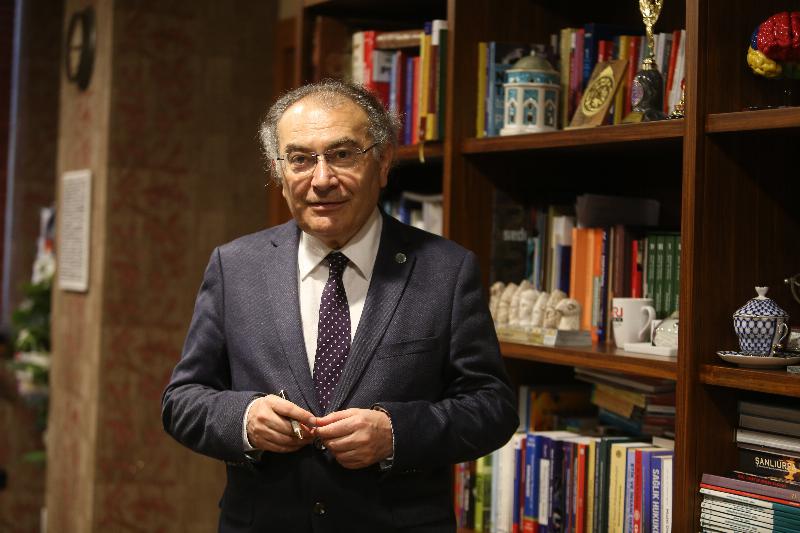
Üsküdar University Founding Rector, Psychiatrist Prof. Dr. Nevzat Tarhan, made evaluations regarding the month of Ramadan and the psychology of faith.
An opportunity to reflect on and evaluate life
Prof. Dr. Nevzat Tarhan stated that Ramadan, the sultan of 12 months, offers individuals a significant opportunity to reflect on life and existence. He said, "There is a 15 percent rule in innovation. If a person wants to be an entrepreneur, the advice of those who advocate this philosophy is usually, 'Apply the 15 percent rule.' This means a person should set aside time to think about their work. If an individual works 100 hours, they should spend 11 hours thinking about their work. They should make new evaluations regarding that work. The month of Ramadan, which occurs within 12 months, is very similar to this 15 percent rule. In this special month, unlike the other 11 months, individuals can step out of their routine and use it as an opportunity to pause, reflect on life and existence, and re-evaluate. From a spiritual perspective, Ramadan can also be regarded as a month for gaining a different perspective for people."
We are not living in the world, we are passing through it
Prof. Dr. Nevzat Tarhan noted that humans are the only beings among other living creatures capable of abstract thought. He said, "No living being other than humans can produce a theory of mind, make assumptions, or dream. When a person dreams, the subjects they dream about turn into needs for them. A need first turns into a desire, and that desire then motivates the person. Dreaming about your work forms the vision part of the work. Creating a human vision is actually an existential problem. At a certain point in life, a person needs to ask, 'What is life, why do I exist, where did I come from, where am I going, what is the end of life, did I come from nothing?' As Rumi said, 'Am I living in the world, or am I passing through the world?' We are actually not living in the world; we are passing through it."
Should be seen as a period of re-evaluation
Prof. Dr. Nevzat Tarhan noted that the month of Ramadan offers a significant opportunity for individuals to reflect on and evaluate their search for meaning in life. He said, "Let's consider Ramadan as a period to pause, reflect, and re-evaluate, to bring a different perspective to one's psychological life, social life, family life, and existence.
When viewed this way, a person grasps the profound meaning provided by fasting. Otherwise, it would just be hunger, merely an act of worship for the body."
The disease of this era: Living fast
Prof. Dr. Nevzat Tarhan stated that this is an age of speed. He said, "This era has a disease: people live too fast. They act hastily and impatiently. They act without thinking about the outcome and want things to happen immediately."
Ramadan provides resilience training to individuals
Prof. Dr. Nevzat Tarhan noted that every person has a comfort zone, and average conditions will not develop a person. He said, "Stress develops a person's abilities. In such situations, people put themselves under stress. Dormant aspects in an individual activate their psychological infrastructure. This is called psychological resilience analysis. It is known as resilience training. In resilience training, a person waits and endures to achieve their goal. Patience is currently misunderstood as a concept. Patience does not mean sitting back and waiting. Patience is active patience, patience in action. Patience means acting in accordance with the rhythm of life, being able to adjust when to slow down and when to speed up. Ramadan also provides individuals with resilience training, also known as fortitude."
The young generation's ability to delay gratification is weak
Prof. Dr. Nevzat Tarhan said, "The month of Ramadan facilitates the maturation and refinement of our souls." He continued, "Today, especially the younger generations are very impatient; they want things to happen immediately. Their ability to delay gratification is so weak that they want to achieve things easily, without effort or fatigue. There are also hidden psychological laws in life. You cannot achieve beautiful things without effort and without getting tired. The paths to success are not hands-in-pockets, flowery paths. They are mountainous, stony, difficult paths. You will put in effort and endure. You will always have a goal. Modernism greatly glorifies hedonistic gratification. Hedonistic gratification says, 'Right now.'"
Those with the ability to delay gratification have 20% higher emotional intelligence
Pointing to the importance of acquiring the ability to delay gratification, Prof. Dr. Nevzat Tarhan said, "There is a study that has become a reference in emotional intelligence research. In a 20-year study, Turkish delight was brought into a classroom of kindergarten children. Of course, the children wanted it immediately. They were told that those who wanted it immediately would get one piece each, and those who waited 15 minutes would get a handful. One group wanted it immediately and settled for one. The other group entertained themselves for 15 minutes and received more. They continued to observe these two groups for 20 years. The group that succeeded in delaying gratification had 20 percent higher emotional intelligence. They were more successful in friendships, in the work environment, and in social relationships. The ability to delay gratification does not happen spontaneously; it needs to be taught. Religious upbringing also makes a significant contribution to individuals in this regard. People learn the skill of postponing pleasures and enjoyments."
The ability to remain calm under stress is gained through worship
Prof. Dr. Nevzat Tarhan stated that one effect of the month of Ramadan, which makes significant contributions to an individual's spiritual development, is its contribution to learning stress management. He said, "During Ramadan, our bodies go hungry, and we inevitably put our bodies under stress. A drop in blood sugar causes irritability. Especially not being able to eat during meal times is a source of tension. In such situations, the ability to remain calm under stress is also developed. Programs consisting of 10-20 sessions are conducted to acquire this skill. Electrodes are attached to the head. Stressful events are imagined. We work on waiting skills, delaying skills, and the ability to remain calm under stress against these events using modules. Here, within the concept of worship, an individual, in a way, learns stress management training, specifically the skill of remaining calm under stress."
Ramadan has a special importance in the family
Prof. Dr. Nevzat Tarhan underlined that the month of Ramadan also holds a very important place, especially in terms of family relationships. He said, "During Ramadans, family life is very different. People pay attention to many things during this month. It is a period when conversation increases within the family. It is a period when sharing increases. It is a period when meals are eaten together and conversations are held. That's why children love Ramadan. If a person normally curses, they reduce it; if they shout, they try to be calm. During this period, a person tries to control themselves. This is a control skill. This control skill is also tried to be acquired in addiction treatment. Many addictions, such as substance or alcohol addiction, are considered a loss of brain control. Previously, withdrawals were considered tolerance development, but now they are evaluated as loss of control. Does the person have internal control or not? If a person only operates with external control, meaning the fear of others controls them, this is not considered sufficient.
External control exists, but the ideal is to instill internal control and self-monitoring skills. Very difficult training is given to individuals to develop the ability to evaluate their desires, urges, and to gain internal control."
Feelings of mutual aid, sharing, and empathy are intensely experienced
Prof. Dr. Nevzat Tarhan noted that the fast of Ramadan also provides individuals with internal control skills. He said, "During fasting, a person does not eat all day and waits. They delay gratification. Internal control skills develop. This also contributes to people being kinder and more considerate towards each other in family relationships. Another benefit it provides is strengthening the feeling of empathy. It is a serious matter in understanding the hungry and the poor. You develop empathy. Your blood sugar drops, but you cannot eat. In this situation, you think more about those who do not eat. Therefore, there is also a dimension of social worship where feelings of mutual aid and sharing are intensely experienced. Practices like 'Sadaka Taşı' (charity stone) and 'Askıda Ekmek' (bread on hanger) are traditional gains stemming from Anatolian wisdom. The most important period that enables these is Ramadan. The month of Ramadan also offers an important opportunity for becoming aware of social consciousness. Realizing and feeling that one is a part of the society they live in, being able to empathize with that society, and becoming aware of disadvantaged people and wanting to do something for them also provide significant gains."
Ramadan also teaches how to be happy by doing good
Prof. Dr. Nevzat Tarhan stated that in a study conducted years ago by Bakırköy Mental and Neurological Diseases Hospital, alcohol consumption decreased by 50 percent during Ramadan, and the reduction in crime and violence in society also coincided with Ramadan. Prof. Dr. Nevzat Tarhan said, "The month of Ramadan can also be regarded as a good period for identifying disadvantaged individuals, making them happy by helping and supporting them, and teaching how to be happy by doing good to others."
The spiritual dimension of Ramadan should not be missed
Emphasizing that the spiritual dimension of Ramadan should not be missed, Prof. Dr. Nevzat Tarhan said, "It is important not to get stuck on the formal aspects of Ramadan. If we miss the spiritual dimension of Ramadan, we cannot fully grasp its formal dimension. Ramadan is also a prominent period in terms of the psychology of religion and faith. Ramadan places great importance on strengthening the areas related to positive responses in our brains. Therefore, by evaluating Ramadan from this perspective, it can also be regarded as an opportunity for individuals to develop themselves, advance their outlook on life, reflect on the meaning of life and spiritual values, and revise themselves anew."
Share
Update Date: February 28, 2026
Creation Date: April 02, 2022
Request a Call
Other News
- The book that read today's digital threats in 2014: Being a Conscious Family
- Experts warn: 'Instead of memorizing letters, teach pencil grip, scissor use, and coloring'
- School fear and school love both start in the family!
- Family is not merely transforming, it is being battered under a serious assault
- Artificial intelligence opens the door to early diagnosis in autism!