

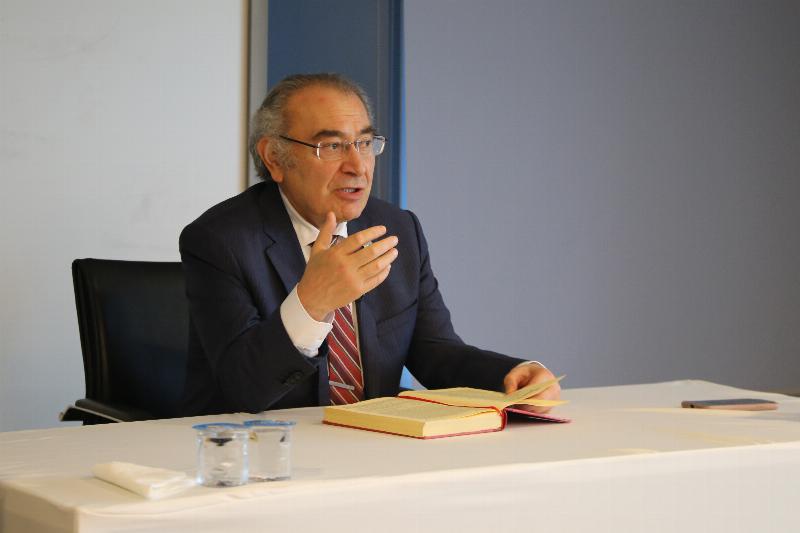
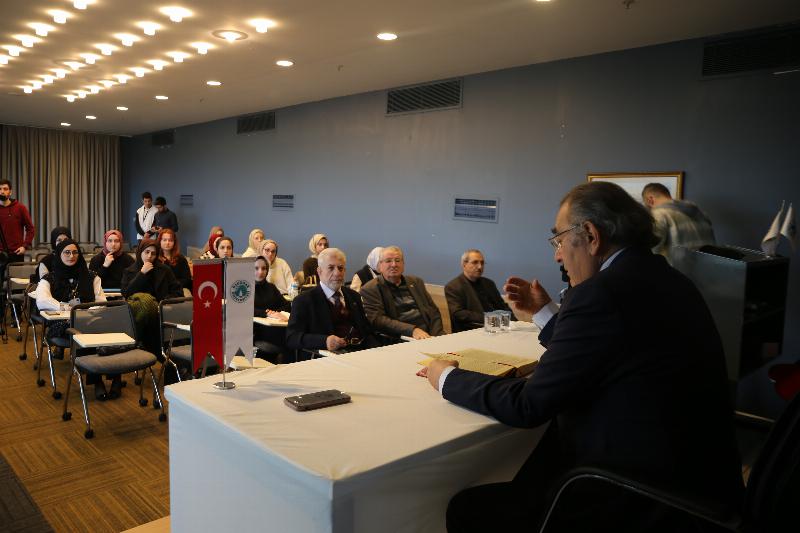
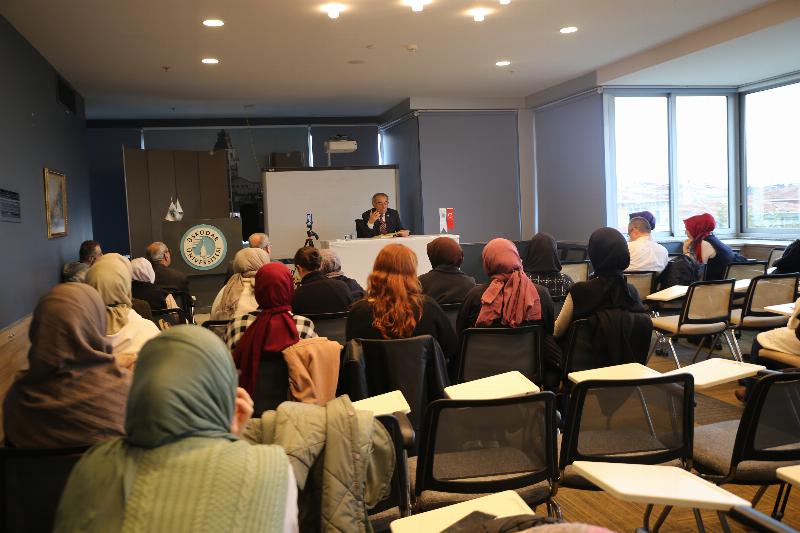
‘Existential Talks with Üsküdar University Founding Rector Prof. Dr. Nevzat Tarhan’, organized by the Conscience of the Age Club with the support of the Üsküdar University Health, Culture and Sports Department, took place this week, as every week, with the intense participation of students. This week's topic was ‘Prophet Job and Patience’. Tarhan stated that the belief in Tawhid (Oneness of God) was strongly demonstrated in the life of Prophet Job, adding that Prophet Job showed gratitude in times of prosperity and patience in the face of illnesses.
Content
Prof. Dr. Nevzat Tarhan: “Prophet Job was patient in times of illness and grateful in times of prosperity”
“When doing a job, aiming for divine pleasure should be at the back of our minds”
Prof. Dr. Nevzat Tarhan stated that one of the most important lessons to be learned from the story of Prophet Job is to do a job with the pleasure of Allah. Tarhan said: “When Prophet Job could no longer worship due to his illness, he sought refuge in Allah, saying; ‘I have sought refuge in Your Most Gracious and Most Merciful attributes. This illness has harmed me. It prevents me from drawing closer to You.’ Here, remembrance (dhikr) means drawing closer to Allah. Things that distance one from Allah are bad. Things that bring one closer to Allah are good. You approach it this way. The word 'Satan' is the Arabic word for devil. Satan's goal is to distance one from Allah. Everything that distances one from Allah is connected to Satan. Everything that brings one closer to Allah, the Most Gracious, is connected to Allah. Here, our measure, according to Prophet Job, is that what prevents me from drawing closer to You is what draws me closer to Allah. His saying this as a very experienced and effective prayer means that science provides us with a measure here. Shall we be like Satan or like the Most Gracious (Rahman)? In what we do, when we wake up in the morning, when we make an intention, when we do a job… Always having divine pleasure as a goal at the back of our minds. Even in routine tasks like eating and drinking. When a person thinks this way, they can say no when a malicious warning or impulse comes from within. This is called an abstract goal. To place this at the very top of our strategic goal pyramid in the brain. This is the goal. If it is in line with this, it is correct. If not, it is wrong; this is the measure.”
“Allah tries to ensure the guidance of society through a test of Prophet Job”
Tarhan, explaining the types of trials in the story of Prophet Job, stated that the sole reason for this trial was not for Allah to test Prophet Job, but that He preferred to guide society to the right path through him. Tarhan said: “Prophet Job was especially very rich before his illness. According to a narration, he was very wealthy in Damascus and Urfa, meaning he had thousands of sheep, cattle. He had many possessions. He had seven sons. And at that time, Satan spread a rumor among the people. He said, ‘He worships very well. Actually, Allah has given him many things, that’s why he does it. If he didn't have these, he wouldn't do it.’ A serious rumor arose among the people due to Satan's whisperings. Upon the general acceptance of this rumor, Prophet Job’s trial began. Allah tries to ensure the guidance of society through a test of Prophet Job. This is also a trial. This time, he first loses his children. Then the illness begins. It progresses severely. He becomes so uncomfortable that he goes to a separate place. Finally, his wife also falls ill. His wife even says something harsh to him. Later, he somewhat recovers. He becomes a thousand times richer than before. Again, probably around 60-70 years of age. He lives for that much longer. That is why patience is truly important. There is a potter named Eyüp. Whenever he makes a pot, it breaks. Finally, he prayed, ‘My name is not Prophet Eyüp, but Eyüp the potter,’ meaning he made such a prayer that it also affected him. It is a story embedded in our culture. He also passes that trial, no matter how many years that condition lasted. He does not object to his condition. He does not rebel. He constantly says, ‘I came into the world naked, and I will leave naked.’”
“Prophet Job was patient in times of illness, and grateful in times of prosperity”
Speaking about the importance of being patient in times of adversity and grateful in times of prosperity, Tarhan stated that the wounds that formed on Prophet Job's body are present in people's souls today. Tarhan said: “The apparent bodily wounds and illnesses of Prophet Job (peace be upon him) correspond to our inner, spiritual, and emotional illnesses. This is actually Bediüzzaman’s new perspective on Prophet Job. At that time, such an illness existed for centuries. He endured suffering. Two magic words: gratitude and patience. He used these two words. We always say that. He was patient in times of illness, grateful in times of prosperity. This increases his rank. Not only when he was grateful, but he was grateful for prosperity in both situations. It had not reached him yet. Patience then comes upon him. The trial of patience comes. There is a beautiful saying among the people: Patience is bitter, but its fruit is sweet. Therefore, we define the word patience psychologically as a meditative act. In a meditative act, you take such a position. You choose a word, a concept, and then you repeat it. For about 15-20 minutes. A meditative act depending on the situation. Effort is put in. You need to concentrate. You need to take special breaths, concentrate, and do this every day. Then it becomes a meditative act. A person actually performs a meditative act with the word patience in our context. Especially against pain. In meditative action, there is a state of mind we call ecstasy. In a state of ecstasy, the human brain works differently. There is an experiment done on Buddhist monks. We also conducted and published this study on Mevlevis as Sufi meditation. The brain has a section called anticoagulation. The homosyaon regulation section. This region works in individuals. When that region works, the person feels all their desires met. All their needs are satisfied, and in Buddhist monks, they feel integrated with the universe. When they capture that feeling, a gene starts producing protein. That protein produces serotonin, dopamine, endorphins. It gives immense pleasure. The equivalent of ecstasy is a state of rapture (cezbe). A state of rapture is addictive. We call patience a meditative act. Psychologicaly, if a person applies this at the right time, the outcome can be good. One should show patience. The brain decides where to be patient and where to speed up. Mind and heart must act together. Otherwise, you will be pushed and shoved. Patience is the ability to wait at the right place and at the right time.”
“Allah has coded a software for souls to find Him”
Tarhan, stating that the universe is a simulation, underlined that the disposition of the cosmos is within Allah's will. Tarhan said: “If you cannot change the flow of the normal world, you will change your perspective. You know strategy games; currently, 6 million people are playing Metaverse games. If the programmer, unlike the players, had these features: if they could read the player's intentions, what they want to do, if they could read their emotions, if they could control them with electromagnetic energy – which is currently possible –. If one considers such a software exists, you think you are playing freely for days and you feel pleasure through a penalty and reward system. You cultivate fields, sow, and harvest. Here, the person who writes the game, the programmer – and here we mean that the universe is a simulation – the player cannot know if the ball will be a goal when thrown, but the programmer knows whether the ball thrown in the game is a goal or not. ‘Lawh-i Mahfuz,’ meaning the master book. Allah first created the Lawh-i Mahfuz. Allah has coded a software for souls to find Allah. It is not correct to say to Allah, ‘Why did you design it like this? Why did you do it like this?’ He disposes as He wills. He wrote this universe from scratch; saying ‘why do you dispose?’ is not correct. It is the same as saying, ‘Why was this game written?’”
“When reading the story of Prophet Job, the belief in Tawhid (Oneness of God) needs to be strong”
Tarhan, drawing attention to the unanswered questions in the materialist education system, gave advice to young people. Tarhan said: “A successful worker and an idle, lazy person cannot be the same. Justice is served this way. On your behalf, I sustain myself this way. Since there has been a materialist system and education from a young age, all these wounds are within us. While these questions revolved in my mind at university, I could not find answers to my questions. Afterwards, the 'Risale-i Nur: Nature's Treatise' came into my hands. I read it 20-30 times. I couldn’t understand it and read it again and again. My doubts began to disappear over time. Since I fell from the roof (an idiom meaning 'I have experienced it firsthand'), I can tell you these things. Life is like riding a bicycle. If you go too fast and stop, you will fall. You need to accelerate at the right place and at the right time. You see in motor races, the one who can adjust wins. Laziness is dangerous. Those who remain silent in the face of evil are as responsible as those who commit it. When reading the story of Job, I said that the belief in Tawhid (Oneness of God) needs to be strong. The belief in Tawhid becomes the most reasonable belief. What you do is not in vain.”
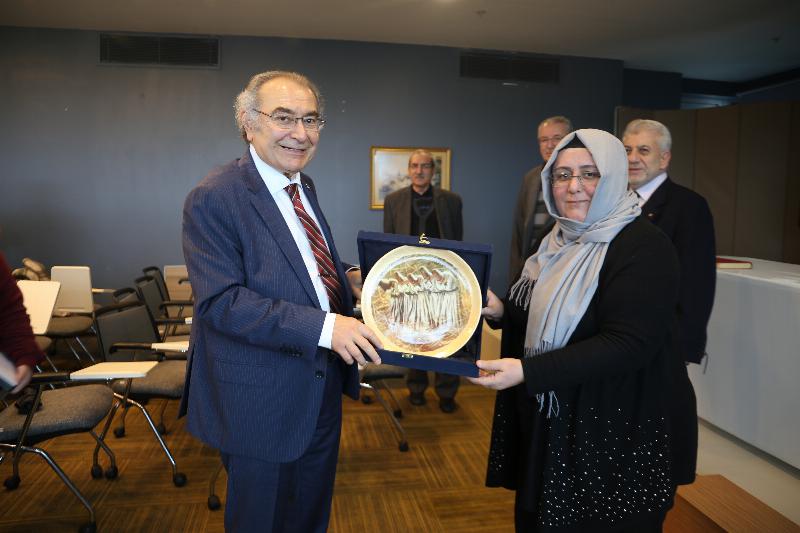
During the program, which was also attended by Şerife Yıldırım, a tile and calligraphy artist and President of Kones Handicrafts Cooperative from Konya, Yıldırım presented her tile artwork to Prof. Dr. Nevzat Tarhan.
Prof. Dr. Tarhan, in turn, conveyed his thanks to the artist, who has been practicing this art for twenty years, by gifting her some of his books.
Share
Update Date: February 26, 2026
Creation Date: December 13, 2022