

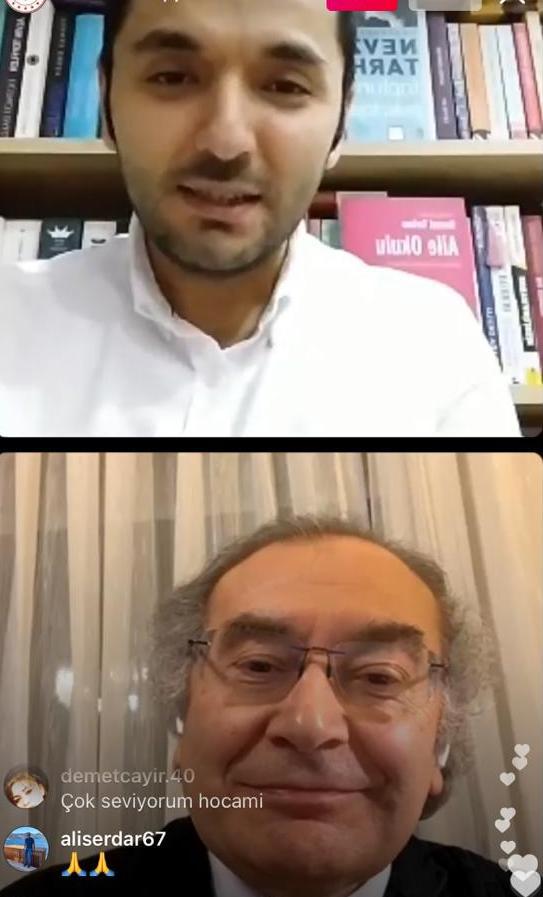
Üsküdar Üniversitesi Founding Rector, Psychiatrist Prof. Dr. Nevzat Tarhan was a guest on the live broadcast titled ‘Positive Psychology in Education,’ organized by the Special Education and Guidance Services Branch of the Istanbul Provincial Directorate of National Education. Tarhan, who touched upon the emergence and history of Positive Psychology, made evaluations about its importance in the field of education. Tarhan stated: “Educators, in particular, strongly embraced positive psychology. If we teach this as a course in our schools, we will be able to protect young people from the disease, the epidemic, of popular culture. 21st-century skills are not taught to young people through conferences, advice, or values education. The method for instilling these skills is through value-based education. We have been working on a book for two years. With a team of 20 people, we wrote a Positive Psychology textbook suitable for 9th-grade students. If our Ministry accepts it, they can recommend it.”
Content
Prof. Dr. Nevzat Tarhan: “We Can Protect Youth from the Epidemic of Popular Culture with 'Positive Psychology'”
“Man is not homo economicus but homo psychologicus”
Tarhan, evaluating the historical journey of positive psychology, made striking statements about the changing understanding of human existence. Tarhan said: “Positive psychology is a concept that began to be used in the 1960s, but it became a separate discipline after the 2000s. After the book ‘Descartes’ Error’ was written in the 1990s, it was revealed that humans do not act solely with their minds when making decisions; their emotions are also effective. Until this period, humans were considered ‘homo economicus,’ an economic being, but as a result of psychological research, it was revealed that humans are ‘homo psychologicus,’ a psychological being. It emerged that people act not out of economic concerns, but with a sense of trust. It was concluded that people invest more in environments where they feel safe. In the past, psychology was known as the absence of any mental illness, bringing the negative to zero; psychology had no agenda to elevate people above zero. While investigating what should be done to create a state of well-being, to elevate people above zero, they encountered the emphasis on ‘well-being’ as explained by Anatolian wisdom, Eastern philosophy, Buddhism, and all monotheistic religions; this is how positive psychology emerged.”
“Teachings in Anatolia Form the Intellectual Infrastructure of Positive Psychology”
Tarhan, evaluating the Turkish equivalent of the ‘well-being’ concept used in positive psychology, emphasized that Üsküdar Üniversitesi is one of the pioneers of this course. Tarhan stated: “In our culture, it is said ‘May Allah grant health and well-being.’ The Turkish equivalent of the word ‘well-being’ is ‘afiyet, iyilik hali’ (wellness, state of goodness). Before positive psychology was presented as a science, we, as a society, unconsciously wished for well-being using this expression among the public. Harvard University introduced Positive Psychology as a course in 2015, and Yale University in 2018. As Üsküdar, we introduced this course in 2013, before Harvard. There are three types of prevention in medicine. Primary prevention involves doing what is necessary to prevent people from getting sick, with preventive medicine being most important for healthy individuals. In secondary prevention, risk groups are identified, and early diagnosis and treatment are applied to those with disease potential. Tertiary prevention is a form of protection to prevent recurrence after a disease has passed. Positive psychology plays a primary role in first-level prevention and is also useful in secondary and tertiary prevention. Due to increasing incidents of violence among children under 18, the US Children's Protection Fund provided a grant to Seligman and his team for a study. The study continued between 2005 and 2008. As a result of this study, positive psychology emerged. These sciences together led to a conclusion about strengthening the positive rather than reinforcing the negative or focusing on it. As a result of the positive psychology course we offer at our university, we observed a 20% increase in students' emotional intelligence. We are receiving very positive feedback from our students regarding the benefits of the course.”
“Generation Z Should Be Taught Life Skills with Positive Psychology”
Tarhan, drawing attention to the importance of learning life skills rather than technical skills in the 21st century, stated: “In the 21st century, robots will replace many professions, and new professions will emerge. In this situation, the idea arose to direct students towards professions that robots cannot perform, such as training them in social sciences like psychology. We need to teach young people life skills more than technical skills. At our university, we have been teaching life skills for 9 years through ‘Positive Psychology’ and ‘Education Skills’ courses. We provide education on how people can live happily and how they can live a quality life. Schools should not only teach academic and technical skills. Generation Z is a digital generation, a generation that knows its rights and is passionate about freedom. When they experience a little pressure, they commit suicide; it's no joke. Our generations cannot understand young people; young people are being wasted, and most of them go abroad. Being traditional is good, but being traditionalist is wrong. In psychology, this is called anachronism. It means getting stuck in a certain period of one's life. The same thing exists in society. Society is a small individual; if an individual is a miniaturized society, then society is an enlarged version of the individual. The psychological dynamics of an individual also exist in society. Therefore, in society, this must be taken into account; emotional and social skills need to be taught.”
“Compassion, Empathy, Gratitude are Taught in Positive Psychology”
Tarhan stated that positive psychology is a very important field for acquiring life skills, emotional and social skills, adding: “Positive psychology, as a discipline, is a field with a very recently established theoretical foundation. However, it has gained acceptance across the world, not just in Turkey, much faster than I expected. Its acceptance in Turkey is easier because it aligns very well with our fundamental values that we hold true. We will learn it only through different methods, with scientific rigor. We used to learn those values with religious solidity in the old methodology, but the methodology of this era is scientific rigor. Both lead to the same conclusion. When I examined Harvard's course materials, I saw that topics such as being compassionate, empathy, gratitude training, and forgiveness were taught. 15-20 years ago, concepts like these were considered outdated. They were considered outside the realm of science, but now they have become subjects of psychology. Third-wave therapies have emerged, and metacognitive therapies exist. Metacognitive treatments, supra-mental treatments, are being applied. In these treatments, if a person believes in a transcendent higher value, therapy is conducted through that belief.”
“If We Teach Positive Psychology as a Course, We Can Protect Youth from Popular Culture”
Tarhan, stating that Mevlana is not referenced in the field of positive psychology, said: “Not promoting Mevlana is our shortcoming.” Tarhan stated: “I examined the book of positive psychology theories. Unfortunately, even though Mevlana was used as a source, there was no reference. Following this, I wrote the book ‘Mesnevi Therapy’ in 2012. When we published the ‘Positive Psychology’ book in 2012, its name was completely unknown. When I first spoke about it, people would ask what its scientific basis was. Because its theoretical foundation had not yet been established then. Now that its theoretical foundation is established, there is no concern; it has been validated in many areas. Educators, in particular, strongly supported it. If we include this as a course in our schools, we will be able to protect young people from the illness, the epidemic, of popular culture. It is necessary to teach young people emotional and social skills. The scientific discipline for teaching 21st-century skills is not through conferences, advice, or values education, but through value-based education. We have a project that has been ongoing for two years; with a team of 20 people, we wrote a textbook suitable for 9th-grade students. If our Ministry accepts it, they can recommend it. For young people to learn the meaning and purpose of life, they first need to learn fundamental values. We conducted a study with scientific resources for 9th-grade high school students through various dramas and activities; it is nearing completion.”
“Positive Psychology is Not Pollyannaism”
Tarhan, stating that positive psychology is not Pollyannaism, said: “Those who are unfamiliar with positive psychology think that Pollyannaism is being recommended. However, that is not the case. Classical psychology aims to bring the negative to zero, while positive psychology aims to elevate it above zero, which is why it is called ‘positive’. It has nothing to do with Pollyannaism. Pollyannaism means turning the other cheek to be hit if one cheek is struck. Positive psychology does not mean this; it has the logic of not allowing yourself to be crushed. You will neither crush nor be crushed. You will defend your rights, but in your life, in your philosophy of life, you will choose positive goals. You will assign positive meaning to your life. When you encounter something, you will make a positive interpretation. You will set positive aims and goals. You will build positive relationships with people.”
News: Esma Nur Tuna / Aleyna Yıldırım / Meryem Türk
Share
Request a Call
Other News
- The book that read today's digital threats in 2014: Being a Conscious Family
- Experts warn: 'Instead of memorizing letters, teach pencil grip, scissor use, and coloring'
- School fear and school love both start in the family!
- Family is not merely transforming, it is being battered under a serious assault
- Artificial intelligence opens the door to early diagnosis in autism!