

Üsküdar Üniversitesi Founding Rector, Psychiatrist Prof. Dr. Nevzat Tarhan was among the speakers at the 'Online Psychology Summit'. Making evaluations under the title 'Psychology of Belief and Science', Tarhan stated that 5D and 6D will enter our lives with Metaverse. Tarhan said that in the virtual universe being established, we will walk the streets and shop with cryptocurrency, adding, 'It will be a universe where we wander with our own 3D identity. Humanity will become extremely lonely and unhappy with the metaverse. Psychology professionals have a serious role to play in this regard. Digital technology and global capital will control the world through digitalization. Harari's statements, 'we are the last free generation, the world is heading towards digital dictatorship,' caused great awareness.' he said.
Content
Prof. Dr. Nevzat Tarhan: 'People Will Become Lonelier in the New Metaverse Universe'
Prof. Dr. Nevzat Tarhan: 'People Will Become Lonelier in the New Metaverse Universe'
Üsküdar Üniversitesi Founding Rector, Psychiatrist Prof. Dr. Nevzat Tarhan was among the speakers at the 'Online Psychology Summit'. Making evaluations under the title 'Psychology of Belief and Science', Tarhan stated that 5D and 6D will enter our lives with Metaverse. Tarhan said that in the virtual universe being established, we will walk the streets and shop with cryptocurrency, adding, 'It will be a universe where we wander with our own 3D identity. Humanity will become extremely lonely and unhappy with the metaverse. Psychology professionals have a serious role to play in this regard. Digital technology and global capital will control the world through digitalization. Harari's statements, 'we are the last free generation, the world is heading towards digital dictatorship,' caused great awareness.' he said.
'Religion is not a social institution, but an existential phenomenon'
Evaluating the concepts of religion and science in the context of existence, Prof. Dr. Tarhan explained the formation of a moral system in the context of believing in a transcendent power. Tarhan said: 'I want to draw conclusions about what has changed in the world, especially after the Metaverse, concerning evidence-based religion-science and existential concepts through the psychology of belief. As you know, the psychology of religion is usually emphasized, but the psychology of belief is not. I did a book study on the psychology of belief in the 2010s, and it revealed that if a person lacks foundations in belief, that religious teaching does not have an impact in this era because it is not based on evidence and reason. It is stated that religion is a social institution. Religion is not only a social institution but also an existential one. If a person has doubts about belief, teachings do not benefit them. You cannot teach such a person to empathize or be helpful. For this, one needs to believe in a high transcendent value. One needs to feel responsibility towards a transcendent value. Someone who says everything consists of worldly life is thinking like in ancient times. Because in ancient times, there was no feeling of accountability after death. With this thought, people believed that inorganic matter created them and therefore there would be no reckoning or inquiry. Because they held this view, no moral system could be established. An understanding based on morality requires evidentiality. Evidentiality is required for the teaching of empathy and for being a good person.' he said.
'We live in a digital-based universe'
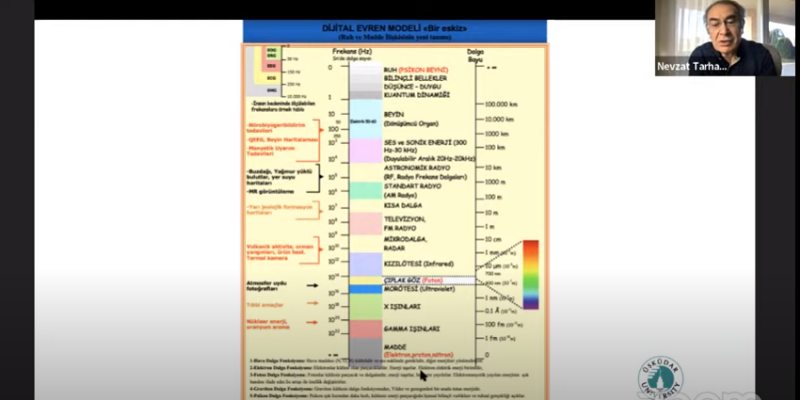
Making evaluations on the structure of the universe and the human model, Tarhan said; 'The model of the universe has transformed into a digital structure today. We live in a digital-based universe, not a matter-based or energy-based one. We need to look at humans from two neurogenetic perspectives: soul and neurobehavioral. The reason is that there is a mind above our brain and a consciousness within it. It has been revealed that our brain does not work in a closed circuit as previously claimed, but in an open circuit. Beyond the five senses, we also have other senses. There are magnetic senses, chemical senses, all of which have led to the learning of new information in science. In fact, in my latest book, I am dealing with the subject of rational belief. Spinoza and Einstein accepted nature as God. But nature is only a point in the vast universe. Beyond that, there is an amazing universe... There is a physical, metaphysical universe. Neurobehavioral and metacognitive perspectives are very important. As Mevlana said, one does not live in the world, one passes through the world. Whatever one believes in their philosophy of life, humans are not permanent in this world but temporary. A universal truth, death is the only rule. Only a very small energy band that we see is moving towards infrared Aref waves. A map of temperature changes is being produced.' he stated.
'People will become lonely with Metaverse'
Stating that global capital is working to establish a digital universe, Tarhan touched upon the possible effects of Metaverse. Tarhan said; 'With Metaverse, 5D, 6D will enter our lives. A virtual universe will be formed, where we will walk the streets, shop, and wander with our own 3D identity, with cryptocurrencies... And humanity will become extremely lonely and unhappy with the metaverse. Psychology professionals have a serious role to play. Digital technology and global capital will control the world by using this very effectively. Harari made a rightful emergence when he said 'we are the last free generation, the world is heading towards digital dictatorship', and awareness was created. Global capital, under the guise of philanthropy, is investing in a digital universe, intending to seriously control people and reduce the population. They say the new god is artificial intelligence. It is stated that these were discussed behind closed doors at Davos in 2018. Those who see themselves as God-kings then said, 'we must do this to gain control in the world.' They said, 'God is almighty, we can do this.' The winds of the future are blowing in this direction. Yes, the human brain is just an electronic circuit. We psychologists and educators are network creators in the brain. Educators create healthy networks, and we treat them.' he stated.
'We must be the subject, not the object, of the digital world'
Stating that humans are the only developing beings, Tarhan emphasized that we must be the subject, not the object, of technology. Tarhan said; 'Humans are the only beings capable of abstract thought. This is called the theory of mind. Living beings without the ability to think abstractly cannot be human. What makes humans human, unlike other living beings, is their ability to reason. Metacognitive genes are mentioned. One of the four genes is the feeling of searching for the meaning of life. Humans are the only beings who question this. Consider the rules of the animal kingdom apart from humans: eating, drinking, reproducing, and sheltering. But the human kingdom is not like that. Humankind has concerns such as self-development and building civilizations. While an ant continues to build its home the same way it did a thousand years ago, humans do not. Humans have a tendency to seek innovation. The risk-taking gene causes human development. Education and society blunt this gene. That's why we have a famous proverb, 'Don't invent things' (often used to mean 'don't make trouble'). Inventing is one of the most important features that provide the cultural legitimacy of the next generation. We must be open to new experiences and take risks. If we don't do this, we cannot catch up with 21st-century skills. We become objects of the digital world, not its subjects. We need to be producers, not consumers. My advice to young people is please be producers of the digital world. Be actors in the digital world; do not be used and directed. If a supercomputer and super young people come together, they will do super things. Humanity is not going for the worse; it is going for the better but experiencing fluctuations.' he said.
'It is very important for us to catch the revolutions of the 21st century'
Stating that being traditionalist is not the same as drawing nourishment from tradition, Tarhan emphasized the importance of following the 21st-century revolutions, noting that the Ottoman Empire missed the industrial revolutions. Tarhan said; 'A NATO strategy expert states that the first bullet of the digital world will be fired from the internet. We should approach digitalization not as users but as software developers. When talking about the changing world, 1.0 started with machines, 2.0 was the Titanic, the giant ship where the electrical revolution was first integrated. An iceberg sank the ship that English headlines said even God could not sink. With Industry 3.0, mechanical and electrical engineering were found. 4.0 saw BIG DATA and big data emerge. Today, there is a situation heading towards Metaverse. There is a great move towards digitalization. We missed Industry 1.0, 2.0, and 3.0, which started and continued during the Ottoman period. What is important now is not to miss the revolutions of the 21st century. Let traditionalists continue to be traditionalists. Being attached to traditions is good, but being a traditionalist is wrong. Young people in Turkey are thinking about and questioning these issues. If we cannot overcome mental transformation, rest assured that we cannot catch up with civilization. They will do it, and we will only apply it. If we want to be actors in the digital world, we need to make a mental transformation in civilization.' he stated.
'There is a gene for belief and finding God in human creation'
Stating that the concept of database is mentioned in the Quran, Tarhan made statements about the creation of the universe. Tarhan said; 'When Allah created the universe, He first created the database. The concept of Levh-i Mahfuz (Preserved Tablet) appears in the Holy Quran as its equivalent. When I researched the concept of Levh-i Mahfuz, I saw that it means the main book. That is, according to the belief of Tawhid, the creator of the universe must be one who first created knowledge, created science. Everything emerges from Allah's knowledge. The first thing created for humanity is knowledge. After that, He creates the universe, creates energy, and then establishes laws like chemistry and physics. In the initial creation, there is the creation of souls. He gathers all souls and asks, 'Am I not your Creator, your God?' Everyone says yes. This is not actually forgotten. When we are born into the world, there is a genetic code related to searching for and finding the Creator. They call it the belief gene, the God gene. In fact, this is a human gene for seeking refuge in a higher power, a gene for attachment. Mevlana calls this the feeling of love... But in this age, we direct the feeling of love towards temporary things. However, the Creator gave us that feeling to find Himself. That's why these seem forgotten, but no, they are not forgotten, only dormant feelings. In other words, this feeling exists within us as a potential, and not using it is our choice.' he concluded his words.
Reporter: Esmanur Tuna
Share
Request a Call
Other News
- Prof. Nevzat Tarhan: “Those with a mental filter are not afraid of the digital”
- Artificial intelligence doesn't eliminate the translator, it transforms their expertise!
- Social responsibility courses moved to the field
- Erasmus+ Orientation Week completed at Üsküdar
- Prof. Nevzat Tarhan: “Brain secretes ‘dark glue’ in social media lynchers!”