

Üsküdar Üniversitesi Founding Rector, Psychiatrist Prof. Dr. Nevzat Tarhan was a guest at the Psychology Career Days event organized by Istanbul Gelişim Üniversitesi. In the online event, Tarhan, who gave a presentation on “Psychology of Wisdom,” stated that the pandemic caused concepts such as self-knowledge, self-awareness, and self-management to come to the fore among people. Tarhan stated that the increasing value of wisdom psychology is one of the opportunities of this period; “Psychology of wisdom can be considered as an opportunity realized as a result of the Covid-19 period. Here, humanity's consciousness of self-knowledge awoke. After recognizing oneself, the concepts of self-management, self-awareness, and self-governance gained importance. Subsequently, the importance of recognizing one's social environment and being able to manage relationships was revealed,” he said.
Content
Prof. Dr. Nevzat Tarhan: “The Pandemic Caused the Psychology of Wisdom to Gain Value”
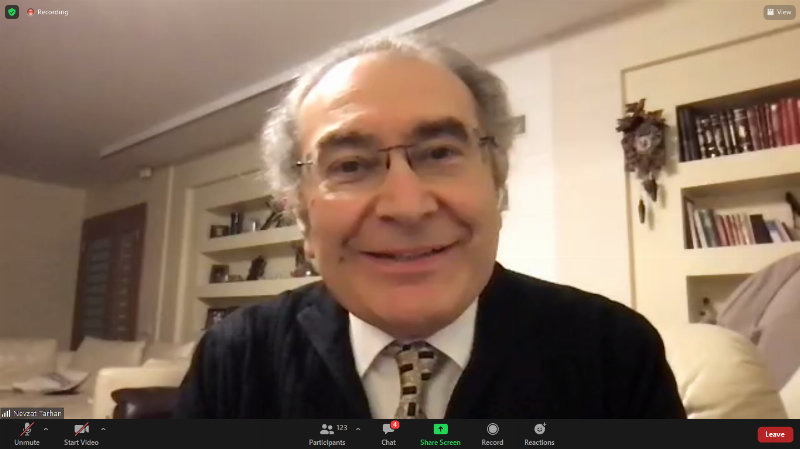
“Psychology of wisdom approaches science with a holistic perspective”
Tarhan began his speech with the history of the psychology of wisdom, giving examples of how the concept is applied in Turkey and around the world. Prof. Dr. Tarhan said; “The psychology of wisdom emerged as a result of a holistic perspective approach to science. In 2014, Arizona, California, and Columbia Universities published a manifesto. The manifesto's name is “The Post-Materialist Science Manifesto.” They published a manifesto under the name of post-materialist science, stating that there is a need for post-materialist science that explains all truth. The project's name is “Galileo Project.” We translated that manifesto and published it on our school's website. After realizing this new perspective, as Üsküdar Üniversitesi, we proposed to YÖK (Council of Higher Education) to open a research center where social sciences, religious sciences, and natural sciences would be taught together. For this, we did not request any public allocation or budget. However, we received a negative response. When we asked for the reason, they replied, “religion is separate, science is separate.” In this field, our country first needs a mental transformation. Without mental transformation, there will be no social transformation, and without social transformation, there will be no economic change or development in civilization. We need to change the walls in our minds.”
“The work titled Wisdom Psychology is a series consisting of two books”
Tarhan, evaluating the contents of the two-book series titled Wisdom Psychology that he authored, drew attention to the connection between neuro-science, psychology, and quantum physics. Tarhan said; “The 20th century was the age of information, the 21st century is the age of wisdom. This became even more prominent after Covid-19. In my first book titled Wisdom Psychology, I used 'Spinoza's Error' and 'The Evolution of Evolution' as the second subtitle. The main theme of the second book is especially the art of finding what is good, true, and beautiful. The first book contained information about a person's search for meaning in life and existence, self-consciousness, the concept of ego, philosophy, psychology, and neuroscience. The most important issue that Arizona University's manifesto focused on is the developments in neuroscience and consciousness studies. It says there cannot be anything more important than finding answers to these questions: ‘Who am I? Where should I go? What is the meaning of life? Why will I die? Why will I study?’ It is necessary to find an answer to the question of why the universe exists, rather than how. Max Planck, the founder of quantum physics, found this answer. In the book, I also tried to build a bridge between neuro-quantology and science. There is a connection between neuroscience, psychology, and quantum physics. Without quantum consciousness, we cannot truly understand a human being. The human brain works in connection with the universe. Mirror neurons in the frontal region of our brain can communicate with mirror neurons in the other person's brain. There are also emotional mirror neurons. There is communication between the other person's emotion and your own emotion. Brains communicate with senses like a sixth sense. After all these discoveries, psychology studies took a very different direction.”
“The integrity of scientific fields means wisdom”
Tarhan emphasized the integrity of sciences and touched upon the impact of managing emotions on human development. Tarhan said; Neuroscience and social psychology became intertwined. In such situations, the integrity of sciences emerged. The integrity of sciences also means wisdom. Wisdom means being able to question one's own knowledge. Accepting uncertainty and change in the universe, accepting that one is part of the social structure, and questioning the meaning of life are all very important. These are also referred to as 21st-century skills in the book. The most important skills of the 21st century are emotivism. Emotivism is a situation we know as emotional transfer, empathy. Until the 1990s, emotions were not considered a scientific category. They were considered the domain of poets, artists, and musicians. After the 1990s, once the brain's emotional interrogation areas and how they work were discovered, emotions began to be seen as a scientific category. The management of emotions came to the forefront with science. Successfully managing emotions is very important for a person's self-development. Currently, there is a test called CERQ. Cognitive Emotion Regulation test. We measure emotions to regulate them, provide treatment, and then measure again. We observe how many percent have improved. We find weak and strong areas and determine the behaviors that the person needs. For this reason, in 2013, we introduced positive psychology as a rectorate course for the first time in Turkey. Harvard introduced it in 2015, and Yale University in 2018. Then Yale University opened it to the public in 2021 and made it a civic course. 3.5 million people subscribed to the course. Bristol University introduced it in 2019. They announced this science as a course against the suicide epidemic.”
“With Covid-19, humanity's consciousness of self-knowledge awoke”
Tarhan stated that the pandemic caused concepts such as self-knowledge, self-awareness, and self-management to come to the fore among people, and expressed that the increasing value of wisdom psychology is one of the opportunities of this period. Tarhan said; “Psychology of wisdom can be considered as an opportunity realized as a result of the Covid-19 period. Here, humanity's consciousness of self-knowledge awoke. After recognizing oneself, the concepts of self-management, self-awareness, and self-governance gained importance. Subsequently, the importance of recognizing one's social environment and being able to manage relationships was revealed. The greatest leadership, in fact, is a person being their own leader. Someone who cannot lead themselves cannot lead a family. For example, a mother who cannot lead herself, we see that her child does not listen to her because she cannot lead the child. If a teacher in a classroom cannot manage their own emotions, desires, and impulses, they cannot control the students and try to get results by instilling fear. We teach how a leader is raised. What we call positive psychology is actually the systematized, scientific methodology of knowledge taken from Mevlana and Anatolian wisdom. In fact, what we call positive psychology is a version of wisdom psychology under the name of the science of happiness. Engaging with positive psychology is actually taking the first step related to wisdom. Gaining empathy skills, gaining social consciousness, conciliation, sharing, gratitude training, forgiveness, all of these are taught there in modules.”
“3 human types in psychology: Sponge, Teflon, rubber type”
Tarhan, touching upon mental flexibility in wisdom psychology, evaluated three types of people. Tarhan said; “In the second part of the second book of the work Wisdom Psychology, I especially tried to address the concept of story. Because the human brain forgets didactic information after a while, but when you tell a story, it becomes permanent. Storytelling is what makes the brain work the most. What we call personality is actually, when we look at the past, life stories, experiences, traumatic events, shock experiences, and beautiful stories. All our experiences are an accumulation of stories. Being human actually means life scenarios. If you adapt to good and bad experiences in life, this is called cognitive flexibility, or mental flexibility. There is mental flexibility in wisdom. How to be wise in stress management? When faced with a stressful event, there are sponge-type people. Sponge-type people take all the burden upon themselves; they are overly self-sacrificing and overly giving. In the end, they fall into depression and collapse. Many candidates for depression emerge from sponge-type people. The second type of person is Teflon-type people. You know Teflon pans; they don't burn themselves, but they burn what falls into them. These are narcissistic people. They crush the people they live with and establish master-slave relationships. They have a high stress load because they always need to be alert to stay upright. They need to be nourished with praise and constant attention, meaning when they don't receive attention and praise, they feel empty and fight with themselves. The third type is rubber-type people, which is the wisdom skill we recommend. For rubber-like people, it's called resilience. This concept means psychological robustness, resistance, and endurance. What is there in resilience? When under stress, they stretch; when the stress is gone, they return to their original state. They even learn things and internalize them as they go. These people stretch but do not break apart; they do not change their essence or identity.”
Share
Request a Call
Other News
- The book that read today's digital threats in 2014: Being a Conscious Family
- Experts warn: 'Instead of memorizing letters, teach pencil grip, scissor use, and coloring'
- School fear and school love both start in the family!
- Family is not merely transforming, it is being battered under a serious assault
- Artificial intelligence opens the door to early diagnosis in autism!