

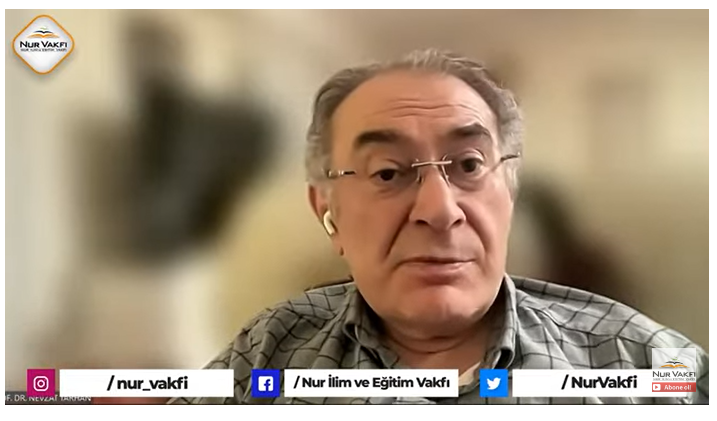
Üsküdar University Founding Rector Prof. Dr. Nevzat Tarhan participated in the panel on 'Be' organized on the anniversary of Bediüzzaman Said Nursi's passing. Speaking about the traumatic effects of the earthquake during the online program, Tarhan said, "If a person's perspective on trauma is correct after experiencing it, they begin to grow by looking at the opportunity dimension of that trauma, rather than its threat dimension."
Content
Prof. Dr. Nevzat Tarhan: "The opportunity dimension of trauma, not the threat, leads to growth"
"After the shock period, the period of meaning-making begins"
Prof. Dr. Nevzat Tarhan stated that people in the earthquake zone experienced primary trauma, while those outside the earthquake zone experienced secondary trauma. Tarhan provided information about the meaning-making period that occurs after the effects of the post-earthquake shock period. Tarhan said, "Meaning-making after trauma is generally recommended after 2-4 weeks. It can happen earlier depending on the person's capacity, but making sense before 2-4 weeks causes pain to the individual. Statements like 'it could be worse' completely fail to understand the suffering people at that moment, showing no empathy at all. Because the need of a person suffering at that moment is to feel that they are not alone, to feel that their emotions are shared. There are so many people experiencing pain that the brain, due to excessive cortisol secretion triggered by anxiety, becomes blocked and stares blankly. The brain stops new information from entering. Forget adding meaning, it stops new information from entering to avoid disintegration, and the brain protects itself at that moment. In such a situation, well-intentioned words said to a person, like fate or consolation, only increase their pain to prevent disintegration. This shock period ends after 2-4 weeks; then the period of meaning-making begins. After that, the visible reasons, invisible reasons, material reasons, and spiritual reasons of the event are tried to be addressed." he explained.
"Uncertainty is a kind of test for a person"
Prof. Dr. Tarhan; "We see the most beautiful example of religious coping methods in Risale-i Nur. While explaining those coping methods in the treatise for the sick, calamities and natural disasters actually have two dimensions. One is the threat dimension, and the second is the opportunity dimension. Geoscientists always focus on the threat dimension, talking about what might happen. They further increase people's anxiety and worsen their mental health. However, they should speak based on evidence: there is this in this part of the earth, this much energy has accumulated, and that accumulated energy will likely be released within this much time. They should perform mathematical modeling, calculate the probability of an earthquake of this magnitude within that time, and speak based on evidence. They don't do that; they only talk about their own assumptions and opinions. This causes uncertainty in people and puts them under stress. Uncertainty about the future causes more fear and constant vigilance than going to prison or receiving a penalty. In such situations, uncertainty is a kind of test for a person. The threat dimension is being discussed; it is necessary to talk about the opportunity dimension." he said.
"Looking at the opportunity dimension of trauma, not the threat, leads to growth"
Prof. Dr. Tarhan; "Bediüzzaman Hazretleri, especially in the 'Lem'alar', says, 'Life purifies, matures, gains strength, progresses, yields results, perfects itself, and fulfills its vital duty through calamities and illnesses.' Now, we have post-traumatic growth scales that we apply here. If a person's perspective on trauma is correct after experiencing it, looking at the opportunity dimension of that trauma, not the threat, leads to growth. For example, after such an event, they might say; 'I started to care more about my relatives. I started to give more importance to spiritual values. I started to appreciate what I have more' which leads to spiritual development and maturation. We call such traumas 'developmental traumas'. So, if we approach this earthquake event as a developmental trauma by looking at its opportunity dimension, this trauma will lead us in a good direction. We will suffer in the short term, but it will develop us positively in the medium to long term." he stated.
"If a person experiences rituals, they overcome problems more easily"
Prof. Dr. Nevzat Tarhan stated that rituals applied in traumatic situations help people overcome trauma. Tarhan; "In such a situation, those who experience trauma, those who lose their loved ones, need to return to normal within the first eight weeks. If a person 'mummifies' this trauma, if they experience a trauma, a blow, an earthquake that happened two months ago as if it happened yesterday, they cannot carry it, they cannot cope. They need to gradually miniaturize it, make it smaller. If they fail to miniaturize it within eight weeks, then expert treatment is needed. That person develops post-traumatic stress disorder, which has symptoms. The moment you close your eyes, everything passes before your eyes like a film strip, they think about this for 50 out of 60 minutes, their television is constantly on. They even fear sleeping because they have many dreams related to it at night, the fear of earthquakes continues, and avoidance behavior emerges. They run away but experience the same fear wherever they go. There are people who sleep with a whistle around their neck and a helmet on their head. They live with this fear to that extent. Therefore, this needs to be resolved. People need to experience the pain of their losses. If a person experiences those rituals, they overcome problems more easily. Otherwise, problems turn into other illnesses. If they don't experience that pain, that sorrow, if they suppress their emotions, that person feels guilty because they cannot experience the pain. Chronic trauma disease emerges." he said.
"Fate does not only test them, it tests all of us"
Prof. Dr. Nevzat Tarhan talked about the importance of empathy. "After the earthquake, I witnessed many people saying 'I feel guilty' while eating, drinking tea, or drinking water. This is actually a very high, beautiful emotion. Feeling this shows that we are human and that we have a good human side. You empathize with that person, you understand them, you try to share their feelings, and it is important that the feeling of wanting to help follows this. They are going through a test, a calamity, they are in tents, in containers, they are hungry, they lost loved ones, they are in a disadvantaged situation. And there are people like us who live in other cities and are not first-degree victims of the earthquake. We are advantaged compared to them; their test is to be patient in the face of such a calamity and not fall into despair or pessimism. Our test is the responsibility to help them. If, in such a situation, we cannot do anything to help them, understand them, comfort them, or help the weak, then it means we are also failing this test. Therefore, let's not think that fate only tests them; it tests all of us." he expressed.
"If you believe in the existence of Allah, you will draw spiritual lessons from calamities"
Prof. Dr. Nevzat Tarhan talked about the importance of belief in Allah in the face of calamities. Tarhan; "When reading the Quran regarding faith, if a person's questions about faith are resolved and then they read it asking 'What message is the Creator of this universe sending me?', they will benefit. If they read it with a critical eye, they will not. If you believe in the existence of Allah, you will draw spiritual lessons from calamities. Allah speaks to people through events, in the language of incidents. These events are incidents; Allah does not speak directly to us, but speaks in a language that those who use their minds can understand." he said.
Share
Update Date: March 01, 2026
Creation Date: March 23, 2023
Request a Call
Other News
- The book that read today's digital threats in 2014: Being a Conscious Family
- Experts warn: 'Instead of memorizing letters, teach pencil grip, scissor use, and coloring'
- School fear and school love both start in the family!
- Family is not merely transforming, it is being battered under a serious assault
- Artificial intelligence opens the door to early diagnosis in autism!