

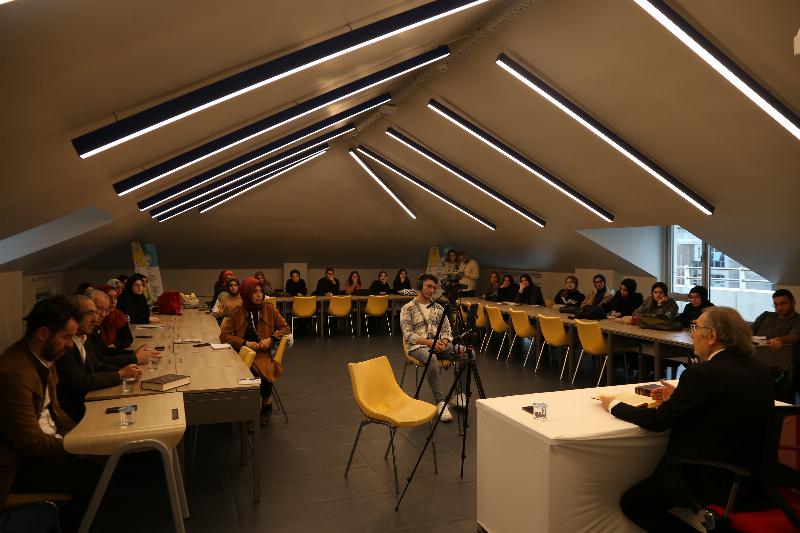
With the support of the Directorate of Health, Culture and Sports of Üsküdar Üniversitesi, the 'Conversations on Existence with Üsküdar Üniversitesi Founding Rector Prof. Dr. Nevzat Tarhan,' organized by the Conscience of the Age Club, continue. This week's topic for the program was 'The Psychological Dimension of the Story of Prophet Jonah.' Tarhan, who defined narcissism as a person living by forgetting the meaning of their existence, emphasized that everyone who disconnects from the meaning of existence is a candidate for narcissism.
Content
Prof. Dr. Nevzat Tarhan: “One who disconnects from the meaning of existence is a candidate for narcissism”

“Prophet Jonah’s prayer is a very great supplication”
In this week's Conversations on Existence program, Prof. Dr. Tarhan made evaluations by reading chapters from the Risale-i Nur work regarding the psychological dimension of the story of Prophet Jonah. Initially sharing insights about the story of Prophet Jonah, Tarhan touched upon the importance of Prophet Jonah’s prayer. Tarhan stated; “Prophet Jonah’s supplication, his prayer, is one of the most resolute prayers. It is a very great supplication. The greatest means of acceptance is prayer. It is a means to achieve the reasons for prayer. It is a deeply moving prayer that provides the means to attain the outcome related to why you performed the prayer's need. The summary of Prophet Jonah’s story is that he was cast into the sea. A large fish swallowed him. The sea was stormy, and the night was rough and dark. In a state of hopelessness from all sides, the supplication 'La Ilaha Illa Anta Subhanaka Inni Kuntu Minaz Zalimin' quickly brought him salvation. Before Prophet Jonah was cast into the sea, revelation came to him. It was revealed that if they did not reform or improve after forty days, disaster would befall them. On the thirty-ninth day, he couldn't wait one more day; Prophet Jonah showed impatience, became angry and frustrated, and somewhat thought he had fallen into the situation of a false prophet, so he left and boarded a ship. When a storm broke out on the ship, there was a custom to draw lots and throw one person into the sea. Lots were drawn for one person, with the belief that if that person died and was sacrificed, the storm would subside. Before the lots were drawn, Prophet Jonah said, 'I am the sinner, throw me into the sea.' He said, 'I turned back without waiting for Allah's message to the very end. I made a very big mistake; I wronged myself. I became one of those who wronged my soul, throw me into the sea,' and they cast him into the sea. According to the narration, because he was thrown into the sea with that regret, a Jonah fish – which in some narrations, like in the Torah, is referred to as a whale – but now in the strongest narration, it is called a Jonah fish. He escapes from it. He reaches the shore. After reaching the shore, Allah protects him there with a special tree until he recovers. Later, he goes and sees that his people have been saved. He is surprised and then even wishes to die, thinking he has become a liar, but then he repents.”
“Whoever says 'I killed my ego' is riding on the horse of their ego”
Tarhan stated that the concepts referred to as 'good and bad parts' within a person in psychology are termed as 'nafs' (ego/self) in Islamic literature; “Prophet Jonah’s saying, ‘I became one of those who wronged my soul,’ as you know, in psychology, we all have a good part and a bad part within us. What is the good part? It sends us to a good place; this heart is our good part. The bad part is our ego/self. Zulm (wrongdoing/oppression) means to suppress or act unjustly. Even a prophet commits sins. The characteristic of prophets is that their sins are forgiven. Otherwise, they can also make mistakes; they are human after all. Our Prophet said; ‘I am not a king; I am a human being who grew up on dry bread, just like you.’ So, for this reason, it’s about being human first, then prophethood. For a person to achieve something, it is not comfortable, it is not without trials; a trial means the ego coming into play. If a person says 'I killed my ego,' they are riding on the horse of their ego. Nafs (ego/self), Lady Aisha even says, 'Whoever says "I am among the good," is among the bad. Whoever says "I am among the bad," is among the good,' and this is referred to as being between 'havf' (fear) and 'reca' (hope). Being between death, hope, and fear. You will live with this feeling of being between hope and fear. Caliph Umar says, 'If one person enters hell, I fear it is me; if one person enters heaven, I hope it is me.' Similarly, if a person is between hope and fear, because it's like that in psychology until their last breath, it's not possible for a person to say 'I am successful.' Success is cumulative success; it becomes clear at the end of life. Servitude to God is also cumulative servitude. It becomes clear at the end of life. No one should say 'I am a good servant, I am among the saved, I am a saint.'” he noted.
“Religious narcissism is deception”
“The psychological equivalent of a person who says there is no ego or bad part within them is narcissism. To say 'I don't make mistakes, I am good, I am enlightened' is religious narcissism. If someone says 'I am enlightened, I am a saint,' that person is a narcissist. Now, a person with religious narcissism will also say 'I am a saint.' They make everyone read (from them), extend their hand for kissing; this is also religious narcissism, no offense. If you encounter such a thing, if you encounter such a religious leader, question them. It is religious narcissism; they are a deceiver. People should not fall for their tricks, because there are many such people in the market. This bad part grows with praise, feeds on applause. But feeding on human applause is a trap; it is the trap of narcissism. Narcissists play the role of a modest person very well. When thought and emotion fuse and intertwine, a thought comes to a person's mind. They mistake it for an emotion. They fear and say, 'Blasphemy against Allah has come to me.' That is, a thought comes into them, a feeling comes, and they say, 'Oh no, I've strayed again.' However, it is necessary to separate emotion and thought. It's a fusion. Because emotion and thought are neighbors in the brain. Emotion and thought are neighbors in the human brain, such close neighbors that, for example, when gunpowder comes to mind, an explosion comes, right? The idea of gunpowder reminds one of the feeling of explosion. There is a thought-emotion fusion there. Thought and emotion are mixed, intertwined. Therefore, when we say 'nafs' here, there is the training of emotions, which is the discipline of the nafs. There is also the training of thought separately. That is referred to as the cognitive side. Therapy is cognitive therapy, but cognitive therapy doesn't work without emotional therapy. If you don't correct emotions while correcting thoughts, you cannot manage thoughts. Because you cannot sustain thoughts. When thought is affected by emotion, it turns into belief. If you sustain belief, it turns into a habit. If you sustain a habit, it turns into personality after six months. At least six months. When you learn and develop a behavior, at least six months of repetition are required for behavior development to be permanent,” he said.
“Narcissism is a person living by forgetting the meaning of their existence”
Stating that “
Share
Update Date: February 26, 2026
Creation Date: December 06, 2022
Request a Call
Other News
- Experts warn: 'Instead of memorizing letters, teach pencil grip, scissor use, and coloring'
- School fear and school love both start in the family!
- Family is not merely transforming, it is being battered under a serious assault
- Artificial intelligence opens the door to early diagnosis in autism!
- Artificial intelligence doesn't end engineering, it transforms it!