

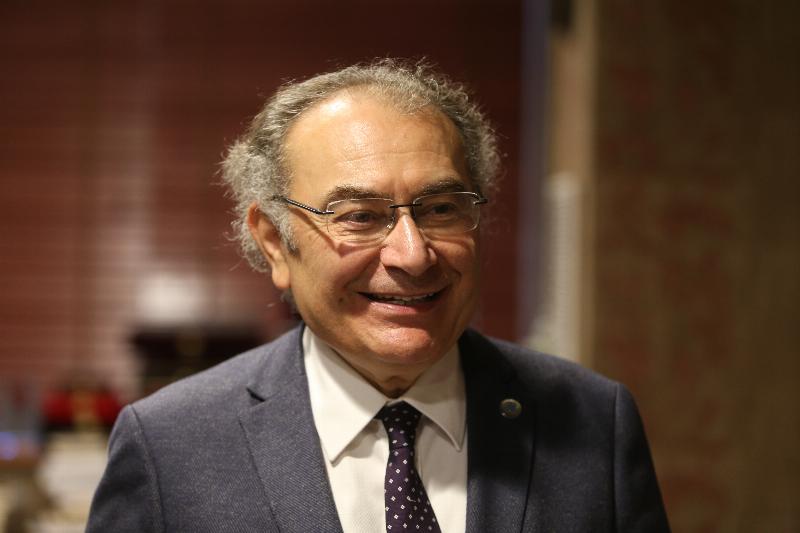
Founding Rector of Üsküdar University, Psychiatrist Prof. Dr. Nevzat Tarhan, was the live broadcast guest of the interview organized periodically by the Ankara Culture and Education Foundation. In the interview titled “Obsession,” Tarhan made evaluations about people with obsessive thoughts, saying; “People with obsessive thoughts do not have mental flexibility. They follow their nose. Instead of persevering in what is right, they tend to persevere in what is wrong. The rate of obsessiveness in the world does not change by country. Only the area of obsession changes,” he said.
Content
Prof. Dr. Nevzat Tarhan: "We call obsessions uninvited guests at the door of the house."
“If the heart believes, the brain obeys it”
In the online program, Prof. Dr. Nevzat Tarhan stated that the heart is actually the commander. Tarhan said; “Man has intellect, ego, heart, and spirit. These are all separate faculties. The ego desires, craves, wishes. The ego always wants. Greed, insatiability insistently desires, longs for, and waits. The heart also regulates emotions. Humans make not only logical decisions but also emotional ones. What is called the heart is not actually the physical heart. The word 'kalp' (heart) already comes from the word 'inkılap' (revolution, transformation). It means to transform, to revolutionize, to turn around. The heart takes thoughts from the brain, mixes them with emotions, adds meaning, processes them, and makes decisions. If the heart believes, the brain obeys it. Therefore, the heart is actually the commander. The commander of our spiritual structure is the heart, but the function of the spirit here is to be the part of us that connects with Allah. The spirit is a program. Just as there is a fixed, unchanging software program in a computer, that is what the spirit is, but the spirit expresses itself through various faculties in the brain: ego, heart, intellect. Intellect and heart cooperate to make accurate decisions, while the ego pulls towards the bad side.” he spoke.
“Today's greatest miracle is steadfastness”
Prof. Dr. Nevzat Tarhan mentioned that the ego harms humans not alone, but together with Satan. Tarhan said; “Actually, when the ego's desire and Satan's whispers combine, it becomes Hannas. The ego desires, wants, and Satan gives whispers. When these two combine, they start to pressure the heart and misguide it. The ego alone cannot harm; it harms together with Satan's whispers. The ego desires, and the person says; ‘This is not beneficial for me, it is harmful.’ but Satan makes a person think in such a way, entering from the right, entering from the left, making it seem beautiful. When it seems beautiful, the ego begins to lean towards it. The power of emotion in the ego, the power of feeling in the heart. The power of desire, the power of pleasure in the ego, the power of feeling, the power of emotion in the heart. It puts pressure on it. The intellect, on the other hand, is the captain's bridge. It is the frontal region of the brain. It says, it performs cost-benefit analysis. Appropriate-not appropriate, sufficient-not sufficient. The frontal region of our brain makes decisions. Therefore, if you ask what today's miracle is, today's greatest miracle is steadfastness. Let's not seek any other miracle; the greatest miracle is to remain steadfast against Hannas. How does the spirit come into play here? Ihsan comes into play in the spirit's involvement. Now, normally we do not see Allah, but Allah sees us. If we have opened our hearts to Allah, and in such situations, we have sought refuge in Allah from Satan and Hannas, when we open our hearts to Allah, Allah's attribute of Ihsan manifests, and Allah protects us. But we need to open our hearts to our Lord. When we do not open it, when we start looking for methods on our own, that Ihsan does not come. When Ihsan does not come, we act according to our own minds and make mistakes.” he said.
Uninvited guests at the door of the house: Obsession and compulsion
Tarhan spoke about how intrusive thoughts grow when we give them importance and shrink when we don't; “For intrusive thoughts, for obsessive compulsions, we call them uninvited guests at the door of the house. If an uninvited guest immediately comes to your door, even someone you don't like or approve of, would you immediately let them in? You wouldn't. You don't know who or what they are, and they are uninvited, you wouldn't let them in. If you let them in and ask them why they came, what their business is, what they are doing, they will stick around even more and stay there. If you close the door and ignore them, they will wander around and eventually leave. It's the same with intrusive thoughts, but this is true in the initial stage of intrusive thoughts. Once they progress, this method no longer works. Here, he's referring to the very initial stage of intrusive thoughts, for example, let me give an example. A mother holds her child in her arms, and while standing by the window, a thought suddenly comes, an intrusive thought, we also call it a parasitic thought. It says; ‘What if I throw this child out of this window?’ Because a mother loves her child very much, values them greatly, and has invested a lot of emotion in them, this thought comes to her mind. Most mothers have that. Mothers check their child's breathing at night. That is, they go into excessive protection due to an abundance of love and compassion. Intrusive thoughts come to such people. When they come, a healthy-thinking person says; ‘I'm in my right mind, I'm not sick, I'm not anything, why would I throw them out? It's absurd,’ and immediately changes the subject, and the intrusive thought immediately fades away. The more importance you give it, the more it grows; if you don't give it importance, it shrinks. If you are afraid, it increases; if you are not afraid, it decreases.” he stated.
“Despite no harm, they suffer when they believe it is harmful”
Prof. Dr. Nevzat Tarhan pointed out that dwelling on anxieties and intrusive thoughts is harmful; “The harm of intrusive thoughts is to imagine harm, to be anxious. That is, to imagine harm is to be harmed in the heart. Despite there being no actual harm, they suffer when they believe it is harmful. When these individuals' brains acquire a physical dimension of illness, we take brain images. In brain imaging, it appears as if there is a battle in these individuals' brains. Signal flow in the brain is disrupted. Substances like serotonin and dopamine in the brain often decrease and slow down. The brain starts to work in slow motion. It cannot decide and solve its problems. Because it perceives a baseless imagination as reality. Currently, this approach, which we call a psychiatric analytical approach, analyzes the event. Fantasizing, believing in fantasies. It becomes believing in a wrong fantasy. It perceives reality as imagination. This perception of a baseless imagination as reality also allows Satan's work to take root in one's heart.” he spoke.
“Our brain works like traffic”
Prof. Dr. Nevzat Tarhan talked about creating a 'pyramid of importance' in treatment. Tarhan said; “When intrusive thoughts come, imagination kicks in. Intrusive thoughts provide a trigger, a suggestion. Imagination then weaves according to it. Giving importance, loving one's child very much. That's why in treatment, we create a pyramid of importance. What is the most important thing for that person? Obsessive compulsions start more in things they deem important. There are no obsessions in things they don't deem important. ‘Why are prayers (namaz) present in worship but not in other matters?’ Because that person gives great importance to prayer, it catches them there. Or a mother doesn't want her child to be harmed. This is the point of importance. Imagination gets stuck on it as it passes. Because they give it importance, there are reference points related to it all over the brain. Our brain works like traffic. There is information traffic, energy flow, information flow. In things given importance, the brain invests there concerning that. When something comes to mind, they say, for example, ‘I need to distinguish between what is important and what is more important.’ They might say, ‘This is very important, this is less important.’ If it's important, they dedicate more time to it, dwell on it more. If it's not important, they overlook it. A file of important information is formed in our brain. In our brain, there are files for very important information, less important information, unimportant information, and suspicious information. Our brain labels information like this. For example, we have a file for a four-legged chair in our brain. If you see a three-legged chair, the brain doesn't put it in the chair file. It opens a 'broken leg' file and puts it there. As information circulates in the brain, important information stands out like cornerstones, like traffic signs. It constantly reminds that 'this is important.' Because it reminds, imagination easily latches onto it.” he said.
“Showing the biological dimension is very effective in therapies”
Tarhan made evaluations on how the brain eventually gains a physical dimension; “There is a mind above the brain. We say; ‘Look, this has captured your mind.’ The brain's erroneous production, its thought. When the patient sees it, they say; ‘This was not in my control,’ they accept treatment, and after a while, as the brain and that infrastructure improve, we gradually see this in treatments: First, when that thought, that feeling comes to mind, those people suffer internally; I know someone who stabbed himself, he wounded his abdomen, and we admitted him to the hospital. He had stabbed his abdomen to kill the intrusive thought; the knife wounded him, and third-degree stitches were applied. When he recovered, the man laughs and says, ‘How did I do this?’ The brain rules at that moment; that is, after a while, the brain gains a physical dimension and makes one do it automatically. If this happens before it reaches the automatic point, since the person has control, they say ‘Oh, come on’ and overcome it. If it has progressed too much, that person can no longer do it; treatment is needed. After treatment, when the underlying brain infrastructure improves, they start to be able to do it. When it has progressed, it is necessary to correct that underlying brain infrastructure, the chemical communication. Showing the biological dimension is very effective in therapies.” he spoke.
“Our brain can connect to another person's brain”
Prof. Dr. Nevzat Tarhan talked about proportionality being in everything; “Human brain cells, we have mirror neurons. They communicate and connect clearly and precisely with the nerve cells in the other person's brain. Our brain can connect to another person's brain. For example, there are motor mirror neurons, mirror cells in the brain. When you lift your hand, the nerve cells in the same region of the other person's brain also become active. Brain imaging shows this. Similarly, there are emotional mirror neurons. You feel excessive love, and the other person suddenly turns and looks at you. When you look at them with strong emotions, they also turn and look at you. That is, there's nothing in between, you haven't said anything, your voice hasn't been heard. It triggers the mirror neurons in their brain, and they turn and look at you. This might seem absurd to a person, but currently, this is its neuroscientific explanation. Allah has linked this to causes. He says it works like this in the brain. For example, it calls it connectivity, 'sırr-ı münasebet' (secret of relation). This is referred to as proportionality; proportionality exists in everything.” he said.
“Satan brings bad things, things that will harm a person, to mind”
Prof. Dr. Nevzat Tarhan mentioned that in his book ‘Psychology of Emotions,’ he divided emotions into positive and negative emotions. Tarhan said; “Intrusive thoughts are merely in the form of reminders. Of course, I am not a theologian, but according to my observations, Satan's whispers have no coercive power. Satan only brings things to a person's mind. Satan brings bad things, things that will harm a person, to mind. The angel, on the other hand, brings positive things to mind. Whichever side a person invests in, they advance more in that direction. In the book 'Psychology of Emotions,' I divided emotions into positive and negative. It addresses positive and negative emotions separately. It depends on a person's personality, morality, and value system. Religious people have a difference. For example, one day a mother came to me. She said, ‘I worship my child.’ Allah has given us all a feeling of attachment. Some attach themselves to possessions, some to the world, some to money. But Allah gave that feeling of attachment as a test, so that my servants would attach themselves to Me. When Rumi says ‘love, love, love,’ he is actually trying to make that feeling of attachment connect to Allah.” he stated.
Reporter: Ebranur Özdemir
Share
Update Date: March 01, 2026
Creation Date: July 22, 2022
Request a Call
Other News
- The book that read today's digital threats in 2014: Being a Conscious Family
- Experts warn: 'Instead of memorizing letters, teach pencil grip, scissor use, and coloring'
- School fear and school love both start in the family!
- Family is not merely transforming, it is being battered under a serious assault
- Artificial intelligence opens the door to early diagnosis in autism!