

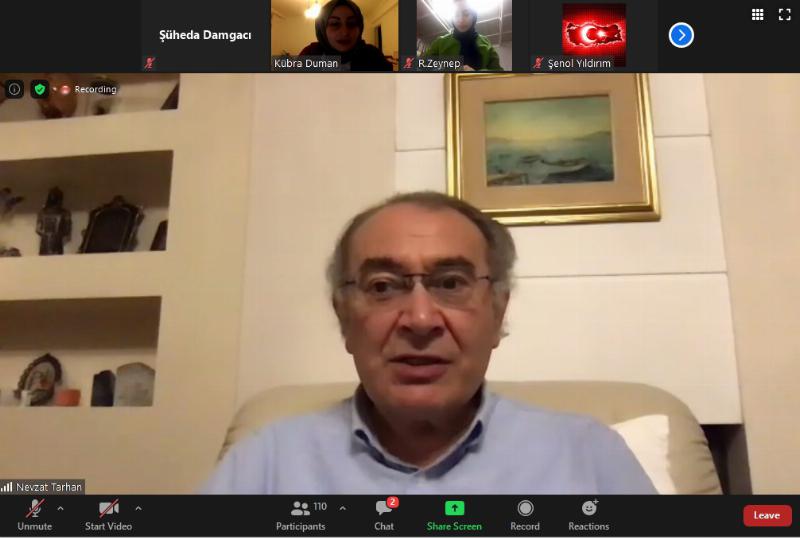
Üsküdar University Founding Rector Prof. Dr. Nevzat Tarhan, participated as a speaker in the program organized by Sakarya Provincial Directorate of National Education within the scope of the “Psychological Counseling and Guidance Festival”. Tarhan made evaluations under the title of ‘Positive Psychology in Education’ in the program, which attracted great interest from educators. Tarhan, drawing attention to the importance of new truths in education; stated, “If we cannot give new answers to new questions, we cannot reach the youth.”
Content
Prof. Dr. Nevzat Tarhan Met with Educators from Sakarya
“Positive Psychology course increases emotional intelligence by 20%”
Prof. Dr. Nevzat Tarhan, stating that a new branch of science called the Science of Happiness has emerged in recent years; “The Western world discovered this. Its official equivalent is Positive Psychology. Harvard University in 2015, Yale University in 2017, and Bristol University in 2019 started to teach it as a course. On the website of Bristol University in England, it says, ‘We introduced this course as a solution to the suicide epidemic.’ As Üsküdar University, we started teaching this course before Harvard University, in 2013. We conducted pre-tests and post-tests for the students who took this course. After taking this course, students stated that their relationships with their fathers and friends improved, they could better control their anger and nerves, and they felt better about themselves. We found that the emotional intelligence of these children increased by 20 percent in the courses. When we look at the course content of positive psychology, there are topics such as self-awareness, self-consciousness, knowing others, social consciousness, empathy, self-management, relationship management, and gratitude education. In addition to these topics, there are modules such as the conciliation module, forgiveness module, and motivation module. With these modules, we provide children with life success along with academic success. Wisdom education is very important in this context. As a society and as an education system, we must be able to achieve this.” he stated.
“Sustainable happiness is the best kind of happiness for our nervous system”
Tarhan stated that psychologist Martin Seligman and his team define positive psychology as authentic happiness, “Authentic happiness is pure, genuine happiness. If a person can be happy whether in prison or in a palace, this happiness becomes sustainable happiness. It contains both pleasure and tranquility. This type of happiness is the best for our nervous system. Here, our parasympathetic nervous system works and tells the person, ‘calm down, everything is under control, everything is going well.’ Such happiness reduces the stress level in our body.”
“If we cannot give new answers to new questions, we cannot reach the youth”
Tarhan, drawing attention to the importance of giving new answers to new questions in education; “We cannot give old answers to new questions. If we cannot give new answers to new questions, we cannot reach the youth. In old truths, there was passive learning. This is the classical learning model. The teacher would explain, the student would listen, and it would end. Now there is active learning. The student learns by trying and experiencing it themselves. Currently, children do not learn all information in the classroom. This type of learning is a convenience brought to us by neuroscience. Information written on sand is lost, but information written on stone remains. Information gained through seeing and hearing is forgotten. But learning that involves all five senses is not easily forgotten.” he said.
“There are four metacognitive genes that distinguish humans from other living beings”
Prof. Dr. Nevzat Tarhan stated that there are four important metacognitive genes that genetically distinguish humans from other living beings; “These are currently referred to as meta-cognitive genes being worked on. The first characteristic of these four genes is the meaningfulness gene; no living being other than humans asks the question ‘why,’ every event receives the same reaction. But humans give different reactions to the same event. Why? Because humans have free will and this is related to the need for meaning-seeking. The search for meaning is an important meta-cognitive feature in humans. The other feature is the innovation-seeking gene in humans. This innovation-seeking gene means that humans do not build the same house as humans did a thousand years ago. But if you look at an ant or a spider, they are the same as they were a thousand years ago. The third feature is related to the concept of time in humans. Humans have a genetic code; no living being other than humans questions time, such as what will happen in the future, or what will happen to our children. The fourth is related to the consciousness of death; these are genetic codes. These are currently being studied.” he stated.
Share
Update Date: February 26, 2026
Creation Date: October 19, 2020
Request a Call
Other News
- The book that read today's digital threats in 2014: Being a Conscious Family
- Experts warn: 'Instead of memorizing letters, teach pencil grip, scissor use, and coloring'
- School fear and school love both start in the family!
- Family is not merely transforming, it is being battered under a serious assault
- Artificial intelligence opens the door to early diagnosis in autism!