

Psychiatrist Prof. Dr. Nevzat Tarhan, who attended the WIHU’20 5th Congress of World Muslim Health Communities organized by the World Islamic Health Union, stated that the Islamic world also has lessons to learn from the pandemic process. Emphasizing the importance of crisis management during the pandemic and the necessity of considering psychological factors, Prof. Dr. Nevzat Tarhan underscored that measures must also be taken for the post-pandemic period.
Content
Prof. Dr. Nevzat Tarhan: “Measures Should Also Be Taken for the Post-Pandemic Period”
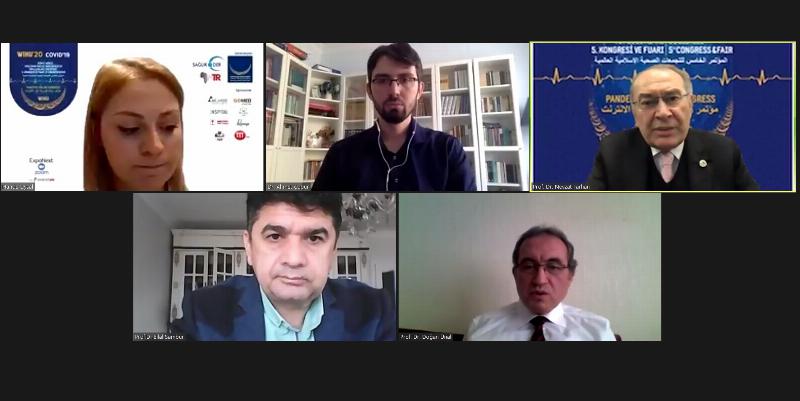
The WIHU’20 5th Congress of World Muslim Health Communities, organized by the World Islamic Health Union (WIHU), was held online within the scope of pandemic measures.
Üsküdar University Founding Rector, Psychiatrist Prof. Dr. Nevzat Tarhan, made a presentation titled “Psychosocial Maturation in the Pandemic” in the session “Individual and Social Psychology in Pandemics.” Tarhan stated that it was important for the Islamic world that the congress was not interrupted despite the pandemic, adding that the congress, which would increase brotherhood among Islamic countries, was significant.
Psychosocial Maturation in the Pandemic
Prof. Dr. Nevzat Tarhan, addressing the social and individual psychological effects of the pandemic process, said, “The outcomes to be drawn from the pandemic affect the whole world. I believe there are situations here that will contribute to our culture and belief system. Therefore, I will evaluate this topic within the framework of psychosocial maturation in the pandemic.”
We Must Keep Track of Global Changes
Tarhan pointed out that the world is in a constant state of change and said that adapting to this change is necessary for development. Prof. Dr. Nevzat Tarhan stated, “The first industrial revolution, described as Industry 1.0, occurred. Steam power was discovered, and mechanical engineering emerged. Later, the second industrial revolution took place. Electricity was discovered in this revolution. Those who used electricity and steam power created Industry 2.0. We missed the industry at this point. The Ottoman political administration tried to benefit from the revolution, which started in England and then spread to Europe, and was accepted by Catholic France and Orthodox Russia, but it could not fully grasp it. Due to our inability to add natural sciences to the education system that advocated it as a science at that time, and the cold approach of the education system during that period, two types of people were raised. One type received only religious education, and the other received only science education. Those who received science education captured the spirit of the time. An opposing stance to the other education system emerged, similar to the Committee of Union and Progress and the Republic. We need to rapidly close the gap in the procedure we left incomplete during the second industrial revolution.”
The New Frontier of Science is the Brain
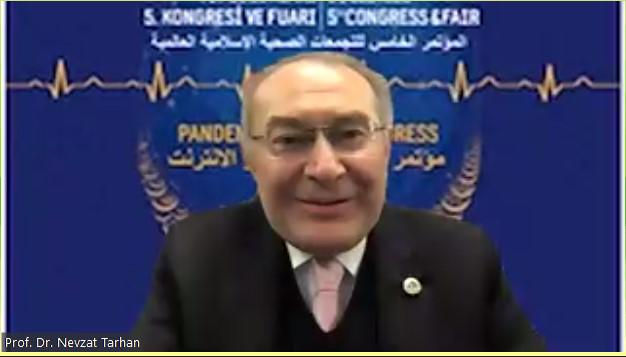
Prof. Dr. Nevzat Tarhan reminded that electronics were discovered in Industry 3.0, which took place in the 20th century, and said, “Power, capital, and dominance fell into the hands of those who realized that revolution. Today, we have Industry 4.0. We can define the realities of this industrial revolution as autonomous robots, simulation, system integration, cybersecurity, cloud access, augmented reality, and big data. Biological big data is DNA, but universal big data is actually the discovery of electronics, information, and quantum. Currently, the new frontier of science is the brain. The brain also possesses a characteristic of communicating with the quantum universe. There is a brain that is in communication with the universe. With such a scientific basis, the concept of Levh-i Mahfûz, which exists in Islamic culture, actually corresponds to big data. A great opportunity has been seized because reason cannot explain creation. It is important for us to explain this truth when people enter into a philosophical search.”
Caught in a Crisis in Today's Reality
Prof. Dr. Nevzat Tarhan noted that in today's reality, there are big houses but small families, more promotions but less common sense, advanced medicines but insufficient health, travel to the moon but not knowing one's neighbor, countless relationships but zero real love, good information but less virtue, high intelligence but less emotion, high income but less peace, and said, “On the other hand, in today's reality, there are many friends on social media but no real friends, more people but less humanity, bigger televisions but fewer books, expensive watches but no time at all, more material prosperity but less spiritual peace, much discrimination but little empathy, more deception but less honesty, more suspicion but less trust. In such a situation, we were caught in a crisis. The strongest point of a chain is its weakest link. The weak links of global Western civilization are now on the verge of breaking.”
The Weak Point of Western Civilization is the Pandemic
Prof. Dr. Nevzat Tarhan reminded that there was a great plague epidemic before the fall of Rome, and said, “During the period of the Persian civilization, Caliph Umar witnessed that an army several times larger became unable to fight due to the plague epidemic on the opposing side. Epidemics have always caused the collapse of the weak points of civilizations. Currently, the weak point of Western civilization is this pandemic. We can emphasize that Western civilization is facing some crises.”
Young People Are Becoming Isolated
Prof. Dr. Nevzat Tarhan pointed out that despite the increase in prosperity, happiness has not risen in the same way, and stated that young people, in particular, are experiencing great loneliness:
“There is data on material prosperity in America, which we call the land of freedoms. Looking at statistics worldwide between 1950 and 2000, per capita income rose like a rocket. It has risen even further now. But happiness levels are not rising in parallel; on the contrary, they are falling. Following this, the federal government intervenes and launches a $5 million project, which an American university begins to work on. It is observed that young people in the 1980s became more isolated from friendships until 2015. A generation is emerging that lives with cell phones in their hands and never meets their friends. Statistics up to 2016 showed an increase in the rate of depression diagnoses in both men and women. These statistics have risen further in 2020,” he said.
Psychological Factors Must Be Considered in Crisis Management
Prof. Dr. Nevzat Tarhan stated that psychological factors must be taken into account in crisis management, and said, “Firstly, individuals and institutions must have crisis plans; secondly, risk calculations must be made and risk management studied; thirdly, strong and weak points must be known before a crisis; fourthly, opportunities and threats must be calculated while managing a crisis; and fifthly, a position must be taken to turn the crisis into a gain. It should not be forgotten that when a crisis occurs, ruptures happen at the weakest points. Finally, it is necessary to know that nothing will resolve itself without leaving damage in a crisis and to be able to approach the relationship with the crisis like a relationship with a storm.”
Measures Should Also Be Taken for the Post-Pandemic Period
Prof. Dr. Nevzat Tarhan pointed out that significant changes have occurred in many aspects of our lives after the Covid-19 epidemic and warned, “While a pandemic of psychiatric illnesses is expected in the post-pandemic period, precursors such as an increase in the number of outpatient and inpatient cases have also emerged. The second rule of a crisis is its inability to spontaneously generate its own solutions. Crisis management is therefore necessary. The same applies to the post-pandemic period.”
The Pandemic Further Isolated Lonely People
Prof. Dr. Nevzat Tarhan noted that in 2018, the UK announced the establishment of a Ministry of Loneliness responsible for isolation, and said, “The pandemic further isolated lonely people. In such a situation, disintegration from a weak link is expected. In 2018, the University of Manchester and the BBC conducted a joint ‘Loneliness Study’ with over 55,000 participants in the UK. The loneliness rate among those aged 16-24 was found to be 40 percent. 27 percent of older individuals are lonely. They faced the crisis in this state,” he said. Prof. Dr. Nevzat Tarhan stated that the crisis experienced by Western civilization is the California syndrome, adding, “They entered the pandemic in this crisis.”
There is an Addiction Epidemic After Covid-19
Prof. Dr. Nevzat Tarhan stated that there is an addiction epidemic after Covid-19, and said, “Alcohol addiction increased significantly due to confinement at home. This also poses a risk for the future.”
Positive psychology is the scientific form of jihad of the self…
Prof. Dr. Nevzat Tarhan stated that the science of positive psychology, which emerged in the 2000s, is taught as the most popular course at the world's most important universities such as Harvard, Yale, and Bristol, and said, “They teach values like compassion, helpfulness, and goodness stemming from the roots of Anatolian wisdom. It is offered as an undergraduate course against suicide epidemics. The scientific world there has sensed where humanity is heading and is trying to rebuild our abandoned values under the name of the science of happiness. We are currently unaware of this. We are trying to fix the world with weapons. However, the Messenger of Allah said during the Battle of Badr, ‘The small jihad is over, the great jihad is beginning.’ When asked what the great jihad is, he replied, ‘The great jihad is the struggle against the self.’ Positive psychology is the scientific form of the jihad of the self.”
How Did Maturation Occur During the Pandemic?
Prof. Dr. Nevzat Tarhan, referring to the research conducted by Üsküdar University in April after the start of the Covid-19 pandemic to understand its effects on maturation, stated that in the study, which included 6,318 people in 81 provinces, they examined psychological processes, perceptions, anxieties, and fears, as well as maturation.
Prof. Dr. Nevzat Tarhan said, “In maturation, we had 6 questions from the Post-Traumatic Growth Inventory. Some results from this research showed that 59% stated that the priority of things I value in life changed. 49% said their interest in spiritual matters increased, 56% understood that they could cope with difficulties, and 56% said they could accept events as they are. 48% stated they started putting more effort into their relationships, and 74% said they better understood the value of what they have. What is this? The equivalent of these six concepts in our culture is patience and gratitude. We need to teach this to the world.”
We Understood the Importance of Spiritual Well-being
Prof. Dr. Nevzat Tarhan stated that an assessment should be made on whether the pandemic is a danger or an opportunity, and said, “Our freedom was restricted, but our ability to delay gratification developed. Our physical and mental comfort decreased, but we had more time to develop ourselves and strengthen family ties. Our pleasure and speed-focused life was restricted, but we were able to discover new interests. We could not exercise some of our rights, but we also realized that others have rights. We were very harsh on nature, but we learned that we need to be more careful about global pollution and climate change. We learned that not only economic prosperity but also spiritual well-being is important. We are sitting on such a resource with our own values. We are sitting on cultural and social capital. If we do not activate this, future generations will say, ‘Shame on our ancestors.’ Therefore, we have a responsibility towards them.”
5 Degraded Features, 3 Important Opportunities
“Our education system should teach students the philosophy of life while there is scientific data,” said Prof. Dr. Nevzat Tarhan, adding, “We can explain why it should teach it as follows: There are 5 degraded features and 3 opportunities. Our psychological well-being deteriorated, we are losing our freedom, we are losing our physical comfort, our social relationships were negatively affected, and we felt that death was near. At the same time, it gave us free time, an opportunity for psychological resilience and endurance training, and an opportunity to rebuild the human and universal values that we had abandoned.”
Being a Good Person Should Be Taught to Children as an Ego Ideal
Prof. Dr. Nevzat Tarhan concluded his words by saying: “In our education system, all parents and teachers want their children to be intelligent, successful, and hardworking. They see intelligence and diligence as conditions for success. However, being a good person should also be taught as an ego ideal. The pandemic taught us that we need a paradigm shift, such as raising good people. We need to shift our philosophy of life in this direction.”
The opening speeches of the congress, held with the participation of many Islamic countries from around the world, were delivered by Mehmet Selim Bağlı, Deputy Minister of Family, Labor and Social Services; Dr. Osman Coşkun, Member of the Presidential Science, Technology and Innovation Policies Board; Specialist Dr. Kasım Sezen, President of the World Islamic Health Union; and Prof. Dr. Suhaini Bin Kadıman from Malaysia.
Share
Update Date: February 27, 2026
Creation Date: December 24, 2020
Request a Call
Other News
- The book that read today's digital threats in 2014: Being a Conscious Family
- Experts warn: 'Instead of memorizing letters, teach pencil grip, scissor use, and coloring'
- School fear and school love both start in the family!
- Family is not merely transforming, it is being battered under a serious assault
- Artificial intelligence opens the door to early diagnosis in autism!