

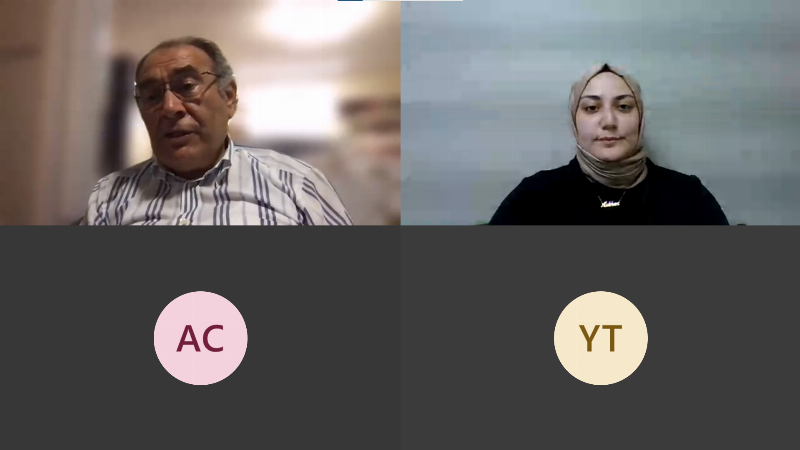
Üsküdar Üniversitesi Founding Rector Psychiatrist Prof. Dr. Nevzat Tarhan, was the guest of the 2020-2021 Young Red Crescent Istanbul Leadership Psychology Training, organized by the Turkish Red Crescent Youth Istanbul Community. Ayşe Aslıhan Kültür moderated the program titled 'Leadership Psychology'.
Content
Prof. Dr. Nevzat Tarhan: “Being able to manage one's own desires and impulses is also a form of leadership.”
“What a mother does at home is leadership.”
Prof. Dr. Nevzat Tarhan, speaking about the content of the leadership concept, said: “When we say leadership psychology, what we understand by the concept of leadership is very important. In recent years, very important studies have been conducted on the concepts of leader and leadership. Since the 2000s, there have been two studies on this topic, and two behavioral economists received the Nobel Prize in Economics. These are studies related to decision-making mechanisms while researching 'how do people make decisions in purchasing behavior?'. Studies on this topic in the human brain and mind attracted great interest and attention. To enable a person to make healthy decisions, whether in purchasing behavior or voter behavior, for instance, what a mother does at home is leadership. What a father does at home or at work is leadership. In fact, being able to manage one's own desires and impulses is also a form of leadership.”
“Leadership is, in a way, a study of ‘how to make healthy decisions’ as a result of human free will.”
Tarhan, stating that leadership in a person's life allows for progress by making correct decisions, said: “So leadership is, in a way, a study of ‘how to make healthy decisions’ as a result of human free will. Decision-making models have been researched many times in this regard. For example, this capitalist system offers us the following decision-making model. It says man is homo economicus. That is, man is an economic being. People are completely rational actors. They decide only with reason. They possess perfect information. People are derived from microeconomics. These studies say that man is the micro of economics. Macroeconomics is the state, politics, global governance. Microeconomics is the management of the individual. Man is also produced from here. These studies state that the actor, the decision-maker, or the leader, maximizes subjective utility. That is, that person calculates benefits and losses. They perform a profit and loss analysis and make decisions accordingly. However, it is observed that people often make very absurd decisions. They spend their fortune. They pay thousands of dollars for a painting. That is, if man is homo economicus, they should make decisions based on basic needs and profit-loss. They do not make these decisions. Why does this happen? In the homo economicus model, man acts by maximizing subjective utility. If the actor, the individual, weighs the benefits in various actions and offers the greatest benefit relative to the cost. They choose this option. The greatest benefit according to cost. They maximize profit. This is called optimal choice.”
“Man is not homo economicus, but homopsychologicus.”
Tarhan, also touching upon a different approach in the studies, said: “Something else was realized in these types of studies. It was said that man is not homo economicus, but homopsychologicus. What does this mean? For example, when a person makes a decision, they do so not only with their mind but also with their emotions. Thus, the following emerges. While decision-making mechanisms were working, it was thought that man possessed perfect information. The capitalist system and capitalism were born from this. Man has perfect information. He does everything accurately and society is made up of individuals. The individual pursues self-interest. Since society is composed of individuals, society should also pursue self-interest. And since states are composed of individuals, states should also pursue self-interest, leading to a global and ruthless competition behind this. Thus, a non-peaceful competition arose among individuals and people.”
“The one calculating benefit, profit, loss is not the truly beneficial one.”
Prof. Dr. Tarhan said: “When making decisions, people decide not based on utility, but on what is good. I think this is better than the other. So, the one calculating benefit, profit, loss is not the truly beneficial one. This type of person is a being who pursues personal interest. For some, the concepts of good and right can change. That is, in such situations, various social pressures, beliefs, and values all come into play for the concept of goodness, and in such situations, the person says, ‘this is good for me’. For example, they donate their entire fortune because they are in love. In that case, we are talking about this: man is not a rational being; man can invest when he feels secure. If he feels secure, he can take risks, grow, and work. The result of this is tied to how a person defines the concepts of good, right, and beautiful.”
Share
Update Date: February 27, 2026
Creation Date: July 16, 2021
Request a Call
Other News
- The book that read today's digital threats in 2014: Being a Conscious Family
- Experts warn: 'Instead of memorizing letters, teach pencil grip, scissor use, and coloring'
- School fear and school love both start in the family!
- Family is not merely transforming, it is being battered under a serious assault
- Artificial intelligence opens the door to early diagnosis in autism!