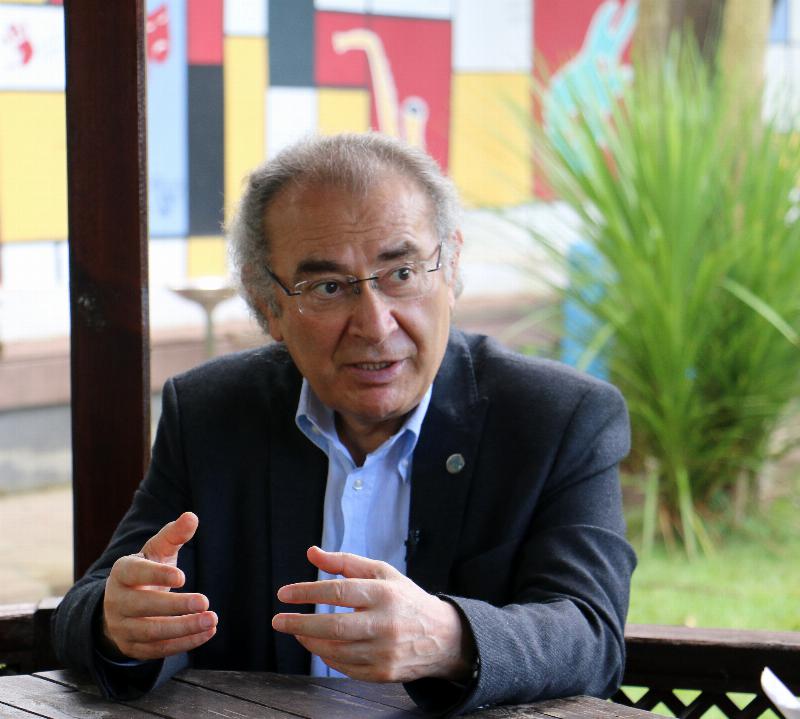
Uskudar University Founding Rector, Psychiatrist Prof. Dr. Nevzat Tarhan, made important evaluations and recommendations regarding arranged marriages in the AKRA FM Marriage School program.
Stating that marriage and spouse selection are among the most important decisions in an individual's life, Prof. Dr. Nevzat Tarhan said, “The decision of marriage is one of the most important provisions in people's lives. These provisions include career choice and marriage choice. It is especially important to get to know the prospective spouse well during the engagement period. The prospective spouse's compatible and incompatible aspects should be noted down. The decision should be made based on which side outweighs the other by 51%.” he advised.
Love Grows as We Focus on the Positive Sides…
Stating that modernism misleads people greatly, Prof. Dr. Nevzat Tarhan said, “Modernism advises, 'Don't marry if you're not in love'. To the question 'Why aren't you getting married?', the answer given is 'I haven't fallen in love'. However, love in marriage is not a cause, but a result. If couples love each other at an average level in marriage, love grows as they focus on their positive sides, and that love decreases as they look at their negative aspects. If a person always focuses on the negative, always questions, and looks for flaws, that marriage won't easily work. A spouse may have 9 good qualities and 1 wrong quality. If one's spouse gets stuck on that single wrong, they cannot carry on from there. Many functioning marriages are like this,” he said.
Even in the Best Marriage, Love is a Process
Stating that couples should see both negative and positive aspects in their prospective spouses before marriage, Prof. Dr. Nevzat Tarhan said, “There is no such thing as zero fault. Such a thing is not even possible. Every person has pros and cons. What is important is what one seeks in the person they will marry. Does their face smile when they see them, do they feel warm emotions? Even in the best marriage, love is a process. If there is good cooperation, love emerges or continues. Having both love and cooperation at the very beginning is a very exceptional situation. That is, generally there is an average level, but when good cooperation is established, they become companions to each other,” he explained.
Not a Spouse, but a Companionate Journey
Prof. Dr. Nevzat Tarhan, pointing out that in our culture, the word 'eş' (spouse) is not used in marriage, but rather the words “refik” and “refika”, said, “‘Refik’ and ‘refika’ mean travel companion. You have embarked on a life journey, you have a goal ahead, you are a guest in this world. The focus should be on whether this person would be a good companion to me on the path of life while raising my children,” he stated.
Prof. Dr. Nevzat Tarhan stated that one of the desired qualities in a spouse is the person's competence to provide for their livelihood and economic compatibility, adding, “Another compatibility is physical compatibility. There are marriage maturity criteria that consider compatibility in education level, age level, and many other characteristics. For example, couples preparing for marriage can find a marriage maturity scale online. If it scores above average, that marriage will work, but if it scores below, paths might diverge even during the engagement period,” he said.
Compassion is Greater Than Love
Prof. Dr. Nevzat Tarhan stated that while physical attributes sometimes take precedence in the decision to marry, what is essential is the beauty of character, adding, “Compassion is greater than love. Love can also be egocentric. One can love the other person's interests. Compassion is unconditional. Kindness is also greater than respect. People can show respect out of fear. A person should decide based on what they feel 51% of the time. Marriage doesn't work with logic alone, nor with emotion alone. It needs to be balanced,” he said.
Prof. Dr. Nevzat Tarhan stated that various fears can sometimes emerge before marriage, adding, “In such situations, you must be objective towards yourself. For example, a doubt came to your mind while boarding a plane: 'What if it crashes?' In such cases, if you take fear seriously, you cannot board the plane. Even if you board, you do so with a pounding heart, in a miserable state. You might even have a heart attack because of it. But regarding this fear, thousands of planes are flying in the world right now, what is the probability of an accident by road in the world? The probability of accidents and fatalities is lower in air travel. Road accidents cause more fatalities. Therefore, traveling by plane is safer. When making a decision, the reasoning power of the brain's frontal lobe emerges. Humans can make the right decision through reasoning,” he stated.
Reason Guides Emotions
Prof. Dr. Nevzat Tarhan, stating that unlike other living beings, humans possess reasoning, abstract thought, and conceptual thought, said, “Reason manages emotions. Reason is in the captain's bridge. Emotions ask reason everything, whether it is appropriate or not. There is a mental jury in the frontal lobe of our brain. The first member of the mental jury is the judge. One of the members here is a scientist. They say 'This is real, this is not real'. There is religion and morality. They ask, 'Is this right or wrong?' There is an aesthetician. They ask, 'Is it beautiful or ugly?' There is a manager who performs cost-benefit analysis. Forming a mental jury in our brain is not innate, but learned later. This conscientious jury is also the same. This exists in making correct decisions. Because God has granted partial free will (cüzi irade), He has given humanity a drop of His own power of decision-making. Partial free will (cüzi irade) is a reflection of absolute free will (külli irade). It is like a glimmer of the sun. We must be able to use it,” he said.
Reason and Emotions Must Act Together
Prof. Dr. Nevzat Tarhan also stated that a person must look at themselves objectively in important life decisions, especially the decision to marry, saying, “A person should view themselves like an independent and impartial judge. If they do this, they will question the thoughts that come to mind; those thoughts cannot control them. Truth guides them. Here they will ask, 'What is the truth?' Is the truth what I feel, or are there some realities I cannot see, rather than what I feel? If they cannot do it themselves, they should consult someone knowledgeable. The engine of the car is emotions. The steering wheel of the car is reason. Both must go together. Without the engine, reason is useless. Even if we are unaware, our reason and brain constantly filter everything from external noises to a lot of psychological information through a rational sieve, making quick judgments and decisions. Whether to use this pen, whether to come here, whether to do something or not, we constantly make many automatic decisions. And in fact, we head towards many mistakes that way. That's why we need to develop our self-criticism ability. God has given self-criticism to humans. The ability to question oneself. Humans are the only beings aware of their own identity,” he concluded.

