

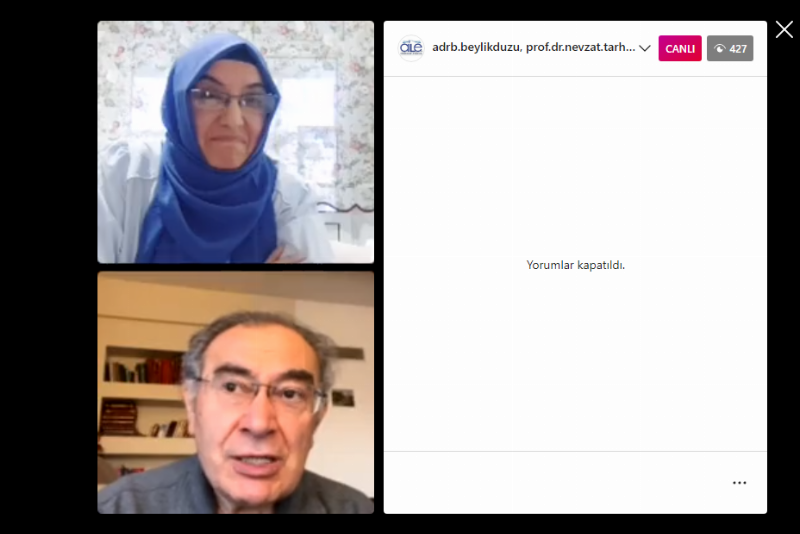
Üsküdar University Founding Rector, Psychiatrist Prof. Dr. Nevzat Tarhan, was a guest on an Instagram live broadcast organized by the Beylikdüzü District Mufti's Office Family and Religious Guidance Bureau. Making evaluations on the topic of “Psychology of Wisdom,” Tarhan said: “What is there in the teaching of the wisdom of this age? Self-knowledge, self-management, and social consciousness. It means being a part of the society you live in, being understanding, conscientious, empathetic, and compassionate. As part of the Anatolian wisdom tradition, our elders say: ‘Be wise, my child; be conscientious, my child; be understanding.’ This was ingrained in our cultural codes, but we are now rapidly losing it.”
Content
Prof. Dr. Nevzat Tarhan: “Life gives its reward to those who endure”
“As a result of capitalist ethics, people pay a price”
Prof. Dr. Nevzat Tarhan, who was a guest on the Instagram live broadcast moderated by Seda Şen and organized by the Beylikdüzü District Mufti's Office Family and Religious Guidance Bureau, stated that capitalist ethics negatively affect wisdom. Tarhan said: “We need to appreciate the things we have, be happy with small things, and focus on changing ourselves instead of changing the world. Primarily, changing oneself—these are actually universal wisdom values. In summary, if these are not present, people cannot be happy. Capitalist ethics ruined wisdom. Globally, with the motivation to work and consume, it pushed people into a race to sell more and earn more. As a result of capitalist ethics, people pay a price. As a result of this price, material prosperity increases, but spiritual prosperity decreases. Depression increases, unhappiness increases, loneliness increases. In such situations, today's youth say: ‘Life is meaningless.’ Modernism offered material prosperity to humanity, but under the influence of popular culture, it also overturned the cultural values that made people happy. The institution of marriage is not genetic, but coupling is genetic. For centuries, the culture of marriage has globally formed the institution of family with the further development of divine teachings.”
“They misinterpreted the women's liberation movement”
Tarhan, addressing various reasons that lead to the destruction of the family today, said: “They are destroying the family with new justifications, but they are not aware of it. With their actions, they misinterpreted the women's liberation movement. Regardless of how religious they may seem, a destructive feminist is someone who promotes competition between women and men, rather than complementarity. A constructive feminist improves the quality of relationships. They do not dismantle the family within the women's liberation movement. They do not harm the role of motherhood. Whoever harms the role of motherhood and dismantles the family, whether appearing religious or otherwise, will pay a price. Currently, Northern European countries have started paying this price. In France, they officially started this. Population registers write 'parent one' and 'parent two' instead of 'mother' and 'father.' Children are given to institutions without a mother or father. Without a parent-child environment, stories and beautiful experiences cannot form in a child's personality development. When that is not established, how can you expect the child to be happy? Harming the family institution was an evil of modernism. Modernism is an incomplete institution. I hope it will be realized and corrected, and family values will be restored. Modernism interpreted individualism, thinking of its colleagues, as selfishness. As a result, selfish people became lonely and self-centered.”
“We are rapidly losing our cultural codes”
Emphasizing that we are losing our cultural transmission and codes, Tarhan stated that we must uphold our own values. Tarhan said: “What is there in the teaching of the wisdom of this age? Self-knowledge, self-management, and social consciousness. It means being a part of the society you live in, being understanding, conscientious, empathetic, and compassionate. As part of the Anatolian wisdom tradition, our elders say: “Be wise, my child; be conscientious, my child; be understanding.” This was ingrained in our cultural codes, but we are now rapidly losing it. When we lose these, for example, we can produce domestic weapons, domestic UAVs-CIAs, domestic bridges, factories, but we lose our domestic people. What is the point if we cannot raise domestic people? For this reason, raising people, establishing the family, and the first school, the family, is essential. The family was our last fortress. Now that fortress is in great danger. Especially, the family is the open door of the house. Children, from the safe environment of the home, can easily access the most unsafe information from the internet, which is an open door to the house. Also, digital literacy and media literacy are very important. The main thing for parents is not just feeding and watering the child, but raising a good person. This is the wisdom within the family.”
“The home is a person's safe space”
Tarhan, evaluating five beautiful spiritual qualities, said: “There is a more developed, greater form of love, which is compassion. In compassion, there is selfless love. In compassion, there is unconditional love, but there can also be selfish love. You love the other person's physical appearance, you love their interests, but the other is selfless love. Respect, for the person you love, if love is water, respect is its container. It prevents the dosage of love from getting out of control, it determines its measure. The greater form of respect is courtesy. Courtesy is greater than respect because in courtesy there is sympathy, there is not causing harm. Sometimes respect can come from fear, or from self-interest, but courtesy is a noble behavior. It comes from within, making it greater. We likened love to water, and respect to a container. To stir the water in that container, you need a spoon. The third is patience. The third most important thing in family relationships is not to be hasty. In fact, there is a beautiful saying that I often repeat: ‘Life gives its reward to those who endure.’ We have a psychological law. Not enduring, patience is not sitting idly by, but a meditative act. It means acting in accordance with its natural, graceful essence. Therefore, this patience is also an important family wisdom. The fourth is loyalty. Loyalty in Arabic means 'sidq'. It has two meanings: one is to be attached, and the other is to be truthful. When loyalty is mentioned, attachment is understood. There is 'sidq' and truth; both must be together. This creates trust. Loyalty is related to belonging in marriage, and for this, one must always be open, transparent, and honest. In relationships, one must be accountable. That generates loyalty and builds trust. The home is a person's safe space. Loyalty ensures it is a safe space. This comes from honesty, from commitment. And the fifth is sincerity. Truly a magical concept.”
“The need for religion is a universal need”
Tarhan, speaking about the values of knowledge, wisdom, and religion, said: “In the face of human helplessness, weakness, and powerlessness against illnesses, and in the face of disasters like earthquakes, plagues, and pandemics, there is a supreme power that knows everything and controls everything, there is a supreme will. When you say, 'He sees me, I need to take refuge in Him,' the inner peace that believing in Him brings, I observe, and that's why monotheism (tawhid) is very important in wisdom. In the first book, I emphasized monotheism because there are 4,300 religions identified in the world. All of them say, 'I am right.' The need for religion is a universal need. It has become the most important religion that gives meaning to life and answers questions. If one of these events is true, then by the method of reasoning, if there is a true religion among 4,300 religions, it is the religion of monotheism. I came to it through methods of reasoning. That is, if there is a creator, what should His attributes be? He must have knowledge. He knows everything. He must have power, being able to rule everything, controlling everything. Third, there must be an absolute will. He must have wisdom, being able to do everything in its proper place. All of these can only be if there is one God. If there are three, four, or multiple gods, it is not possible for them to be in harmony. That's why, for example, Ibn Sina called God 'wajib al-wujud' (necessary existent). They called Allah 'the necessary being, the indispensable.' 'Wajib al-wujud' is also one of the attributes of Allah in the language of monotheism. In fact, it is the essence of Surah al-Ikhlas. Everyone needs Him, but He needs no one. For example, Surah al-Ikhlas is the only one I mention in the Quran in the sense of being unique. Therefore, someone who can grasp this meaning satisfies their conception of God. For this reason, someone who has not achieved satisfaction with God remains incomplete in knowledge. That is, there will be knowledge and wisdom, but not 'ismet' (infallibility/purity). And if there is no 'ismet', that small country will collapse; we can easily say this about that wisdom.”
“There is no perfect person”
Prof. Dr. Nevzat Tarhan, evaluating the need for people to question their intentions, said: “Being able to give infaq, glorified by Islam, is one of these wisdoms. It's not always about 'me, me'; doing good to those who do good is a human trait. Doing bad to those who do bad is in accordance with sharia. For the wrongdoer to pay a price, but doing good to someone who does bad is a great virtue. Not being unjust to someone who does bad is the most ideal. Is there a perfect person? Everyone will have a flaw; everyone will upset you from time to time, sometimes intentionally, sometimes unintentionally. If someone is upsetting you as a burden, you should first look at their intention. Are they doing this knowingly or unknowingly? If they are doing it unknowingly and their intention is good, you should not break ties with them. But if their intention is bad and they are doing it willingly, then breaking ties is correct. Questioning intentions is what we emphasize in couples therapy. There are relationship status scales. When people come to us for couples therapy, we look at that. What is the level of expectation, is the level of expectation for each other realistic or not? Second, is there intimacy avoidance, meaning, are they avoiding being with their spouse or not, is there avoidance of intimacy? Third, for the person we are examining, is there mind-reading, meaning, if they believe their spouse said something they didn't, and then abandon them, the fault of that abandonment is not with the spouse, but with you. You are mind-reading. That's why those personal development gurus don't embark on the arduous path of self-knowledge and self-improvement; they always take the easy way out, and as a result, they lead people to loneliness.”
Share
Update Date: February 28, 2026
Creation Date: May 12, 2022
Request a Call
Other News
- The book that read today's digital threats in 2014: Being a Conscious Family
- Experts warn: 'Instead of memorizing letters, teach pencil grip, scissor use, and coloring'
- School fear and school love both start in the family!
- Family is not merely transforming, it is being battered under a serious assault
- Artificial intelligence opens the door to early diagnosis in autism!