

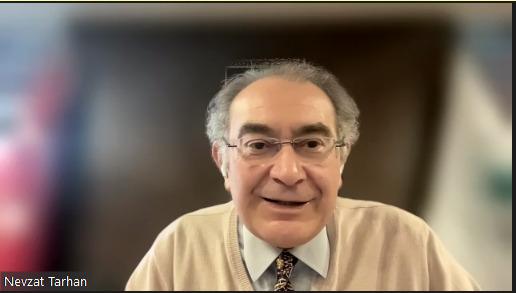
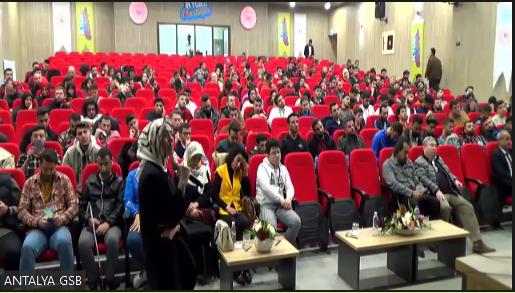
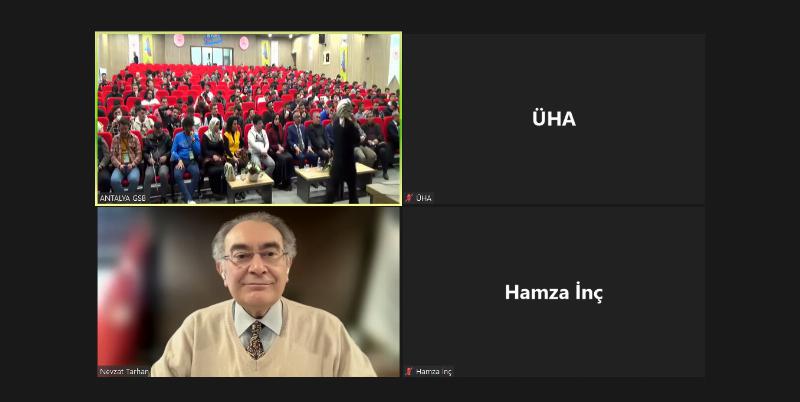
Psychiatrist Prof. Dr. Nevzat Tarhan, Founding Rector of Üsküdar Üniversitesi, met with university students within the scope of the Volunteerism Camp organized by the Ministry of Youth and Sports in Antalya. Tarhan, who held a sincere talk with young people under the title 'Goodness Heals', pointed out that a lack of empathy underlies being deprived of goodness. Emphasizing that they can now biologically see the difference between benevolent and malevolent behavior in the brain, Tarhan stated that doing good is currently the greatest spiritual investment. Tarhan, who said that remaining silent in the face of evil is a greater evil than evil itself, used the expressions, “While lack of empathy opens the door to evil, humility opens the door to goodness.”
Content
Prof. Dr. Nevzat Tarhan: “Lack of Empathy Underlies Being Deprived of Goodness”
“The reason for being deprived of goodness is a lack of empathy”
Tarhan drew attention to the changes caused in the brain by doing good, and even thinking about good, and explained the functions of mirror neurons. Prof. Dr. Tarhan said: “To understand some concepts, it is necessary to know their opposites. The boundaries of goodness are understood when goodness is compared with evil. The concept of goodness has biological, psychological, and sociological dimensions. After the 2000s, psychology, in particular, experienced a revolution regarding goodness. A revolution occurred in psychology after neuroscience revealed the brain's areas related to social and emotional skills. A neuroscience-based psychology emerged. In other words, we started to better understand the relationship between the brain and human behavior. In the studies conducted here, the difference that benevolent and malevolent behavior creates in the brain was very clearly understood. We developed a benevolence and malevolence scale. This scale was published in the style of 'which behavior is good and which behavior is bad'. After thoroughly understanding, measuring, and evaluating the concepts of good and evil here, studies were conducted on how goodness affects the brain. Which behavior benefits humanity... For example, the understanding of goodness in a capitalist system is not the same as the understanding of goodness in the Far East. The understanding of goodness in religions is not the same as the understanding of goodness in popular culture or the capitalist system. The object of goodness is important here; does the person do good for themselves, their children, or their loved ones? According to the results of goodness studies, doing good was explained as what activates mirror neurons. For example, mirror neurons are undeveloped or underdeveloped in autistic children, and not developed at all in advanced autistics. Mirror neurons are the neurons related to abstract thought, which make us human. For instance, if I raise my hand now and we measure your brain, the mirror neurons in the part of your brain related to arm lifting are activated. Similarly, emotional mirror neurons; when we feel emotions like anger, rage, fear, excitement, sadness, jealousy, grudge, and hostility, mirror neurons are felt in the other person's brain. This is called emotional literacy. The same area in the other person's brain is activated. In such a situation, when we dream about grudge, anger, and jealousy, our mirror neurons work as if we have done it. But motor neurons do not work then, of course. So, goodness has a biological equivalent. Actually, mirror neurons are neurons related to empathy. In studies on evil deeds, you will see that they stem from a lack of empathy. A lack of empathy underlies being deprived of goodness. While a lack of empathy opens the door to evil, humility opens the door to goodness. There is arrogance and selfishness in a lack of empathy. Where there is selfishness, there is no empathy; there is "me first" and one's own interest.”
“The core keyword of the concept of goodness is empathy”
Tarhan elaborated on the concepts of empathy and sympathy: “Emotional literacy is actually empathy, being able to view events from the other person's perspective. As you know, sympathy and empathy are often confused. Sympathy is sitting next to someone who is crying and crying along, which is incorrect and very problematic. But empathy is to consider the other person's rights, wishes, and feelings while protecting one's own emotions, and to try to understand them. We can describe empathy in this way. Empati is a learned behavior, and this emotion develops with cultures. Whether something is empathy or not, if our emotional brain has high empathy related to emotional intelligence, people will behave more intelligently emotionally. Individuals with low empathy show emotionally less intelligent behaviors. Therefore, the core keyword of the concept of goodness is empathy. Empathy, of course, does not just mean making sacrifices or always compromising oneself. Empaty means you will consider both their rights and your own rights, and you will be able to make the most correct decision. A lack of empathy underlies being deprived of goodness.”
“By doing good to others, you also develop your own social and emotional skills”
Tarhan pointed out the necessity of doing random acts of kindness to make the world a more livable place, stating that courses and projects on this topic are offered in schools in the West. Emphasizing that doing good to others provides a two-way, not one-way, benefit, Tarhan said: “When Mother Teresa was asked how the world could become a more livable place, she gave a very concise answer: 'doing one-on-one acts of kindness.' In other words, if we want to make the world more livable, we need to develop a method of one-on-one acts of kindness instead of methods of conflict and power struggles. Indeed, throughout history, dictators have used methods of tension, violence, oppression, intimidation, and threat. But the teachings of the prophets are based on doing good, on compassion and mercy. People with good social and emotional skills are those who perform random acts of kindness. There are two types of goodness. If you do good with the expectation of a return, like 'you don't spare the chicken where you expect gain,' then this is selfish goodness. But selfless goodness, and also random acts of kindness, are currently being developed in schools, especially in the California region of the USA. In these projects, people are encouraged to do good without expecting anything in return. They go and help people they don't know at all; these are credit courses, and children get points for them in high school. By doing good to others, one also develops their own social and emotional skills. When one does good, they also feel relieved. Therefore, doing good does not diminish a person; in fact, it brings more. What we call goodness is not necessarily giving a gift. A smile is goodness, a warm touch is goodness, asking after someone is goodness. A loving look, a smile, kind words are all goodness. Who is the person who nourishes our culture and has influenced one-third of the world's population? It is our Prophet. Those who remember him always remember a smile, never a grim face. In a society that buried daughters alive, he sat his cat on the edge of his robe. He cut off the edge of his robe so as not to wake the cat. This is a sociological and psychological revolution.”
“Goodness done with the expectation of gain is social and psychological usury”
Tarhan also made notable remarks regarding the expectation of reciprocity when doing good, stating that intention is very important when performing acts of kindness. Tarhan said: “In emotional intelligence experiments, the concept of 'delayed gratification skill' emerged. If a person has the skill of delayed gratification, they do not ask for the reward of that good deed immediately, but rather say, 'when the time comes, this will be its spiritual reward for me.' In such a situation, goodness and righteousness are done because they are right, not because something is expected in return. Good deeds are done as a principle because they are right, but for a believing person, doing them for divine pleasure is essential. What does a smart person do? A long-term, strategically thinking person invests in the afterlife. Smart people, because they think strategically, think long-term in such situations, regarding the afterlife. Doing good is currently the greatest spiritual investment. The reward for spiritual investment is received after death; this is, of course, related to the belief in monotheism, these are acts of kindness done for divine pleasure. However, worldly good deeds are done solely for worldly gain. When non-worldly, universal good deeds or those with a spiritual dimension are performed, they bring happiness to the person in both worlds. Happiness that only brings joy in this world is like a one-winged bird; it cannot fly... The good we do should bring us happiness in both worlds. If the work we do gives us happiness in two worlds, then that work is the right step. A smart person is a long-term thinker, so in the good we do, making someone happy in the short term, social benefit, and doing good are good, but the main intention should be divine pleasure. When we consider this, we will have made this good deed a kind of seed, an investment, for our eternal life and our life after death. Cemil Meriç has a very beautiful saying: 'Goodness done with the expectation of benefit is usury.' This is social, psychological usury; it's like charging interest. It is more correct to think of the reward for the good you do as a long-term investment.”
“There is no evil; there is the absence of goodness”
Tarhan, expressing the concept of evil as the absence of goodness, also shared insights on the understanding of evil in religious literature. Tarhan said: “Why does evil exist? It is asked, 'If Allah is powerful and mighty, why does He not destroy evil?' This is a universal question in the vein of, 'If goodness does not destroy evil, and cannot destroy evil, how can there be a God?' The reason Allah created this world is the balance of good and evil; there is a dynamic balance of opposites in the universe, which is even called behavioral entropy. The entropy of good and evil. Good and evil are like the relationship between hot and cold... When heat increases, cold decreases; in reality, there is no such thing as cold, there is the absence of heat. In reality, there is no such thing as darkness, there is the absence of light. Therefore, there is no such thing as evil; there is the absence of goodness. For this reason, evils are a part of goodness for goodness to be understood. Evils are a part of the formation of goodness. Therefore, the creation of evil is right and just for us to understand good and goodness. Just as diseases show us our health, evils show our need for goodness; just as flaws and mistakes are a part of perfection, things that appear as flaws in quantum physics in the universe are actually a part of perfection... Good deeds are also part of Allah's test in this world: will you be among the good or the evil? Allah has given humans free will; that is, in every action, we make a choice. As Rumi said, 'We do not live in the world; we pass through the world.' Do you know what the greatest evil is? The greatest evil is doing nothing in the face of evil. Remaining silent in the face of evil is a greater evil than evil itself.”
Share
Request a Call
Other News
- The book that read today's digital threats in 2014: Being a Conscious Family
- Experts warn: 'Instead of memorizing letters, teach pencil grip, scissor use, and coloring'
- School fear and school love both start in the family!
- Family is not merely transforming, it is being battered under a serious assault
- Artificial intelligence opens the door to early diagnosis in autism!