

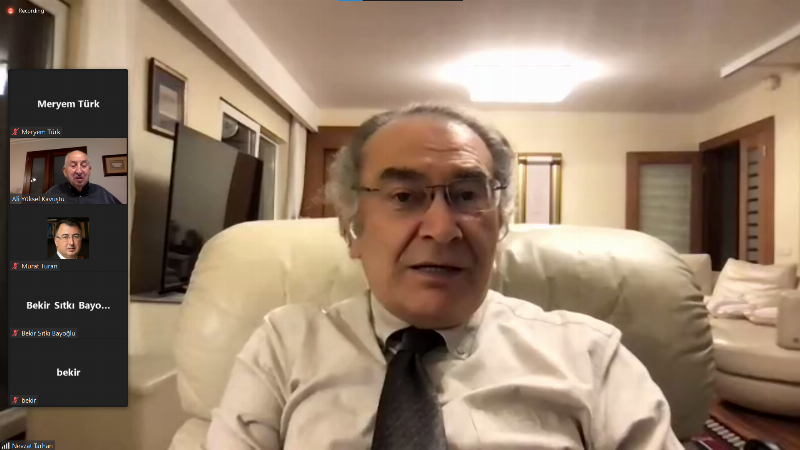
Üsküdar University Founding Rector, Psychiatrist Prof. Dr. Nevzat Tarhan, was the guest of the online talk organized by the Ankara Culture and Education Foundation (AKEV). In the program held online, Prof. Dr. Nevzat Tarhan, who made evaluations on the topic of 'Ego: The Disease of the Age', drew attention to the connection between ego (enaniyet) and sincerity (ihlas). Tarhan said: 'There can be no ego (enaniyet) in a person who has sincerity (ihlas). That is, ego and sincerity cannot exist at the same time. They are like fire and gunpowder. If there is ego in a person, sincerity weakens.'
Content
Prof. Dr. Nevzat Tarhan: "If There Is Ego in a Person, Sincerity Weakens"
"Defensive Egos Are Often Hidden"
Prof. Dr. Nevzat Tarhan, emphasizing the diversity of ego, said: 'Now there are two types of ego. One is hidden ego, the other is overt ego. Overt ego is known as arrogance, pride. There is also a hidden ego. This is called cautious ego, cautious pride. In this situation, the person plays a completely humble role. The reason for this cautious pride is that the person is very beautifully modest, but in reality, feels the need to hide themselves in this way to avoid harm. They observe well, behave very quietly and calmly; you generally say they have a mouth but no tongue, they appear modest, say yes to everything, but then, when they start talking, you always see them highlighting themselves and their ego, putting themselves forward, even in the questions they ask. There is an urge to protect their own ego. So, in this case, there is defensive ego. In the other case, there is overt ego… But defensive egos are often hidden and deceptive. The person subtly influences people.'
"A Person Beginning to Love Themselves Narrates the World of Schizophrenics"
Prof. Dr. Nevzat Tarhan, talking about the process of narcissism in people's lives, said: 'Freud examines narcissism as follows. He says there are two types of narcissism: Primary Narcissism and Secondary Narcissism. By the way, the most primary narcissist is a child. Quite rightly, the primary narcissist is a child. The child says the world revolves around them. That is, as soon as a child is born, they first invest their love in themselves. They love themselves. To survive, they need to love something. They have a love impulse, but they see that if they love themselves, they can survive. After that, they start loving the caregiver, who is the mother or a mother figure. As they grow, especially after they start walking, they expand their love investment to people they are in contact with, such as their father, siblings, etc. When they reach adolescence, they start investing their love in the opposite sex. If this person becomes schizophrenic, they direct their love investment back to themselves, which is secondary narcissism. They start loving themselves again. Here, he makes a truly wonderful observation. A person starting to love themselves means – this is something that beautifully describes the world of schizophrenics – a person starting to love themselves describes the world of schizophrenics. Because it is like this in schizophrenics. There is an encapsulated area in their brains, and they fantasize, and they are happy within that fantasy; for them, this situation is quite beautiful.'
"If There Is Ego in a Person, Sincerity Weakens"
Prof. Dr. Nevzat Tarhan, drawing attention to the connection between ego (enaniyet) and sincerity (ihlas), said: 'A person with sincerity cannot be egoistic. That is, ego and sincerity cannot exist at the same time. They are like fire and gunpowder. If there is ego in a person, sincerity weakens. Sincerity has three points in relation to ego. First, the person's counterpart in terms of generosity; that is, an egoistic person does not want to give, a person with a high ego always wants to take. If a person can give less than fifty percent, that person is called 'sehavet' (generosity). If they give more than fifty percent of what they possess and are to spend, it is called 'Cûd' (extreme generosity). If they can give everything, it is called the virtue of 'îsâr' (altruism, giving preference to others). One day, when we look at the reason for the revelation (mebeb-i nüzul) of the Holy Verses (Ayet-i Kerimeler) regarding îsâr, the virtue of îsâr: a guest came to the Sahabah's house at night, and they were going to eat. But there was only enough food for one person in the house. He turned off the lights, fed the guest, pretended to eat the food himself, but only drank water. The next day, this Holy Verse about the virtue of îsâr was revealed. Then the Messenger of Allah (Resulullah) said, 'What did you do for this verse to be revealed?' So, in fact, the virtue of îsâr shows this fundamental morality of Islam, a person's ability to put their ego in the background.'
Share
Update Date: February 28, 2026
Creation Date: October 28, 2021