The promotional meeting and interview for the two-volume book Psychology of Wisdom, authored by Üsküdar Üniversitesi Founding Rector, Psychiatrist Prof. Dr. Nevzat Tarhan, garnered great interest. Prof. Dr. Nevzat Tarhan noted that his book is a fruit of the Covid period, stating that he embarked on a journey to seek the truth and said, “After reading this book, you will believe in the truth of monotheism as you believe that two times two is four.” Stating the need for new perspectives to understand the universe, Prof. Dr. Nevzat Tarhan said, “It is necessary to offer new alternatives to people. This exists in our culture. If we do not write and articulate these, if we do not present them to the scientific discourse, future generations will be angry with us, saying that we only thought of ourselves. Therefore, I presented this information to contribute to the scientific discourse on this matter.”
Content
Prof. Dr. Nevzat Tarhan: “I embarked on a journey to seek the truth”
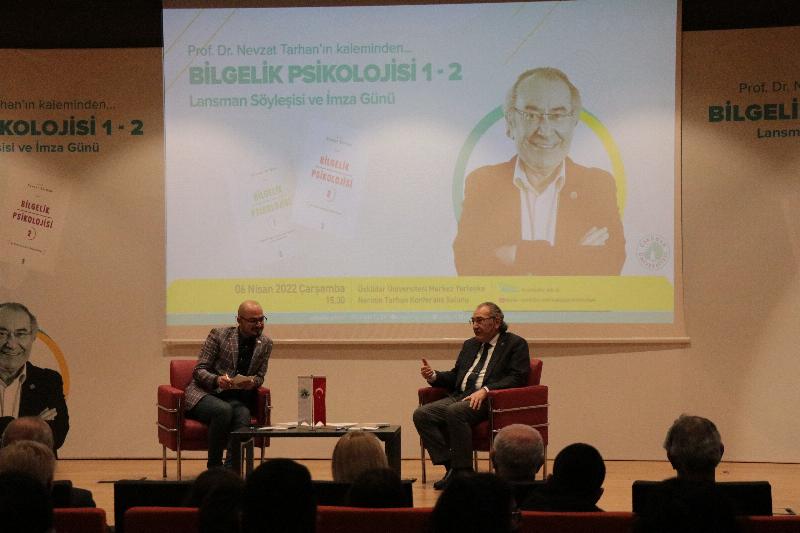
“After reading this book, you will believe in the truth of monotheism”
Prof. Dr. Nevzat Tarhan met with his readers at the interview moderated by journalist Şaban Özdemir at the Nermin Tarhan Conference Hall, Üsküdar Üniversitesi Central Campus.
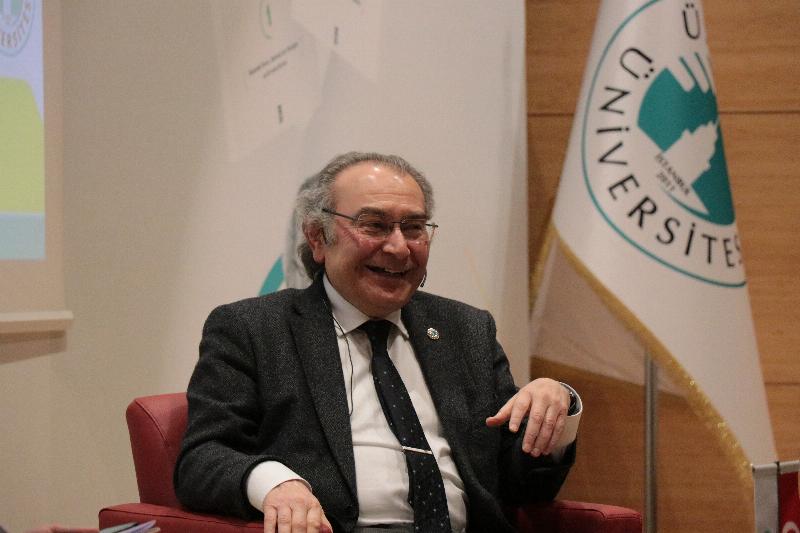
Prof. Dr. Nevzat Tarhan: “This book is a fruit of the Covid period”
Üsküdar Üniversitesi Founding Rector, Psychiatrist Prof. Dr. Nevzat Tarhan stated that the idea for his two-volume book, Psychology of Wisdom, emerged during the Covid-19 pandemic, which affected the entire world, and said, “We can say this book is a fruit of the Covid period. It was a period during Covid when I was trying to make sense of things in my mind, a period I was troubled by. How do we solve this problem? This is a topic I have mentally pondered and researched for many years, thinking we could address it using scientific methodology. First, I framed the topic logically, and then we decided to address it by dividing it into chapters.”
Prof. Dr. Nevzat Tarhan: “New perspectives are needed to understand the universe"
Stating that there is an important development in the scientific world currently, Prof. Dr. Nevzat Tarhan said, “There is a post-materialist science manifesto created jointly by Arizona University and Columbia University in 2014. There is a claim there: ‘Currently, science cannot answer everything. Therefore, we need to expand the boundaries of science.’ They say, ‘We need to take science to other fields and realms.’ Those who say this are a team consisting of neuroscientists, psychiatrists, and psychologists. Later, engineers, geneticists, physicists, and theologians join them. New perspectives are needed to explain the universe. Max Planck, who developed quantum theory, says, ‘We cannot solve the universe because someone from within the universe cannot solve that system. An external perspective is needed.’ In neuroscience, it was known that the human brain operates in a closed circuit; now neuroscience states it operates openly. Currently, there should be a mind above our brain, and a quantum brain above that mind.”
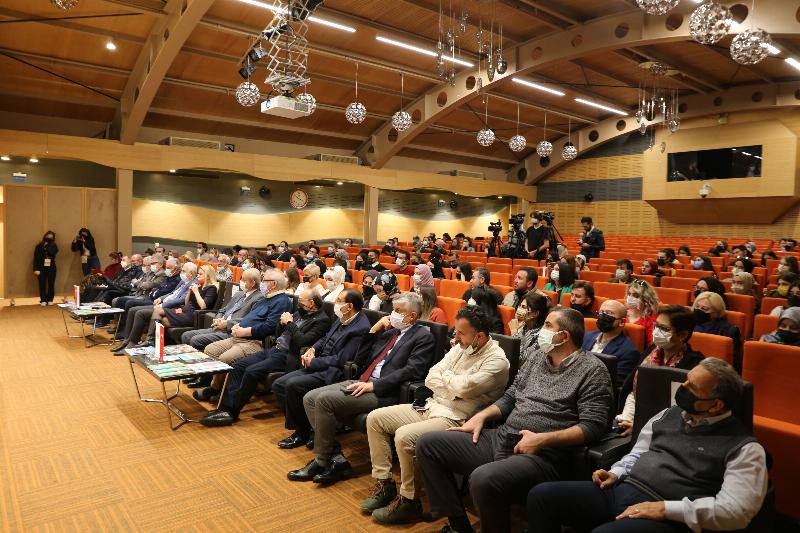
Prof. Dr. Nevzat Tarhan: “There is a need for an evidence-based understanding of faith”
Stating that science and religion can be evaluated together, Prof. Dr. Nevzat Tarhan noted that this perspective is absent in many segments, saying, “How will you defend something you don't put into a laboratory? When 'laboratory' is mentioned, it's always understood as a physical laboratory, yet there are thought experiments. Einstein discovered the concept of time through a thought experiment. Here, it is necessary to question. All sciences are a pool leading to the truth. All information enters a pool; what is approved passes, what is not approved is set aside, perhaps to be proven when the time comes. There is a need for an evidence-based understanding of faith.”
Noting that there are 4,300 religions in the world, Prof. Dr. Nevzat Tarhan said, “They all claim to be the most correct. So which one is the most correct? Science will determine this. Scientific robustness will determine it. It will be put to the test in a laboratory, and whichever is closest to reason will be identified. Currently, there is a need for this synthesis. There is evil in the world. Evil has been created, why is there evil?”
Prof. Dr. Nevzat Tarhan: “Humanity had to pause life during the pandemic”
Stating that a severe lockdown period was experienced worldwide during the Covid-19 pandemic, Prof. Dr. Nevzat Tarhan said, “Humanity understood its helplessness, weakness, and desperation during this period. It had to put life on hold, so to speak. It questioned existence. Why do these exist? It questioned losing its old comfort. People were bothered by the restriction of their freedoms. But this should have pushed them to question. These interrogations happened. I also wanted to combine my professional field with other related areas of interest. There are no other original books written on this topic. I called it Spinoza's fallacy, the evolution of evolution. These are ambitious statements. We called it evidence-based faith, which is also very ambitious.”
Prof. Dr. Nevzat Tarhan: “How will we implement values into life?”
Noting that the values of the lands we live on should be explained to the West, Prof. Dr. Nevzat Tarhan said, “In the first part of the book, we focused on these topics. There are character traits such as being just, honest, and hardworking. How do we implement these traits into life? In the second part, we researched how humans make decisions. The most important question: How does our brain make decisions? Good, bad, right, wrong, beautiful, ugly… We make a decision every minute. Life is a choice. The frontal lobe of our brain is constantly making choices. What needs to be done for these choices to always be correct? How can we avoid falling into mental traps? We addressed this. We also discussed the importance of leadership psychology in decision-making. We covered the concepts of wise leadership, leadership in the family, and wisdom in individuals and families. I performed an ego analysis and also discussed the concept of SWOT analysis, which has not yet entered psychology. This is something not found in psychology books.”
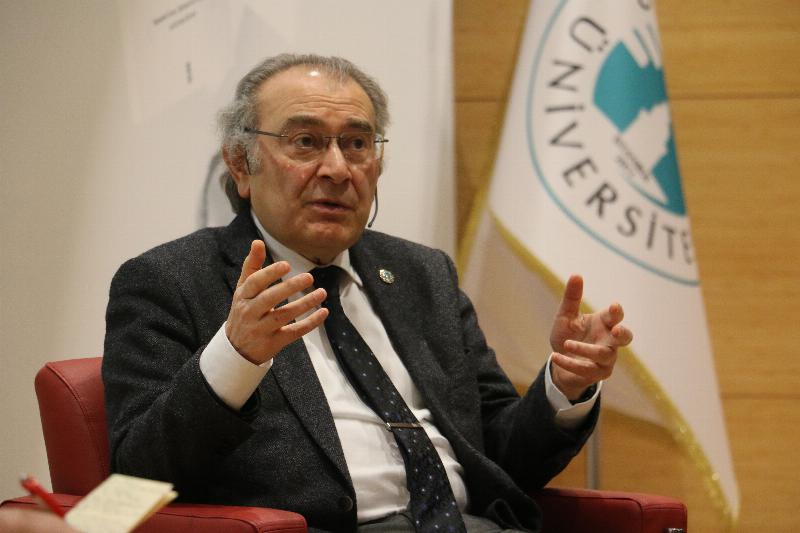
Prof. Dr. Nevzat Tarhan: “Eastern people learn by paying a price with pain”
Noting that Eastern people learn by paying a price with pain, while Western people learn through reasoning, Prof. Dr. Nevzat Tarhan said, “Why shouldn't we learn through reasoning? What we currently call tradition is Mesopotamian culture. In Mesopotamian culture, under the Code of Hammurabi, there were teachers responsible for corporal punishment. The Mesopotamian culture, which forms the Middle East, is a culture of dominant violence and despotism. We have lived this culture for centuries.” Prof. Dr. Nevzat Tarhan stated that we should question many things, from our perspective on the Quran to our beliefs and traditions. Noting that he might receive criticism because of the book, Prof. Dr. Nevzat Tarhan said, “I embarked on a journey to seek the truth. I am open to criticism. I am prepared for anger and difficult questions.”
Prof. Dr. Nevzat Tarhan: “There is a constant need for external control in the universe”
Stating that there is entropy in the universe and a constant need for external control, Prof. Dr. Nevzat Tarhan said, “There is a constant need for external control; otherwise, the universe goes out of control. Ibn Sina called this the necessary being, 'Wajib al-Wujud'. He sees the existence of a single God as a necessary being. Why one God and not many gods? I tried to address this in the sense of monotheism. After reading this book, you will believe in the truth of monotheism as you believe that two times two is four... By using reasoning methods, which is the most probable option, many gods or one God? This is based on probability calculations. If there is to be a God, how should that God be? For example, according to Quantum physics, the universe is a simulation. If there is a simulation, there is a simulator, meaning an organizer, somewhere. Then there must be someone who calculates all possibilities. The possibility of death, the possibility after death, the possibility of human birth, the possibility of illness... This possibility is an omnipotent possibility. It must be a possibility that rules over everything, knows everything, and controls everything. If there is such a being, then it is God. Otherwise, if you say it has created but does not interfere, then a helpless God is understood. Such a belief is contrary to reason. There is such a fair balance within the cell that nothing works by chance. There is a tremendous harmony. It operates in balance like a factory. Why would a system that establishes this order within the cell create injustice and unfairness in this universe? I then thought there must be an explanation for this.”
Prof. Dr. Nevzat Tarhan: “The universe, a database…”
Noting that what is called the universe is a database, Prof. Dr. Nevzat Tarhan said, “In the universe, there is first a database. After this database, there is calculation, there is mathematics, and then design, energy, physics, chemistry, and matter emerge. After that, biology and living things come into being. There is such an existential hierarchy. Dialectical materialism says, ‘First there is matter; abstract knowledge emerged dialectically from matter. Humans discovered and extracted this. Meaning emerged while analyzing matter.’ Quantum, on the other hand, says, ‘First there is information, there is a database. Only then can matter exist. Matter is not the cause but the result’.”
Prof. Dr. Nevzat Tarhan: “Metacognitive genes distinguish humans from other living beings”
Noting that humans possess four distinct metacognitive genes, Prof. Dr. Nevzat Tarhan said, “One of these is the gene for meaningfulness. No other living being besides humans seeks meaning. It doesn't ask what the meaning of life is or why it exists, but humans seek meaning. When there is no meaning, humans are not satisfied. The ability to dream exists in humans. The second gene is the gene for seeking novelty. Humans constantly develop themselves. The third is the gene related to the concept of time. No other living being besides humans has this concept. The fourth is the gene for awareness of death. Humans are the only living beings aware of their mortality. The questioning of the afterlife also exists only in humans. There are genetic codes that encode abstract thought.”
Prof. Dr. Nevzat Tarhan: “I presented the information to the scientific discourse”
Noting that the philosophy of life emerging from modernism has made humans selfish, thinking only of their own interests, and that this situation accelerated after the Covid-19 pandemic, Prof. Dr. Nevzat Tarhan stated that people are in search of a new existential philosophical quest. Prof. Dr. Nevzat Tarhan said, “It is necessary to offer new alternatives to people. This exists in our culture. If we do not write and articulate these, if we do not present them to the scientific discourse, future generations will be angry with us, saying that we only thought of ourselves. Therefore, I presented this information to the scientific discourse on this matter.”
Prof. Dr. Nevzat Tarhan: “Love is an electromagnetic energy”
Prof. Dr. Nevzat Tarhan noted that one of the topics covered in the book is values, stating, “Love is an important concept. Love is like electromagnetic energy. It creates attraction. It is no longer solely the subject of litterateurs and poets. It has entered the realm of science. It concerns the management of emotions. Humans make decisions not only with their logic but also with their emotions. Emotions have now entered a scientific domain. People can be persuaded by reason but motivated by emotions. A synthesis of reason and emotion is necessary. Emotion is the engine; it drives people to act. Reason is the steering wheel. Both should be used together. The most important wisdom in overall wisdom is emotional wisdom. One of the topics we covered here is the skill of managing emotions.”
Prof. Dr. Nevzat Tarhan: “Compassion is love with empathy”
Noting that love should be unconditional, Prof. Dr. Nevzat Tarhan said, “For example, a mother who loves her child says, ‘If you do this, I will love you. If you don't, I won't.’ Here, she uses love like a stick. This conditional love is unhealthy and harmful. It also arouses feelings of guilt in the person and weakens self-confidence. There is a greater concept than love, which is compassion. Compassion means love that contains empathy. Respect with empathy is respect accompanied by sensitivity not to hurt the other party. This respect is politeness. Be assured that if we implement the two concepts, the values of compassion and politeness, in a home, family, or institution, many problems solve themselves.”
Great interest in the mini-competition
At the end of the interview, participants showed great interest in the 10-question Kahoot competition. In the competition, which featured questions about the two-volume book Psychology of Wisdom, the first 50 participants who answered the questions correctly were gifted a set of the Psychology of Wisdom books authored by Prof. Dr. Nevzat Tarhan.
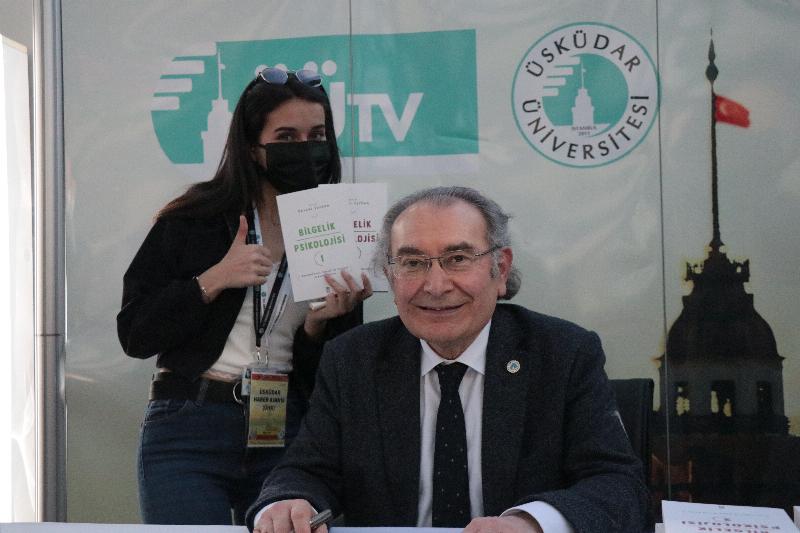
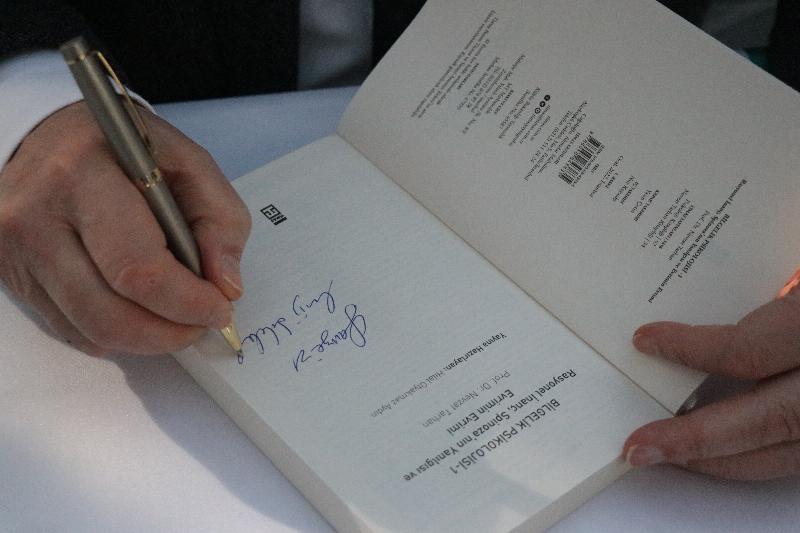
Prof. Dr. Nevzat Tarhan signed his books
Participation in the interview, which was broadcast live on Üsküdar Üniversitesi’s official YouTube account and ÜÜ TV, was high.
After the program, author Prof. Dr. Nevzat Tarhan signed his books for his readers and took photos with them.