

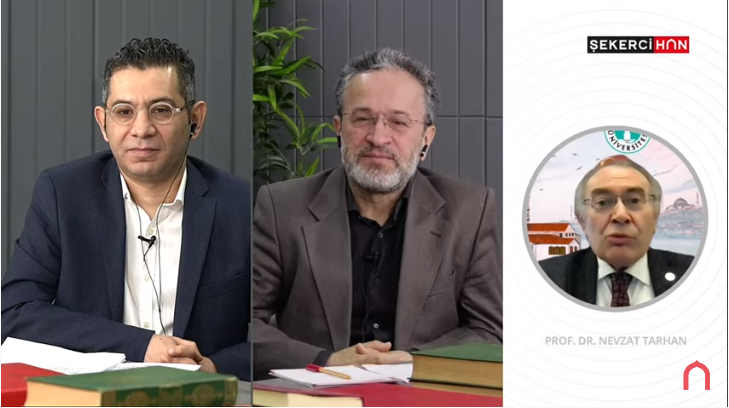
Üsküdar University Founding Rector Psychiatrist Prof. Dr. Nevzat Tarhan was the live broadcast guest on the ‘Ramazan is a Feast’ program on the 19th day of Ramadan. In the program, which discussed “Social Lessons from the Ifk Incident,” Tarhan stated that goodwill is the rule and ill-will is the exception in close relationships. Tarhan also underlined that backbiting is a societal, social poison.
Content
Prof. Dr. Nevzat Tarhan: “Goodwill is the rule, ill-will is the exception”
“The first thing despotism corrupts is morality”
Speaking on Şekercihan Association's YouTube live broadcast, Tarhan stated that the concept of despotism is not compatible with Islam; “The biggest cause of gossip is ill-will. The disease of ill-will is the disease of a culture of fear. This happens in cultures of oppression and fear. In a society where there is oppression, fear, and tyranny, people in despotic cultures cannot speak the truth, so they internalize it and engage in sedition, mischief, and intrigue. The reason for the sound business ethics in Europe is the presence of open, transparent relationships. Because people have open, transparent, and honest relationships, they speak openly about everything. They say, 'This is your everything,' and 'This is your situation.' They don't feel the need to hide intrigues to become topical. I wondered why our ancestors' morality was good in a society, but now it has deteriorated... The reason for this is that the Ottoman Empire, especially from the 1600s onwards, became harsher and more authoritarian as its power weakened. As its power waned, despotism took hold. For example, during the reign of Abdülhamid, under the influence of despotism, the judicial process was secret, while the interrogation process was open. Can there be justice where the judiciary is secret? Thus, the system of justice was corrupted, and despotism ruined morality. The first thing despotism corrupts is morality. It makes people tell defensive lies. When lies are told, that lie is like a virus; it spreads rapidly, and all evils begin to follow. Lies become slander, intrigue, and when morality deteriorates, justice also deteriorates. Therefore, cultures of oppression and despotism are not compatible with Islam.”
“Goodwill is the rule, ill-will is the exception”
Emphasizing the importance of acting with good intentions, Prof. Dr. Tarhan said; “For example, a mother tells her child, 'Eat your food, if you don't eat your food, I will not forgive you...' And then she says, 'You will have wronged me.' By saying, 'If you don't do what I say, if you don't eat your food, you will have wronged me,' she awakens a sense of guilt in the child. In such situations, the child's self-confidence is damaged. The child develops both love and anger towards the mother. What does such a child do to survive? They start acting with suspicions in the face of events. Wondering 'is it like this or like that,' ill-will in close relationships and experiences is something we see as an illness. One should have good intentions towards a friend, and ill-will towards an enemy. If you harbor ill-will towards your friend, the devil within you has activated you. You must immediately feel regret. You must ask, 'Why did I think such evil of my friend?' For example, if you say something, and you claim your intention is right, what does this mean? It means your intention might not be right in return, but there is judgment here. Therefore, in close relationships, good intentions are the rule, and ill-will is the exception. I believe destiny gives us a wonderful lesson on good and bad suspicion in the Holy Quran. It says you must act with good intentions.”
“The spread rate of gossip and slander is 5-6 times faster”
Prof. Dr. Nevzat Tarhan gave examples using the working mechanism of the human brain; “An electroencephalogram (EEG) is attached to the brain. A person is given a positive stimulus and a negative stimulus. The brain's response to the positive stimulus is observed; for example, a button is given, and the person is told to press white if yes, red if no. Something is asked of the person, and the brain's immediate response is recorded. The brain responds to a positive event after 300 milliseconds. A P300 wave emerges. If it is a negative event, if the brain perceives the event as a threat, a P50 wave emerges after 50 milliseconds. The human brain perceives negative events 6 times earlier. The human brain operates based on feelings of safety and threat. So if something explodes here, we drop everything and deal with it. Because there is now a vital reason, a threat. That's why the media uses this very well. It always dramatizes events, exaggerates them, and then tries to attract attention under excitement. It covers up and hides many important events. This also creates a weakness for the media. So here, the human brain perceives negative events earlier and faster. It perceives positive events later and slower. For this reason, the spread rate of gossip and slander is 5-6 times faster. More than truths, and in such situations, if a person is pointed at, if they are a public figure, a hadith states that being pointed at is enough of a calamity for a person. It says, 'Except for those whom Allah protects.' When does Allah protect those who are pointed at, those in the public eye? He protects you if you are sincere. If you are sincere, if you make the apparent divine purpose your goal, if you expect nothing from people for the work you do, Allah gives protective angels to such people. In such situations, seeking refuge in sincerity is the most correct course of action.”
“Our life is always a choice”
Tarhan explained the importance of making choices, stating that the human being always has to make choices in life. Tarhan; “Our life is always a choice. We are constantly making choices, constantly in every decision. When we experience a crisis, a person first decides based on existing decisions. If they don't know, they decide based on assumptions. Here, values and prejudices come to the forefront. If a person cannot self-criticize, has a high ego, is selfish, or acts with other dynamics, their values do not immediately question things. For example, we know the justice of Caliph Omar (Hz. Ömer); as he was going to implement a decision, someone comes and brings news, saying 'it's not like that, it's like this.' That's why Caliph Omar stops and says, 'This is the right one, we made a mistake,' and turns towards the correct path. That's why they called Caliph Omar 'Vakkaf' (one who stops and reflects). Vakkaf stops and re-decides. That is, he looks at his mistake and decides accordingly. Caliph Omar achieved justice in this way. He doesn't act on his feelings, he doesn't make sudden decisions. Humans have a basis for having both bad and good suspicions. Because the human brain generates theories. When it cannot prove something, it decides with assumptions. It decides with suspicions, saying, 'It must be like this,' and makes a decision. Without proof; there's a saying in Anatolia, 'Believe what you hear, and only half of what you see,' it's so beautiful, it's a saying of Anatolian wisdom. Because for a person who believes what they see, telling everything they hear would be enough as a calamity. They tell everything they hear, and they can break up a family. This is very important. There is wisdom in the Holy Quran giving such importance to it in one verse.”
“Backbiting is a societal and social poison”
Tarhan pointed out that backbiting is a poison and that people who slander are often narcissistic. Tarhan; “When a person backbites, it's as if their good deeds (sevap) are taken and given to the one they backbit because backbiting is a sin. This helps the person realize their mistake and, in a subtle way, provides a tremendous lesson. Indeed, backbiting is a societal poison, a social poison. When you look at those who slander, you see a specific psychology: they are narcissistic individuals. They see themselves as important, superior, and special. They see themselves at the center of the world, and their sense of entitlement is directed towards themselves. They appear to deserve everything. A narcissistic person has a traffic accident on the way, facing a great danger of death. When they arrive, they say, 'I had an accident,' and the other person objects, 'How can you be late for my appointment?' The man has returned from the brink of death, yet there is no empathy in the other person. One must flee from such people as if fleeing from a snake or a scorpion. They are selfish, they want to enslave you, and they desire a master-slave relationship. These individuals easily slander to achieve their goals. It doesn't matter if you've been disgraced or lost something. They are opportunistic, self-serving individuals. Unfortunately, capitalist ethics feed this. The prevailing concept is that what matters is winning.”
What is the Ifk Incident?
Ifk is the name given in sources to the incident of slandering Aisha (Hz. Aişe). It means words that have been twisted from their original essence, with the truth altered. According to sources unanimously, the Ifk incident occurred on the return from the Ghazwa of Banu Mustaliq (Benî Mustalik).
Share
Update Date: February 28, 2026
Creation Date: April 21, 2022
Request a Call
Other News
- Social responsibility courses moved to the field
- Erasmus+ Orientation Week completed at Üsküdar
- Prof. Nevzat Tarhan: “Brain secretes ‘dark glue’ in social media lynchers!”
- Prof. Nevzat Tarhan: “Every segment of society should be able to say, ‘This constitution is my constitution!’”
- OHS releases guide for safe operation of industrial robots