

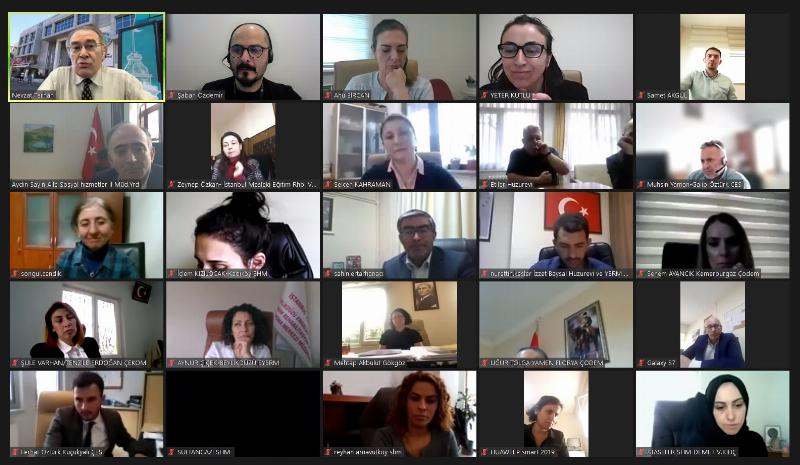
Psychiatrist Prof. Dr. Nevzat Tarhan, Founding Rector of Üsküdar University, participated as a speaker in the in-service training program organized by the Istanbul Provincial Directorate of Family and Social Services. The training program, held online for senior executives and personnel of the Istanbul Provincial Directorate of Family and Social Services, featured Tarhan's remarks within the context of 'The Use of Positive Psychology Techniques in Management'. Tarhan stated: “A good person is not someone who never thinks of evil, but someone who thinks of evil and chooses good. A positive person is not someone who doesn't feel or know negativity. A positive person has both negative and positive feelings, but they live their life based on their positive feelings.”
Content
Prof. Dr. Nevzat Tarhan; 'A good person is not someone who never thinks of evil, but someone who chooses good'
“This consent-based system comes with its own problems”
Prof. Dr. Nevzat Tarhan began his speech by asking, 'Why has today's leadership model changed, and what is the new concept in leadership?', making predictions about the future. Prof. Dr. Nevzat Tarhan stated: “These are simple realities of today. There are expensive watches but no time at all, too much friendship on social media but less real friendship, more suspicion and less trust, more discrimination and less empathy, more material prosperity and less spiritual peace. We are in such a time now. So, what has changed? Actually, there was first Industry 1.0. The machine revolution occurred. In the years 1800-1900, electrical power was added to this. Power, the feeling of capital domination, passed into the hands of the powerful. Industry 3.0, in the 20th century, with electricity, electronics, and machines, initiated the third industrial revolution, the information age. In Industry 4.0, there are autonomous robots. Simulation, Metaverse, cybersecurity, cloud communication, 3D printers, and augmented reality. In the Metaverse era, everyone will have an avatar, a virtual world will be created. In 2018, a new artificial deity was used at the Davos Summit for the virtual universe. In fact, a dissenting voice emerged, stating that this world is heading towards a digital dictatorship. Assange said, ‘we are the last free generation.’ He was right in saying this. With digital control, it will be possible to control all social movements and human mobility. This consent-based system comes with its own problems.”
“All of us have benevolent or malevolent aspects within us”
Prof. Dr. Nevzat Tarhan drew attention to the concepts of benevolent and malevolent in leadership: “In society, there are legal norms along with laws. There is social morality determined by traditions. These are also governed by externally controlled laws. By social norms, what we call peer pressure. And there is a third one: conscientious norms, an internal control system. There are two guardians in the conscience, a person has a mental jury. External control refers to openly committing evil. The reason for all this comes from a person's desire to commit secret evil. Being our own leader is actually the first condition of leadership. Someone who cannot do this cannot be the leader of others. If they cannot manage themselves, they cannot command their children. If they are a teacher, they cannot be the leader of the class. If they are a manager somewhere and cannot keep their word, their credibility weakens in the eyes of others. It is said that leadership candidates should be diligent and intelligent, but that's not enough. They must also be benevolent. For example, a smart, hardworking engineer graduates but then produces synthetic cannabis and goes to prison. Yes, smart, hardworking, but not useful. All of us have benevolent or malevolent aspects within us. Whichever we feed, those come to the forefront more.” he said.
“A human being is a creature composed of a mixture of negative and positive aspects”
Prof. Dr. Nevzat Tarhan elaborated on the types of intelligence and their effects on leadership: “Logical intelligence is about being idealistic. It is strategic thinking, such as predicting the future, creating expectations, and planning for the future. Emotional intelligence, on the other hand, is activist. One is idealistic, optimistic, and courageous, instilling trust in people. They are self-confident. Those with bodily-kinesthetic intelligence also have work discipline, risk-taking ability, and self-sacrifice. Conscientious intelligence involves job responsibility and accountability. One is responsible to the Creator. They act in accordance with ethical values, such as reasoning with morality. Social intelligence is about being open. It is about business and trust cohesion, and being able to manage crises. It's about making solution-oriented decisions as an active listener and considering the feelings of others. All these are necessary in a balanced way for leadership. If a person possesses these, they can make sound decisions. Those who are emotionally negative see both winter and summer, but they constantly live according to winter, fearing its arrival. They always complain, they are unhappy. They grumble about everything. They constantly want trouble to be with them, and they listen to troubles. Those who are emotionally positive, in this case, are like this: Emotional positivity is not Pollyanism. There is a difference between the two. In Pollyanism, you interpret everything optimistically, never see the negative, and ignore it. In personal development, coaches mistakenly provide Pollyanism training. They train people by making them ignore their negative aspects. However, a human being is a creature composed of a mixture of negative and positive aspects. A good person is not someone who never thinks of evil, but someone who thinks of evil and chooses good. A positive person is not someone who doesn't feel or know negativity. A positive person has both negative and positive feelings, but they live their life based on their positive feelings.” he said.
“If there is accountable leadership, trust is formed among people”
Prof. Dr. Nevzat Tarhan spoke about the necessary characteristics for achieving corporate loyalty among employees: “Corporate loyalty studies are being conducted. Personality traits that ensure corporate loyalty have been researched there. First, the person needs to love their workplace. If a person willingly goes to both work and home, it means there is corporate loyalty. Because home is also an institution. Second, the person needs to feel secure about their future. What does this mean? If there is a malevolent leader in your institution, who can undermine you, or plot against you at any moment, you will not feel secure about your future in this way. You will always act defensively. In third place comes the salary the person receives. So, the first condition of corporate loyalty studies is for the person to love their workplace. Second is feeling secure about their future, and third is the salary they receive. Working in a peaceful environment cannot be measured by money. You spend eight hours there; if you don't work peacefully, it won't work. In other words, you don't go to work every day as if going to war. That wouldn't be sustainable. That's why positive leadership brings this. The issue is not religiosity, patriotism, or good intentions. The issue is accountability. If there is accountable leadership, trust is formed among people. This is a big thing. That is, there is no staff unrest or group stress. In this way, even the number of people going on sick leave decreases.” he said.
Share
Request a Call
Other News
- The book that read today's digital threats in 2014: Being a Conscious Family
- Experts warn: 'Instead of memorizing letters, teach pencil grip, scissor use, and coloring'
- School fear and school love both start in the family!
- Family is not merely transforming, it is being battered under a serious assault
- Artificial intelligence opens the door to early diagnosis in autism!