

Üsküdar Üniversitesi Department of Health, Culture and Sports, under the leadership of Üsküdar Üniversitesi Positive Psychology, Üsküdar Üniversitesi Political Psychology Club, Psychopark, and Üsküdar Üniversitesi Psychology Club, organized the “Being a Conscious Young Person” talk, which garnered great interest. Tarhan, speaking on the topic of love being a fanatic emotion, said: “Fanatic love is the irrational form of love. Even knowing it is absurd, fanatic individuals are fanatics. People in love are also like that. In fact, the feeling of love is also a fanatic emotion. That is, it directs its target not with rational love but with irrational love. The period when this emotion is most intense is high school, adolescence. Fanatic outbursts are natural during adolescence. That's why fanaticism in adolescence is beneficial.”
Content
Prof. Dr. Nevzat Tarhan: “Fanaticism in adolescence is beneficial”
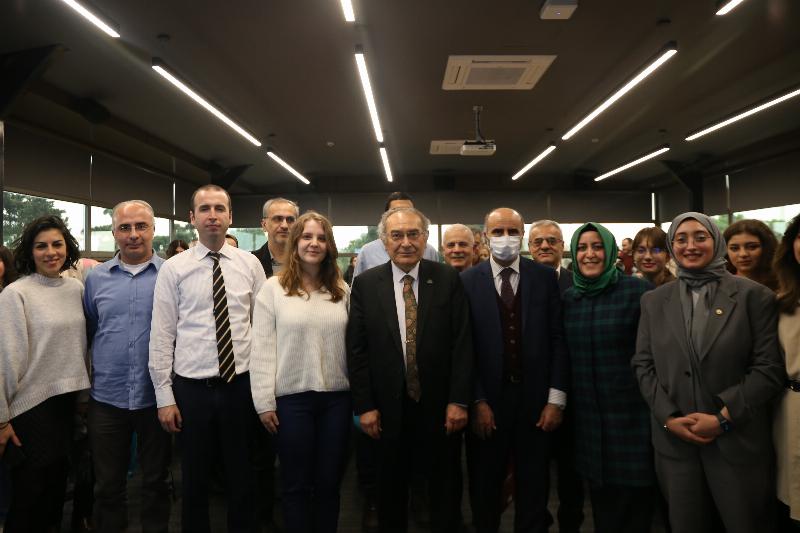
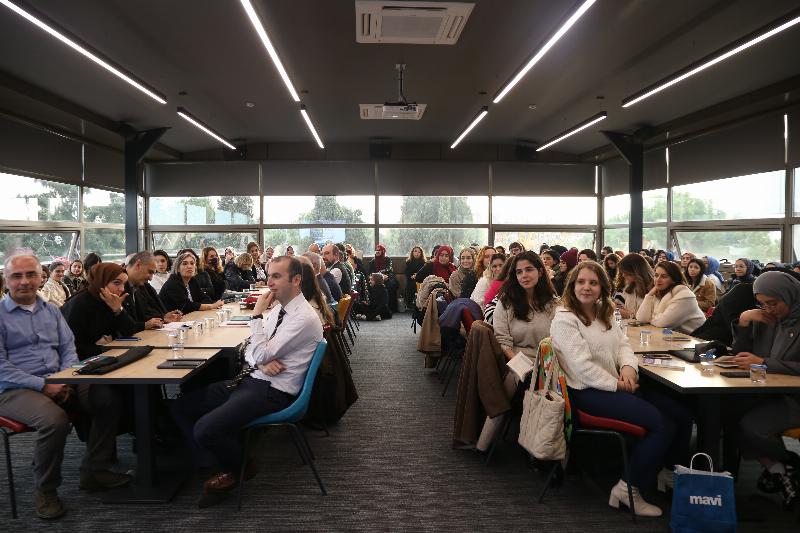
Academics from Üsküdar Üniversitesi's Faculty of Humanities and Social Sciences attended in full the talk held in the Socrates Hall of the Faculty of Humanities and Social Sciences.

“If there were no frontal lobe, there would be no civilization”
In the talk held under the title of the book 'Being a Conscious Young Person' written by Üsküdar Üniversitesi Founding Rector Psychiatrist Prof. Dr. Nevzat Tarhan, Tarhan first spoke about the purpose of writing his book and its emergence process. Tarhan said: “I tried to explain something that could be very beneficial for a person to read in their life up to the age of 22, by synthesizing my own experiences with ancient knowledge and scientific information. My purpose in writing the book was this: In 2006, we had made a television program about young people, especially high school students. In 2006, there was SKY TÜRK. High school students came to the program, and the Q&A continued for 10-12 months. Broadcasters have a 13-week rule. I asked the communicator, 'Why is it 13?' and he said, 'I don't know.' Then it occurred to me, dividing a year by four makes 13. They found 26-52 weeks from there. The number 13 is not very popular. In America, I noticed there's no 13th floor in elevators. Is it the same here? Perhaps people approach the 13th floor with a superstition of bad luck. They say the number, the word '13' is like sending a message to a devil, attracting negative energy, but these are superstitions. Believing in such a thing is both irrational and unscientific. In some things, I deliberately choose 13 because if you perpetuate absurdity, it continues. I analyzed what high school students need. In the decision-making stage of life, adolescence cerebrally transitions to the period of positivity at age 22. The brain's maturation process occurs by age 22. It goes into the positivity period at age 22. But in some men, this takes until the age of 40. We call the end of adolescence 'prolonged adolescence'. That is, in men, the bridge part between the right and left brain, the maturation of this bridge part is almost fully established at age 22. In the 20-18 age period, during adolescence, the area where decisions are made about what is beneficial/unbeneficial, good/bad, right/wrong, as I frequently emphasize, if the frontal lobe, the front part of the human brain, did not exist, there would be no civilization.”
“If maternal deprivation lasts more than a month, there is a risk of autism in the child”
Prof. Dr. Nevzat Tarhan spoke about the need to teach children to take initiative, question, and be assertive at a young age. Tarhan said: “When raising a child, our emphasis on self-confidence does not mean spoiling them; we are talking about the necessity of teaching children to take initiative, question, and be assertive at an early age. Because low self-confidence is most common in childhood traumas, these individuals also become very depressive and pessimistic. Basically, if a person doesn't lose self-confidence, there is a way out. They find it themselves. Seek and you shall find. Because searching, being able to succeed in searching, is important. For example, the mother's womb is a very comfortable environment. Everything is ready. It lives quite comfortably. When born, air suddenly enters the baby's lungs. The first reaction it feels is fear. After that, it seeks security. There is the mother, who provides security with her love. It smells its mother's scent. There is even a maternal deprivation syndrome in childhood. In maternal deprivation syndrome, the child's behavior is used in diagnosis. The child cries constantly. When someone comes, it stops crying. It looks for its mother and cries again. In maternal deprivation syndrome, if a mother's clothing is placed there, the child stops crying when it smells the scent. If maternal deprivation lasts more than a month, there is a risk of autism in the child. Therefore, if the mother is working, going to work, we say she should say goodbye to the child before leaving. If she deceives the child, puts it to sleep and then leaves, the child not finding its mother upon waking up causes it to live in fear until the evening. After saying, 'I am leaving now, but I will be back at this time in the evening,' she should keep her word and say goodbye before leaving. If she doesn't say goodbye and leaves, that child feels relieved when its mother returns, but spends the entire day in fear. An open, transparent, and honest relationship between mother and child is important.”
“When you don't have the power to change the flow, you will change your perspective”
Tarhan, drawing attention to the fact that spouses should not try to change each other, noted that the life script needs to be rewritten. Tarhan said: “The brain does not forget emotion. Emotion makes experiences more vivid. Because we easily forget what we think in the brain. If we repeat what we understand, we won't forget, but if we don't repeat, we will forget again, yet we don't forget what we have experienced. Because experiences, childhood stories, childhood scripts, and childhood experiences remain as scenarios in our developing souls. Let's say two people got married. After getting married, one comes with a different life script. The other comes with a different life script. Two people who have lived two different life scripts come together. If a man or woman says; 'My father was such a person, and I want my spouse to act like my father,' then there will be no peace in that home. That is, trying to change one's spouse. One needs to rewrite the life script. If one does not rewrite the life script, one cannot succeed. The actors have changed, there are new actors. One should say, 'I will rewrite the script for these actors.' One will not change one's personality. One will only change one's perspective. If one tries to change the flow, one will hit a wall, but if one changes one's perspective, it will have a positive effect. When you don't have the power to change the flow, you will change your perspective. Sometimes things happen where a person says yes to everything. They bottle it up and then get sick. At the beginning of marriage, they say in Anatolia, 'You must separate the cat's leg.' Today, there is no type of woman who will be silenced by a cat's leg, not in the world, and men shouldn't expect it here either. One of the biggest causes of violence against women is these cultural accumulations. Here, it is the male mind that does not notice the transformation in the world.”
“Humanity's anxiety about the future is also related to our genetic codes”
Prof. Dr. Nevzat Tarhan stated that anxiety about the future stems from a person looking at an event entirely with prejudices. Tarhan said: “Anxiety about the future in youth is the most important characteristic that distinguishes humans from other living beings. Metacognitive genes are mentioned in humans. Genes above the mind are mentioned. There are four 'supra-mind' genes in humans; a genetic counterpart has been found for one of them. Research is being conducted to see if there are genetic counterparts for all four. It might be multi-factor, or multi-genetic, but there is a 6% difference between chimpanzees and humans. We share 95% of the same genes, with a 5-6% difference. We share 50-60% of the same genes with moss. Some people are right when they say 'like grass'. The person has never developed himself. Just as he was born. He only grazed in the same field and grew up like that. Humanity's anxiety about the future is also related to our genetic codes. This isn't called a specific genetic code yet, but it's believed to exist. For example, there is a gene related to time perception. No living creature other than humans perceives the past and the future. Think of cows, sheep. In their world, there is living in the moment. Humans live in the present. They know the past, think about the future, but live in the present. 'Live that moment' is a wrong expression; humans live in the present. The past is history. The future is a puzzle. Therefore, you will live today. If you don't look at life through this lens, then the future is a puzzle. How do you approach a puzzle? You look at life thinking, 'How can I solve this puzzle?' Because 20% of our reactions are related to the events, 80% are related to our reaction to the events. 20% of the events we experience are directly related to the event itself, 80% are related to our attitude towards the event, the position we take, and the connections we establish. Therefore, 80% of our reactions are changeable. Since 80% of our reactions are changeable, anxiety about the future is due to looking at the event entirely with prejudices. We call this a cognitive trap.”
“You make provisions according to the strategic goal”
Tarhan, emphasizing that someone planning for the future should not worry about it, said: “A person who is pursuing a meaning in life does not easily lose connection with their goal, and this also exists in military terminology. We also use this in political psychology. There, a commander creates a war strategy. He wants to carry out the best course of action. In war strategy, if the strategic move is wrong, success in the operational action has no meaning. For example, our strategic goal/strategy that we applied in the First World War was wrong. Entering the war was strategically wrong. We didn't have that power, but once we went, we succeeded in the Gallipoli Campaign. We were successful in Iraq, but because the strategic goal was wrong, we lost the whole. Local successes had no meaning. Therefore, you make provisions according to the strategic goal. In military objectives, if your strategic goal is correct, you make provisions accordingly. In fact, when a commander captures a hill between enemies, tents are set up. Everyone sleeps. The commander cannot sleep. Why? He goes around one by one, wondering where the enemy might attack from. He places the sentries and then sleeps. It is the same for people in life. When under threat, you take precautions and then continue on your way. But what do we do? We prepare for winter, we wait for winter. We will prepare for winter but wait for summer. Anyone who plans for the future should not worry about it at all. Humans also have a concern for the future and past, and the ability to produce abstract thought.”
“Fanaticism in adolescence is beneficial”
Tarhan, mentioning that the feeling of love is also a fanatic emotion, spoke about how the target is now directed not by rational love but by irrational love. Tarhan said: “Since sports are important for men, what is fanaticism in sports? Fanatic love is the irrational form of love. That is, even knowing it is absurd, fanatic individuals are fanatics; people in love are also like that. In fact, the feeling of love is also a fanatic emotion. That is, it directs its target not with rational love but with irrational love. For example, like the love of Leyla and Mecnun. It is a fanatic love. As you know, Leyla and Mecnun are both in love with each other. Even a war broke out to bring them together. It is a magnificent work by Fuzuli. Fuzuli is an Azerbaijani poet. Later, such was the love that they married off Leyla. But Leyla cannot express her love. She doesn't marry after much contemplation, but dies from refusing and pondering. They finally unite her with him, the family also wants to bring them together, but Mecnun leaves her precisely when they meet. That's why they called him Mecnun. After that, they asked Mecnun: 'This Leyla is a dark and scrawny girl, how did you love her?' Mecnun replied: 'Look at the Leyla in my eyes.' That's why it was called love. He was blindly and fanatically attached. There is even the phenomenon of the moth for this. At night, there are moth insects around lights. They circle around the light. That's why they are called pervanes (moths). They dive into the fire, hit it, and die. They too, in a way, go towards that light. It's not related to love, but their brains see it as a threat. They sacrifice themselves. Humans also have this feeling/emotion, like this. The period when this emotion is most intense is high school, adolescence. Fanatic outbursts are natural during adolescence. That's why fanaticism in adolescence is beneficial. A person lives and feels it, but if they develop behaviors, they correct it. The environment is very important here. Culture is very important. Just as there is a dividing boundary between buildings, there are also boundaries in social life. We approach civilization in our books from the point where humans began carving stone.”
“Love in life is not a cause but a result”
Prof. Dr. Nevzat Tarhan drew attention to the idea that love + good cooperation turns into lifelong love. Tarhan said: “As it is in Ümit Yaşar's poem; 'I looked at the tree, it was you; I looked at the season, it was you; everywhere you. Everywhere Aysel.' If you fall in love, you see Aysel everywhere. To not be like that, fanaticism is a wild horse. Love is something that needs to be managed, but love is like an ivy. Love in life is not a cause but a result. Love is a beautiful thing, but it is a result. That is, in relationships with the opposite sex, they fall in love with each other. After 6 months, they get caught up in this 'televole' culture; they divorce after 6 months, love ends. What happened? It flew, it evaporated. Why? They are in love with each other but cannot establish good cooperation. Love + good cooperation = turns into lifelong love. But if they cannot establish good cooperation, love evaporates, and then it makes one wander from mountain to mountain and become a poet. Fanaticism in sports is also like that; it was nice and beautiful in adolescence, but if a person deactivates their mind, love turns into torment for them.”
“Only worldly thought does not make a person happy”
Prof. Dr. Nevzat Tarhan, speaking about the human desire for eternity, said: “Our perspective on life and the decisions we make are very important. From this point of view, we need to see if role models are the right guide for us not only in our life but also in our eternal life. Only worldly thought does not make a person happy. That is why there is a desire for eternity in humans. There is most likely a 'gene for permanence/survival'; just as there is a cause-and-effect relationship between our stomach's desire for hunger and the existence of food. There is a causal link, and the desire to live after death also has a causal relationship with the existence of an afterlife for humans. Therefore, if there is no life after death, this life has no meaning. That is, it has no meaning in the world. Then why are we human? If the purpose of life is to eat, drink, and procreate, then life has no purpose, but humans do not belong to this world. You know that if the bees we have today disappeared, the world would become a desert in fifty years. It was done with mathematical modeling. If humans disappeared, the world would be paradise in fifty years. What is this? This means that humans came to Earth later, from another place. Not a product of the Earth, that's why we are here; there's an unseen universe beyond Earth, there are black holes, and we will also think about what's beyond black holes. Everything that enters black holes disappears. Beyond black holes, there is another universe.”
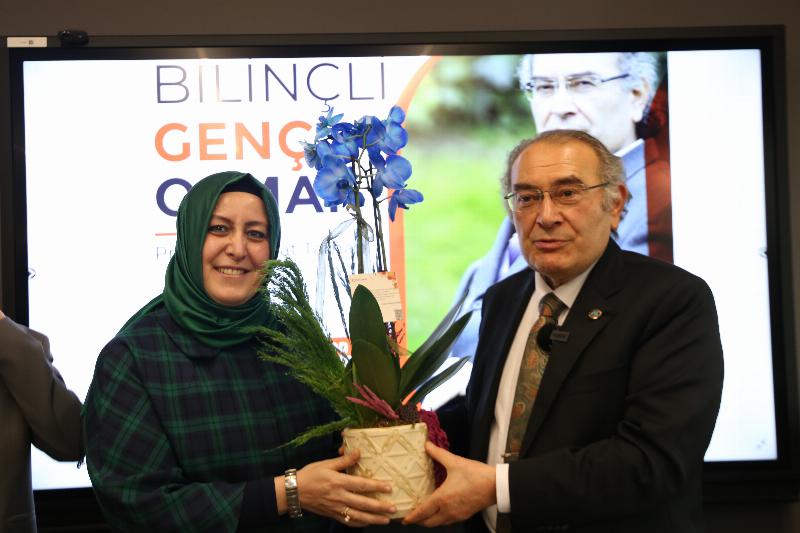
The talk, during which the book 'Being a Conscious Young Person' was distributed to every student, concluded with a group photo.