

Pointing out that the exclusion of people with disabilities from society psychologically harms them, Prof. Dr. Nevzat Tarhan said, “When you treat people with disabilities as second-class citizens, we create social barriers for them, we hurt them. The greatest harm is psychological harm.” Stating that one of the biggest invisible barriers created against people with disabilities is emotional blindness and emotional deafness, Tarhan said, “People with emotional blindness and emotional deafness cannot empathize.”
Content
Prof. Dr. Nevzat Tarhan: “Exclusion Harms People with Disabilities the Most”
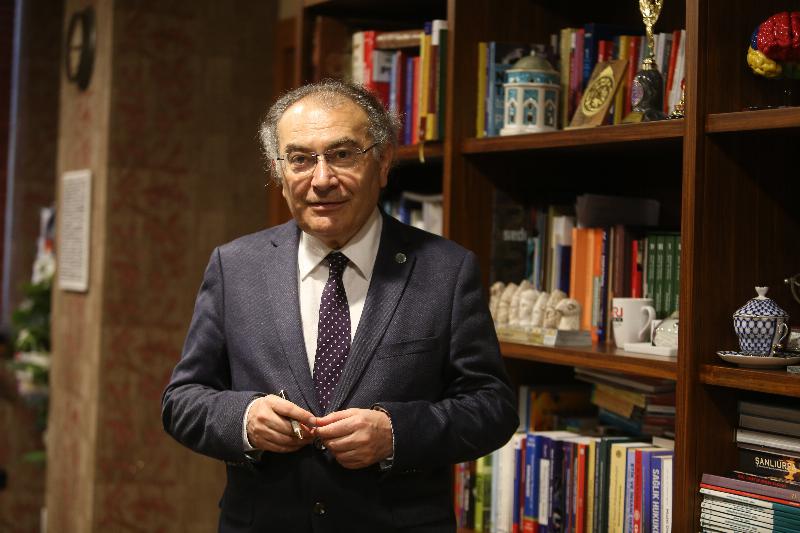
Social barriers bother people with disabilities the most
Prof. Dr. Nevzat Tarhan, stressing that what bothers people with disabilities is not their own disabilities, but the existing barriers in society, said, “When we empathize, we see this: What bothers people with disabilities the most are not their physical disabilities, but social barriers. They are people’s prejudices. These barriers and prejudices sadden and hurt people with disabilities even more.”
Prof. Dr. Nevzat Tarhan noted that there are many types of disabilities, stating that in addition to physical and mental disabilities, there are also disabilities caused by developmental disorders. He emphasized the importance of attitudes of mothers, fathers, families, and teachers in overcoming the difficulties caused especially by congenital disabilities. Pointing to the importance of leadership for individuals with disabilities, Tarhan said, “Leadership is important for children with disabilities. Teacher leadership is important, and parental leadership is important.”
They should take a greater part in working life
Prof. Dr. Nevzat Tarhan also emphasized the place of individuals with disabilities in society and their necessity to participate in working life, stating, “One of Turkey’s biggest achievements during its European Union accession process was the granting of various rights related to people with disabilities. In the European Union, individuals with disabilities are enabled to participate in life. According to TÜİK (Turkish Statistical Institute) statistics, there are approximately people with disabilities in Turkey.” Prof. Dr. Nevzat Tarhan said that people with disabilities should be more involved in working life.
Emotional blindness and emotional deafness harm people with disabilities
Prof. Dr. Nevzat Tarhan, emphasizing that the exclusion of people with disabilities from society psychologically harms them, said, “When you treat people with disabilities as second-class citizens, we create social barriers for them, we hurt them. The greatest harm is psychological harm. One of the biggest invisible barriers created against people with disabilities is emotional blindness and emotional deafness. People with emotional blindness and emotional deafness cannot empathize. Because they cannot empathize, they cannot establish healthy work relationships, friendships, and family relationships. Most of the time, they remain alone. They are unhappy for a long time and are not aware of it.”
Communication should not be established through their disability
Prof. Dr. Nevzat Tarhan stated that the perspective towards people with disabilities develops from childhood, emphasizing the importance of empathy. Tarhan said that certain topics should never be discussed in human relationships: “It is essential never to touch upon a person’s disability, privacy, or sacred aspects. In addition to our identities, we also have sub-identities.
For example, we are citizens of the Republic of Turkey. As sub-identities, there are many identities. Establishing relationships based on those identities, focusing on their identities, is characteristic of undeveloped societies. In developed societies, people do not delve into these topics. This is also an indicator of cultural advancement. Relationships are built not on differences, but on similarities, on the future, and on common interests. In other words, when communicating with a person with a disability, it should be based on their pursuits, profession, and other topics, not on their disability. This also needs to be taught in the family.”
Participation of individuals with disabilities in social life is important
Prof. Dr. Nevzat Tarhan noted the importance of individuals with disabilities participating in social life and that Turkey has made significant progress in this regard. He stated, “What truly saddens individuals with disabilities are not their own disabilities, but social barriers. Turkey has made considerable improvements in this area compared to before. Ramps for people with disabilities have been built on roads and in public transportation vehicles, and special parking spaces have been allocated for them. An effort is being made to raise awareness.”
It is necessary to understand people with disabilities
Prof. Dr. Nevzat Tarhan also pointed out some misconceptions in the messages given to individuals with disabilities: “It is necessary to understand people with disabilities. We tell them to fight their disability. This is one of the mistakes: you cannot fight a disability. There are things beyond a person's power, just as there are things within their power. There are things they can control, and things they cannot control. If a person fights something they cannot control or is beyond their power, they suffer. Currently, there are third-wave psychotherapies. In this method, individuals are taught acceptance and management techniques instead of fighting things they cannot control or are beyond their power. These are also called metacognitive, mind-over-matter therapies. In this method, the person accepts the problem they need to deal with and learns how to manage it. In such situations, the person does not live focused on their disability but lives focused on their future.”
We need to choose the right goals
Prof. Dr. Nevzat Tarhan stated that when a person with a disability is emotionally strong, there are many success stories about how they achieve great things in life despite their disability. He said, “Beethoven, who suffered health problems throughout his life, began experiencing hearing problems in his middle age and later became completely deaf. After this period, his deafness did not affect his musical life in any way. He composed the 9th Symphony during his period of deafness. How did Beethoven do this? A person who knows the truth of existence does not see their disability as an enemy. Let these people work on the truth of existence. In other words, there is no injustice in creation. Not everyone can be rich, strong, healthy, handsome, or beautiful, but everyone can be a good person. Therefore, if we choose the wrong goal, that is, if we insist on becoming rich, we will be disappointed when we cannot reach this synthesis. We become victims, sacrifices of serious capitalist competition. When we choose the right goals, we will be both happy and successful.”
Individuals with disabilities can develop themselves and move forward
“Positive psychology, also known as the science of happiness, whose importance is understood today, also advises people to change their pyramids of importance and priorities,” said Prof. Dr. Nevzat Tarhan. He continued, “A person needs to be able to choose high, self-transcending, transcendent goals. If a person does not operate within meaning, they will not think that a task they do has meaning. For this, the search for meaningfulness leads us to the search for truth. Unlike other living beings, humans have a gene for seeking novelty and a gene for awareness of death. We call these metacognitive genes. That is why humans are special, different, and superior to other living beings. A person with a disability can accept themselves in this way and develop themselves in music, art, and philosophy, and go very far. There is a very serious example: Hawking. Hawking had an illness. He passed away in 2018, but if he hadn’t had that illness, perhaps he would have been an ordinary person, but he didn’t give up. What did he do? From where he sat, using lip movements, eye movements, and a computer, he made discoveries that changed the course of humanity. For example, he discovered the Big Bang. He had a disability. He did not choose to fight his disability; he accepted it and tried to move forward with it. This is what a smart person would do.”
It is important to live in accordance with existential factory settings…
Prof. Dr. Nevzat Tarhan stated that some old literature encouraging people to “fight your disability” makes them unhappy. He said, “When a person realizes they are powerless, they can become depressed. An individual with a disability needs to think about how to reach their life goal with this disability. Life is like a palace with 100 gates. If 99 gates are closed, you enter through 1 gate. Even if 99 gates are closed, we can find one open gate and reach our goal. Therefore, we need to set correct, realistic goals for ourselves. This applies to a person with a disability, and it applies to all of us. This life is not a life to be understood only with the five senses. We cannot understand the secrets of the universe with our five senses. We need to understand them through reasoning methods. We can also find the truth through reason and intuition. As Rumi said, we are not living in the world; we are passing through the world. The world is a test; for some, it is a test of wealth, for others, poverty, for some, disability, and for others, physical health. The important thing is to be able to use these for correct goals that will add true meaning. It is important to live in accordance with existential factory settings.”
Share
Update Date: February 28, 2026
Creation Date: December 06, 2021
Request a Call
Other News
- The book that read today's digital threats in 2014: Being a Conscious Family
- Experts warn: 'Instead of memorizing letters, teach pencil grip, scissor use, and coloring'
- School fear and school love both start in the family!
- Family is not merely transforming, it is being battered under a serious assault
- Artificial intelligence opens the door to early diagnosis in autism!