

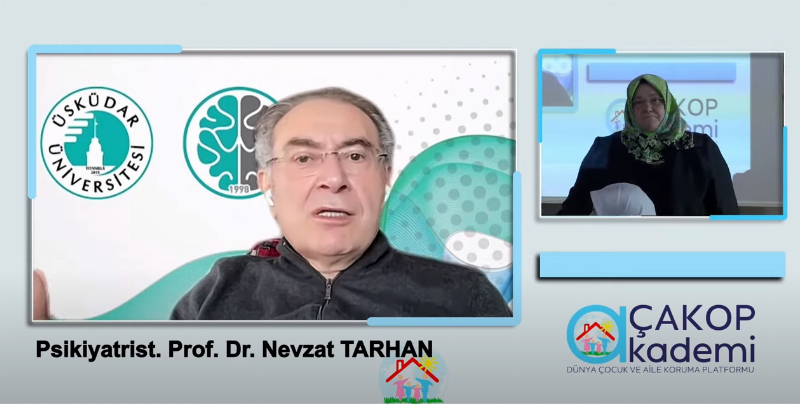
Psychiatrist Prof. Dr. Nevzat Tarhan, Founding Rector of Üsküdar Üniversitesi, attended the Trainer Training program organized by the World Child and Family Protection Platform as a guest. Speaking under the title ‘Sexual Identity Disorder Scale and the Importance of Age,’ Tarhan said: “If you bring a child to us after the age of 14-15, we have to say you are too late. At adolescence, a person asks, ‘who am I, where should I turn, why?’ It is the period when the child searches for and finds their own identity. The most important thing we can do in this period is to teach the child their age-appropriate sexual and social role at a young age.” Tarhan emphasized the correctability of epigenetic mechanisms and noted that the epigenetic tendency is the responsibility of parents.
Content
Prof. Dr. Nevzat Tarhan: “Epigenetic tendency is the responsibility of parents”
“Epigenetics is the quantum of genetics”
Psychiatrist Prof. Dr. Nevzat Tarhan, Founding Rector of Üsküdar Üniversitesi, stated that humans are open to epigenetics because they are open to social change. Tarhan said; “Epigenetics is the quantum of genetics. The way we treat a child in early ages or until early adolescence, the things they learn can seemingly become genetic in the child’s developing psyche. This is what epigenetics means. In fact, it is not innate. Later, there are sequence changes in genes, which result in polymorphism. This happens in addiction. In addiction treatment, epigenetic changes occur, and brain plasticity is disrupted. Addiction cannot be treated without biological treatment, without hospitalization and intensive treatment. Epigenetic sequencing is important. Moreover, if teaching continues, it can be passed down for one or two generations. If the same social teaching does not continue, it disappears spontaneously, so it is not hereditary. Perhaps it can be passed genetically for one or two generations. This is a difference between epigenetics and genetics. This is something planned in creation, and because humans are open to social change, they are very open to epigenetics. Other living beings do not have much epigenetics.”
“Parents are natural guardians until age 18”
Prof. Dr. Nevzat Tarhan also shared insights on sexual identity. Tarhan said; “What do we understand by the definition of sexual identity? Sexual identity disorder is a condition where a person intensely desires to be of the opposite sex or believes they are of the opposite sex. If a patient experiences extreme discomfort with their biological sex, we call this gender dysphoria. Until the age of 18, parents are natural guardians. In this context, parents have the right to tell their child regarding sexual identity: ‘I do not approve of your sexual identity.’”
“Epigenetic tendency is entirely the responsibility of parents”
Emphasizing the correctability of epigenetic mechanisms, Tarhan stated that the epigenetic tendency is the responsibility of parents. Tarhan said; “There are fifty to sixty cases of ‘wild children’ in the literature. Both parents are alcoholics, and the child grows up with complete physical and emotional neglect. The child grows up among dogs in the garden and is found at the age of 10. When the child is found, it is observed that they imitate the behaviors of the animals they grew up with. Epigenetically, this child has acted according to the genetic expression of the animal they learned from in all aspects of eating, drinking, and walking. It is not even clear from their behaviors whether they are male or female, or human. This child is found at 10 years old. They only learn to stand and speak a few things by the age of 22, and are taken from the family at 22. The child can learn after being found. This shows us, even if minimally, the correctability of epigenetic mechanisms. Some mothers, because they always have daughters in the family, are eager for a boy. The last born child, even if a girl and named as such, is fed, dressed, given toy guns, etc., like a boy. The child becomes like a boy and acts like a boy. When they reach adolescence and are told, ‘You are actually a girl,’ the child does not accept it. They say, ‘I am more comfortable this way.’ This becomes a female transsexual. This is entirely an educational error. Therefore, epigenetic tendency is entirely the responsibility of parents.”
“How can a society that feeds even organic tomatoes do this?”
Tarhan stated that the most important thing to do in this period is to teach children their age-appropriate sexual and social roles at a young age; “If you bring a child to us after the age of 14-15, we have to say you are too late. That's why age is very important. At adolescence, a person asks, ‘who am I, where should I turn, why?’ It is the period when the child searches for and finds their own identity. The most important thing we can do in this period is to teach the child their age-appropriate sexual and social role at a young age. When we fail to teach, currently in kindergartens, children are asked: ‘Do you want to be a girl or a boy?’ Hormone pills are given for decisions about their identity and genes. This is common in America and Northern Europe. Hormone pills are given to young children. If it's a girl, male hormones are given. If it's a boy, female hormones are given so that their organs develop that way. How can a society that feeds even organic tomatoes do this? Currently, there is a discussion about lowering the age of sexual freedom to 12. There are theses suggesting children aged 12 to 18 should be able to experience sexuality randomly. We need to be very careful. There is a global cultural imperialism that has entered our homes. We need to know that this issue has been targeted.”
“We applied the gender dysphoria scale”
Prof. Dr. Nevzat Tarhan provided information about the gender dysphoria scale. Tarhan said; “In 2021, we conducted validity studies for the adult form, applicable to individuals over 18. We created the Turkish form with 25 items and a single dimension, which we can use in the clinic. A female version is given to women, and a male version to men. Biological sex is taken into account when applying the scale, and the frequency of the person’s participation in the statements on the scale is used as 1 for never, 5 for always. After being academically published, the gender dysphoria scale will be publicly available on NPİSTANBUL Hospital’s website, where anyone interested can evaluate themselves. Subsequently, the results are automatically finalized and sent to the email address requested from the person at the beginning. In the Turkish version of the gender dysphoria scale, the lowest possible score is 25, and the highest is 125. Accordingly, as the total score obtained from the scale increases, gender dysphoria increases. In studies conducted in 2007, an internal consistency coefficient was calculated with 462 participants. In the Turkish adaptation, we found 0.89. The American sensitivity was 97, which is a good high sensitivity. In Turkey, the first valid safety study of the scale was applied to 368 university students and transgender-oriented individuals. It was determined that university students had a low level of gender dissatisfaction, and the non-social male group had a moderate level of gender dissatisfaction.”
Share
Request a Call
Other News
- The book that read today's digital threats in 2014: Being a Conscious Family
- Experts warn: 'Instead of memorizing letters, teach pencil grip, scissor use, and coloring'
- School fear and school love both start in the family!
- Family is not merely transforming, it is being battered under a serious assault
- Artificial intelligence opens the door to early diagnosis in autism!