

Üsküdar Üniversitesi Founding Rector Prof. Dr. Nevzat Tarhan, was a guest on the YOUTUBE live broadcast titled “Ramadan is a Feast,” organized by the Şekercihan Association. Making evaluations under the title “How Should the Story of Prophet Yusuf Be Read?” Tarhan said; “Envy is such an emotion that it is like nuclear energy. If used in a good way, it motivates people and turns into a useful energy. If used in a bad way, if the object of envy is wrong, or if the dose of envy is excessive, it starts to destroy in such situations.”
Content
Prof. Dr. Nevzat Tarhan: “Envy is Like Nuclear Energy”
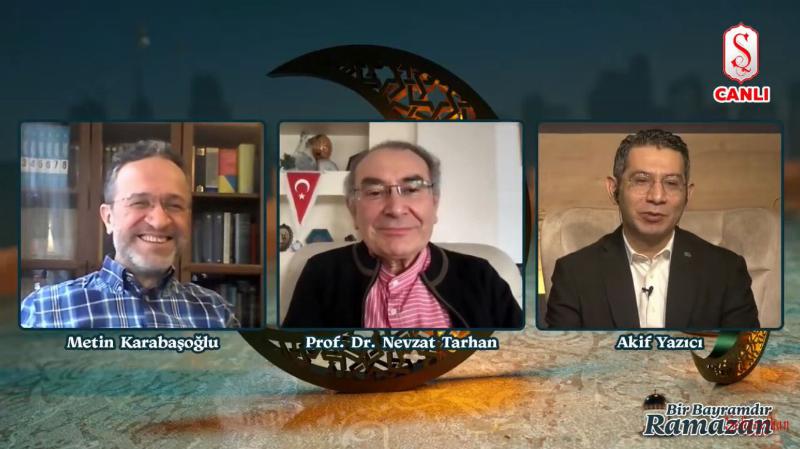
“Envy is like nuclear energy”
Tarhan emphasized that envy is a human emotion; “Envy is such an emotion that it is like nuclear energy. If used in a good way, it motivates people and turns into a useful energy. If used in a bad way, if the object of envy is wrong, or if the dose of envy is excessive, it starts to destroy in such situations. The first emotion in Prophet Adam’s trial with Satan was envy. That’s why the story of Prophet Yusuf is a tremendous story of richness. I saw even more when I examined it a little. It is a story exactly related to psychological dynamics. When we consider it only from a psychological dimension, there are tremendous lessons, admonitions, and wisdom to be learned. Envy is one of them. Regarding envy, it is necessary to balance the emotion and thought from the benevolent and malevolent aspects. As an emotion, envy comes from within all of us; it is a very human emotion. But after this emotion comes, thoughts are added to it. When thoughts are added to and combine with emotion, malevolence begins to be produced. Therefore, it is necessary to keep the emotional dimension within us as much as possible and to process it within ourselves. Even if we cannot do this, we must at least know that it is correct.” he said.
The Trial of Prophet Jacob…
Prof. Dr. Nevzat Tarhan, “We look at the event from the perspective of Prophet Yusuf’s trial, but Prophet Jacob also has a trial. Prophet Jacob loves Yusuf very much. Because he loves him so much, he dotes on him immensely. Because he dotes on him, the situation of siblings envying each other, which we frequently encounter in Anatolia, in our families, emerges. This is a very human situation. This is the incompleteness of love’s justice and a reason for Prophet Jacob’s trial. He unknowingly sets the stage for those who envy and are envied. Unknowingly but with good intentions. Because he had good intentions, they come together after years of separation. This is a tremendous test of patience.” he said.
“We will also draw lessons on time and time management from the story of Prophet Yusuf”
Tarhan stated that there are two dimensions in the story of Prophet Yusuf, and these are seeing the ethics of sincerity (ihlas) and integrity. “In the Surah of Yusuf, there is both a dimension of consolation and a dimension of meaning. We can see many dimensions of consolation in enduring jealousy and pain. On the other hand, there is also a dimension of meaning. In the dimension of meaning, there is an emphasis on the belief in Tawhid, meaning that everything is under the power of Allah. When Prophet Yusuf was with Zuleikha in the palace, he experienced a story of jealousy and love, and there he was slandered. Prophet Yusuf was in a state of being victimized, oppressed, and a victim for years. But there is tremendous patience, submission to Allah. Faith in Allah is not enough. If there is faith, Tawhid is formed. As Bediüzzaman Hazretleri said, ‘Faith necessitates Tawhid, Tawhid necessitates submission, submission necessitates reliance on Allah, reliance on Allah necessitates the happiness of both worlds.’ But within reliance on Allah, there is a time-centered way of life here. When Allah establishes a heart-connection with Him, He swore by time. That is why Islamic civilization is called a time-centered civilization. We will also draw lessons on time and time management from the story of Prophet Yusuf. Thus, if those negative, jealous feelings, destructive feelings are faced correctly, you become like Yusuf; if faced poorly, you become like the other brothers. There are even more malevolent examples of this, but since these are believing individuals, the trials turn out to be for their good. Moreover, I see here not only the ethics of sincerity (ihlas) but also the ethics of integrity (samimiyet), as far as I have read. Currently, there is a neuroscience of sincerity. If there is sincerity, mirror neurons work in our brain. It affects the other person’s brain like wireless internet. These have been shown by experiments. Therefore, sincerity has a magical effect. Our elders say, ‘Sincerity has miracles,’ and it truly is so. Here there are lessons of sincerity and lessons of devotion. At the same time, we can say there is a tremendous journey of patience from Tawhid to reliance on Allah.” he said.
“Patience does not mean stepping aside and waiting”
Tarhan stated that according to the chaos theory, there is a magnificent and perfect order in the universe; “However, mistakes and evils are also a part of this order. It’s the dynamic balance of opposites. Since evils are a part of this, one needs to adjust the boundaries of what one can and cannot control, and the limits of one’s power. When one reaches the limit of what cannot be controlled, one must stop. When Prophet Jacob reached a point he could not control, he did not pursue it; he submitted to Allah, fled, and ran to Him. Because he ran and took refuge in Allah, Allah took him under His protection and tested him with time and patience. Patience does not mean stepping aside and waiting. Patience is a meditative action; it means adapting to the speed and rhythm of nature, knowing where to slow down and where to speed up. Both Prophet Yusuf and Prophet Jacob are patient, but they are not blindly patient. They spend years establishing a connection with Allah in their hearts every moment.” he said.
Share
Update Date: February 27, 2026
Creation Date: May 04, 2021
Request a Call
Other News
- Social responsibility courses moved to the field
- Erasmus+ Orientation Week completed at Üsküdar
- Prof. Nevzat Tarhan: “Brain secretes ‘dark glue’ in social media lynchers!”
- Prof. Nevzat Tarhan: “Every segment of society should be able to say, ‘This constitution is my constitution!’”
- OHS releases guide for safe operation of industrial robots