

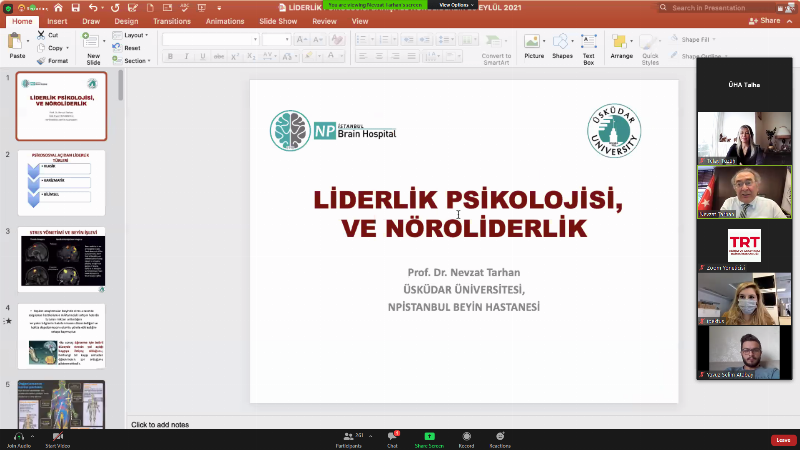
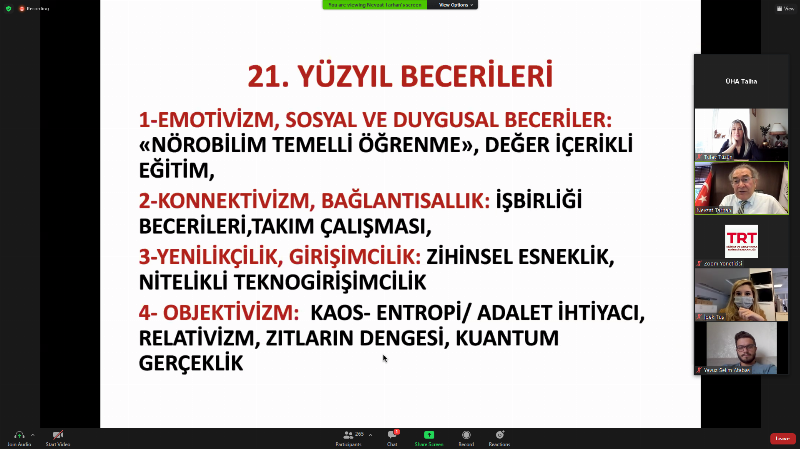
Üsküdar Üniversitesi Founding Rector, Psychiatrist Prof. Dr. Nevzat Tarhan, met with new personnel starting work at TRT. In the “Online Trainings” program organized by TRT Academy, Tarhan made evaluations regarding the topic of “Leadership Psychology.” Tarhan said; “In classical leadership, the left brain was used; in 21st-century leadership, the right brain, meaning emotional intelligence and emotional skills, came to the forefront. In this situation, it is important to use both together. The left brain handles logical intelligence skills, while the right brain handles emotional intelligence skills. The brain combines and synthesizes these two. That’s why using both is very important in this new leadership style.”
Content
Prof. Dr. Nevzat Tarhan; “Emotional skills came to the forefront in 21st-century leadership”
“Apply the 5W1H method when examining an event”
Prof. Dr. Nevzat Tarhan, who emphasized the importance of memory for time capital in the program which attracted great interest from employees, stated: “We all should have a time pyramid. The time pyramid is very important in leadership. Time is capital, and time capital is much more valuable than money and financial capital. You can lose money, and it will come back somehow, but time does not come back. That's why a Canadian psychologist developed a 5W1H method called the six guardians of memory. Later, communicators adopted this method and it stuck with them. Actually, when we say the six loyal guardians of memory, we are talking about six networks in the brain. These are the questions ‘who, what, where, when, how, and why.’ Our brain asks a question for these six questions and archives information in this way. We use the network of the ‘who’ question, the ‘where, when, how, why’ networks, and the brain records it that way. If you forget it from one, you remember it from another. If you want to make quick decisions and have a strong memory, apply the 5W1H method when examining an event. You can be sure that you won't easily forget that event.”
“Manage stress, don’t defeat it!”
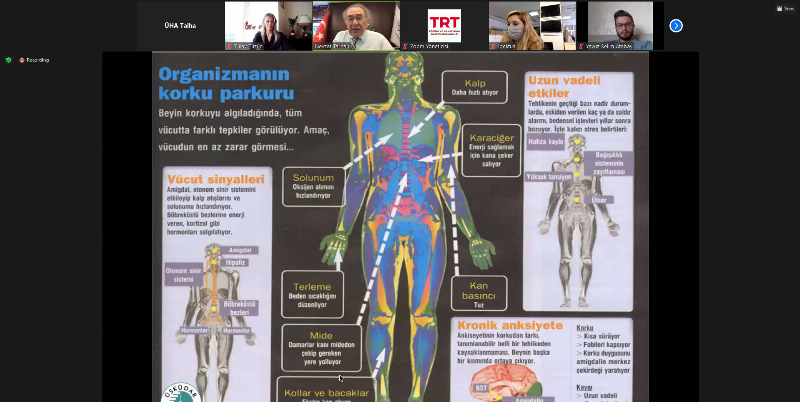
Prof. Dr. Nevzat Tarhan, drawing attention to the effect of stress and anxiety on humans, said: “In stress, there is an object and anxiety, but this is controllable anxiety. It's like riding a bicycle. If a person's stress level is zero while riding a bicycle, they fall over, but if they are overly stressed, they crash. In this case, controlled stress is beneficial. Anxiety, on the other hand, is related to a person's inability to manage their emotions towards events, experiencing too much of a feeling of threat. The similarity between anxiety and stress here is as follows: If a person sees anxiety as energy and manages it, they protect themselves from threats and making mistakes, but if they cannot manage it, it harms their mental processes. This is why anxiety can turn into a clinical case. Stress exists in every area of our lives. And it will continue to exist. Stress is inevitable, but the important thing is to be able to manage it. That’s why you should manage stress, not defeat it. Because zero stress is not healthy. When that happens, the body cannot defend itself; you become defenseless. That’s why controllable stress is beneficial.”
“Logical intelligence exalts idealism”
Prof. Dr. Nevzat Tarhan emphasized that in one's leadership, conscientious intelligence should also be brought to the forefront; “There are various types of intelligence in humans. Emotional, social, bodily, logical intelligence, but if a leader is successful but has low conscientious intelligence, that leader can be like Hitler. That's why we need to prioritize keeping our conscientious intelligence at a high level. What are these, for example? Logical intelligence exalts idealism. A person who can dream, generate thoughts for logical intelligence, create expectations, think strategically and outside the box, believe in themselves, and trust themselves is an emotional intelligence activist. These individuals, who can be hopeful and optimistic, and can use abilities such as courage, empathy, and humor, are activists. They mobilize emotions. As idealist thinkers, they generate many project ideas; emotional intelligence activates them, and bodily intelligence provides their internal discipline. They focus on goals and reduce risks. They have dedication and self-sacrifice. Individuals with high conscientious intelligence can easily listen to their inner voices in this way. They have feelings of compassion and mercy. They can use moral reasoning. They do not commit cruelty. They can succeed in being humble and honest. In social intelligence, we need to be able to use all these types of intelligence to a certain extent to strengthen family ties, such as being open to cooperation, being trustworthy, crisis management, being an active listener, being solution-oriented, being able to make decisions, and considering the emotional needs and rights of others. If you use one of these and not the other, it will surely start to wobble like a five-legged table.”
“A charismatic leader generates ideas through PR”
Prof. Dr. Nevzat Tarhan, speaking about the differences in reward-punishment methods among classical, charismatic, and scientific leaders, said: “What does a classical leader use as a reward-punishment method, for example? They immediately hand over the yellow envelope. For them, punishment is the rule, reward is the exception. What does a charismatic leader do in this situation? They act with excessive sensitivity towards those who make mistakes. They act on their intuition, make quick decisions, and love to punish. These are the types who say 'you will hang, you will swing,' but what does a scientific leader do? For them, reward is the priority, punishment is the exception. Instead of punishment, they seek ways to make people realistically feel the consequences of wrong behaviors. That's why scientific leaders can be team leaders. In generating ideas, there is an ideology like that of a classical leader. They generate ideas like a head teacher. A charismatic leader generates ideas by doing PR. That is, they use publicity and propaganda very well. They mobilize the emotions of the masses in this way. They love to dominate. Scientific leadership, on the other hand, generates ideas without making it obvious. They do not easily give ideas to their employees. They give the idea to the person who will buy it, do not waste it unnecessarily, and manage to use it appropriately and timely. In leveraging experience, classical leaders benefit from the experiences of others, talk to those who know well, and focus on the existing sound operation; that is, they manage the existing order very well, but charismatic leaders benefit from experiences but make quick decisions. They act more on their intuition than on literature.”
“The malevolent part makes us rich and good in the short term, but not in the medium and long term”
Prof. Dr. Nevzat Tarhan emphasized that one should be taught to be both happy and successful in life; “We all have a benevolent and a malevolent part within us. Whichever one we nurture, that one wins. The malevolent part makes us rich and good in the short term, but not in the medium and long term. At least, it doesn’t make us happy. That's why being honest with ourselves is very important. A person's philosophy of life is also very effective at this point. One needs to be both happy and successful in life. Teaching only to be successful is wrong. Be both happy and successful. Being able to achieve both is very closely related to being a good person. Harvard already introduced this as a course in 2015. Positive Psychology. Yale University introduced it in 2018. As Üsküdar Üniversitesi, we introduced it in 2013. The science of goodness. Last March, this course was also reported in The New York Times.”
“Being on the side of the strong is not a condition for success”
Prof. Dr. Nevzat Tarhan, speaking about the impact of a person's belief in their work on their success, said: “They asked Gandhi, 'How will you fight against the mighty British? You have no weapons, nothing, how will you do it?' And he replied, 'At first, I thought, what can I do alone? But then I thought, no one is a minority when God is on their side.' That's why they called Gandhi a 'majority of one.' No one is a minority when God is on their side. He says, 'I will do what I believe is right, I will act according to my beliefs,' and in this way, he removed 200 years of British rule from there. For a while, his morale was also down, then he looked at the past and said, 'In history, those who were honest, principled, patient, and idealistic always won. As long as I maintain these qualities, I will win,' and he continued that way. This is actually one of the secrets of success. First, believing in the work one does, and second, working very hard. One day, I was going to convey something called '3 benefits of success' in a meeting, and I forgot the third item. While I was thinking, the first being diligent, the second being honest, what was the third? One of the rector friends there said, 'If this were in Turkey, the third item would be having a powerful uncle/backer.' This is also a reality of Turkey, but powerful uncles always change. Being on the side of the strong is not a condition for success. If you are honest, as Adam Smith said, there is an invisible hand that provides order in the world. He says there is an invisible hand that provides justice, and indeed, there is an invisible hand behind a person.”
Share
Update Date: February 28, 2026
Creation Date: November 03, 2021
Request a Call
Other News
- Prof. Nevzat Tarhan: “Every segment of society should be able to say, ‘This constitution is my constitution!’”
- OHS Releases Guide for Safe Operation of Industrial Robots
- Prof. Nevzat Tarhan: “Social media is digital fast food”
- 2026-2027 Academic Year orientations completed
- Asst. Prof. İdil Arasan Doğan explained the importance of early intervention in living with dementia