

Üsküdar Üniversitesi Founding Rector Prof. Dr. Nevzat Tarhan, was a guest on the Gündem Dışı program, broadcast on Kanal 24 and moderated by Billur Aktürk. Evaluating the topic of “The psychological impact of Eids and old Eids,” Tarhan spoke about the crime-preventing effect of Eids and Ramadan, stating: “Resentment, anger, hatred are all emotions within us. After all, humankind has both benevolent and malevolent emotions. In Ramadan, we gain the ability to manage our malevolent emotions, and Eid becomes a space where we are rewarded for this.”
Content
Prof. Dr. Nevzat Tarhan: “Eid and Ramadan have a crime-preventing aspect”
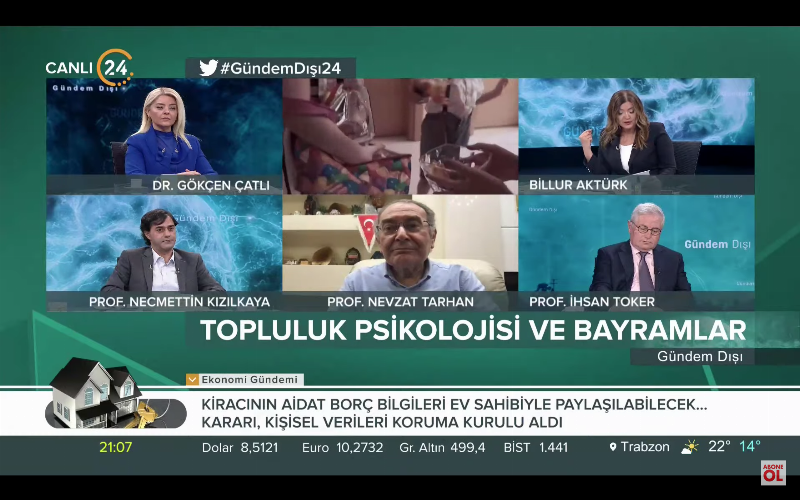
“Eids are the episodic memory that makes a person human”
Tarhan, speaking about the reasons why Eids are special for people, said; “Eids are the episodic memory that makes a person human. Life events, experiences, stories, narratives, traumas, positive and negative experiences lived from childhood all collectively form a person's episodic memory of the past. Eid has a special place for children. Because there have been many cultural changes and transformations both in Turkey and throughout the world. However, the rituals in Ramadan, the climate and atmosphere there, have served as a means to establish many of our values. Because Eid is not just an individual joy. Eids have a social joy dimension, a spiritual dimension. When we say religion, we always perceive it as 'a social institution,' but religion is also 'an existential institution.' It is a situation that encompasses issues related to existence and life.” he stated.
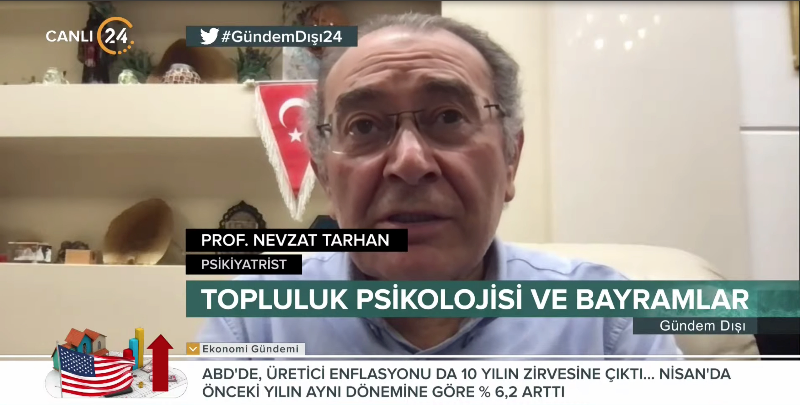
“The most important problem of this era is loneliness”
Tarhan, stating that Eids are the reason we are not lonely, said; “The most important problem of this era is loneliness. For example, the reason we are not as lonely as Westerners is our culture of experiencing many close, warm experiences and relationships, such as Ramadan and Eids. In other words, if the first institution that sustains us is Ramadan and Eid, the second is the family. For a child to be raised healthily, the family needs to be a safe space. There is a need for a safe space. We used to call home a 'nest of love,' now we call it a 'nest of safety.' Because if a person is in a safe space, they feel secure, and thus become open to change and innovation. For instance, the reason most discoveries happen in the USA is that it is a secure society. Entrepreneurship and innovation emerge because a culture of fear does not dominate, and trust is more prevalent. Even though there are changes related to trust in our culture, there is social solidarity provided by religious Eids. For example, these Eids contribute greatly to the concept we call emotional intelligence. If you approach problems positively, if you approach them constructively, problems reveal themselves.” he said.
“Eids and Ramadan have a crime-preventing aspect”
Tarhan stated that religious days have a crime-preventing characteristic; “The number of addiction patients hospitalized in our hospital decreased by 50 percent. Crime and violence incidents decreased by 50 percent. Eids and Ramadan have a crime-preventing aspect. This situation also reflects on the family. Voice tones do not rise in the family. For example, they say, 'Don't make me lose my temper while fasting.' All of these are about being the leader of ourselves. The resentment, anger, and hatred within us are present in all of us. After all, humankind has both benevolent and malevolent emotions. We gain the ability to manage our malevolent emotions, and Eid becomes a space where we are rewarded. For this reason, a person is not just comprised of logical intelligence. They have multiple intelligences, emotional intelligence, social intelligence. It is an area where all of these can be learned. The order in humans and the universe is not an artistic order, but a relational one. In such an order, a person cannot be happy when left alone. Currently, the most important thing in the science of happiness is to find both happiness based on internal and external causes, not just happiness based on internal causes.” he concluded.
Share
Update Date: February 27, 2026
Creation Date: May 17, 2021
Request a Call
Other News
- The book that read today's digital threats in 2014: Being a Conscious Family
- Experts warn: 'Instead of memorizing letters, teach pencil grip, scissor use, and coloring'
- School fear and school love both start in the family!
- Family is not merely transforming, it is being battered under a serious assault
- Artificial intelligence opens the door to early diagnosis in autism!