

Prof. Dr. Nevzat Tarhan, Founding Rector of Üsküdar University, participated in an Instagram live broadcast held with the support of the Humanitarian Aid Foundation (IHH). In the broadcast titled 'Earthquake Psychology,' Tarhan drew attention to the need not to confuse 'tawakkul' with idleness.
Content
Prof. Dr. Nevzat Tarhan: 'One should not confuse 'tawakkul' with idleness'

Prof. Dr. Nevzat Tarhan: "A serious intense trauma is being experienced"
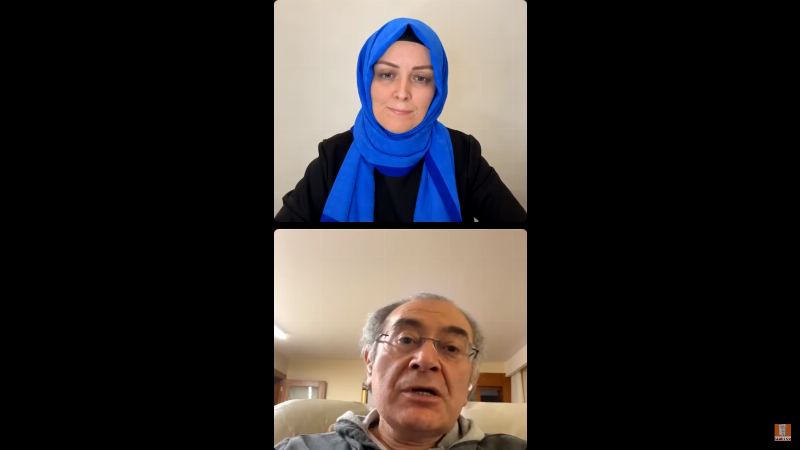
Prof. Dr. Nevzat Tarhan, Founding Rector of Üsküdar University, made assessments regarding earthquake psychology during an Instagram live broadcast supported by the Humanitarian Aid Foundation (IHH) and moderated by Hatice Kübra Tongar. Tarhan underlined that in such situations, emotions are more dominant than reason, and therefore, it is necessary to develop a sense of trust; "We are currently still in the shock phase of the earthquake. There are people being rescued alive from under the rubble. During this period, even AFAD personnel and volunteers were trapped under the rubble. It was such a massive disaster. The entire region was under rubble, one by one, to help each other. America made an official statement calling it 'the disaster of the 20th century.' Such an earthquake is a test for those there. It is important to face such an earthquake correctly without rebellion. Our test is to be able to help the people there. While doing this, people in shock, some withdraw into themselves, some become aggressive, some may wander around talking nonsense. A completely serious, intense trauma is being experienced. In such an environment, debriefing therapy, which involves making sense of one's grief by questioning 'if only' and 'I wonder' statements, should not be conducted during the acute phase but rather later. It is done after 6-8 weeks. If done in the acute period, the person cannot reason due to the shock effect at that moment. In such situations, emotions are more dominant than reason, so it is necessary to develop a sense of trust," he said.
"Saying 'If only' has the effect of scratching a wound"
Prof. Dr. Nevzat Tarhan pointed out that there are things beyond human power and control at present, stating that grieving over such matters causes people suffering. Tarhan said; "Saying 'if only' has the effect of scratching a wound. It causes suffering related to things beyond human power and control. For one, it blocks a person's mind. When a person thinks about this for 59 out of 60 minutes, they become unable to perform their normal routine tasks. Because if our body is a state, our brain is like the government. When it cannot do its job, the body does not function. We cannot engage in goal-oriented behaviors. When we block our brain, we cannot plan, prioritize, or schedule. Therefore, these are situations that hinder our brain and disrupt our routine. To solve this, we use the method of shifting the focus of attention. It is a method of changing the center of interest. When one says 'if only, if only…,' the 'accept and manage' method is important. Currently, there is something beyond human power and control. Grieving over such a thing causes pain for a person. When such grief or shock is experienced, if the person has a remedy, they should do what is necessary; if there is no remedy, even if they grieve, the result will not change, so it's not worth grieving too much. That is to say, there will be some sadness, but it is necessary not to do anything exaggerated or disrupt one's routine. In such situations, the 'accept and manage' method is to accept that you have experienced such a thing. It was meant to be, it's out of your hands; instead of saying 'Why did my arm break?', it's like focusing on the outcome, 'How do I treat it?' In this case, if a person focuses on 'What is my role, what should I do?', if they shift their focus of interest and attention, they will manage their time well. They will manage their intellectual mental energy correctly. Our mental energy is also like resource management. It should be used purposefully, in a planned manner. Let's not use it however we feel like it."
"This is not 'tawakkul'; it is idleness"
Prof. Dr. Nevzat Tarhan touched upon the topic of how mental refuge and submission add tremendous solace and meaning to one's life, as if integrated with the universe and all desires fulfilled; "Humanity's greatest need is the need for attachment. Genetically, there is a need for attachment, and there's even an attachment hormone called oxytocin. The attachment hormone is secreted most in breastfeeding mothers. It is also one of humanity's happiness hormones. Think about a mother's feeling for her child; that feeling of compassion beyond love is a greater emotion than love because it contains unconditional love. Compassion is a stronger emotion than love. When we have this feeling, chemicals related to compassion and mercy are genetically coded into the human brain. Spiritual support allows us to activate these. People who lack spiritual strength are not actually helping others; they are helping themselves. Happiness-related hormones are also secreted in their brains, and at the same time, in such situations, there is a power that knows everything, controls everything—a higher will. For example, if you get on a plane, you must trust the captain. If you don't trust, you can't sleep. This is our world-ship; it is not randomly wandering in space. It has a creator, a captain, an owner. We will trust in that and surrender our mental strength in such situations, but we will do this after taking every possible precaution. Taking precautions and then saying 'Fate' is called laziness. This is not 'tawakkul'; it is idleness. In Anatolia, there's a beautiful saying: 'Show ambition in your studies, then rely on God for the harvest.' After showing every effort you can, when it's harvest time, everything is done; you don't say 'if only' or 'I wonder' now. In such situations, 'tawakkul' is applied, but not during the time of working in the field. Mental refuge and submission add tremendous solace and meaning to one's life, as if integrated with the universe and all desires fulfilled. It provides comfort. For this reason, those with strong faith, this strong faith being the faith of 'Tawhid' (Oneness of God), are the ones who overcome such situations most easily," he stated.
Share
Update Date: March 01, 2026
Creation Date: February 20, 2023