

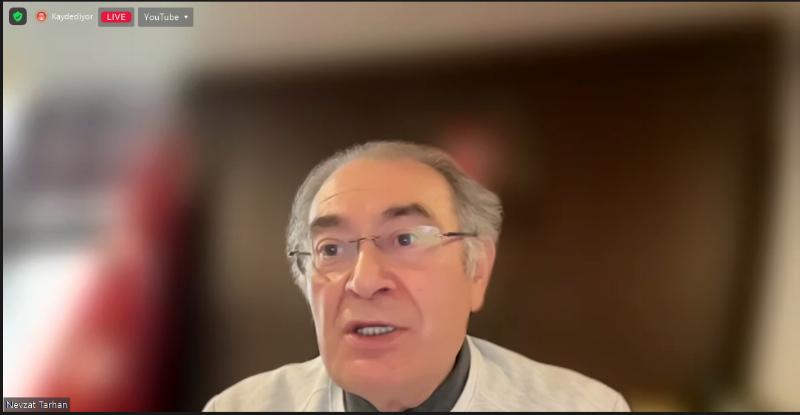
Organized by the Conscience of the Age Club with the support of Üsküdar University Health, Culture and Sports Department, the program ‘Psychological Talks from Existence to the Search for Meaning’ with Üsküdar University Founding Rector Prof. Dr. Nevzat Tarhan continues. Tarhan made striking remarks about emotion management and the brain's decision-making stages, emphasizing that good thoughts attract good. Tarhan stated, “A person's free will is activated by the frontal lobe of the brain, and we decide to do things. If we choose the good side, we are responsible for good things; if we choose the bad, then for bad... In fact, divine energy is within our brain. Whichever file we enlarge in our brain, that file becomes a gain for us at the end of our lives.”
Content
Prof. Dr. Nevzat Tarhan: “Divine energy is within our brain”
“Managing emotions is the highest level of human maturation”
Regarding the concept of emotion, Tarhan pointed out that managing emotions is the highest step in maturation. Tarhan said; “Emotion management, which we call ‘emotion regulation’ in psychiatry, is the ability to adjust emotions. Where you will get angry, where you will be sad, all these are a regulation. Emotions also have rules; if we do not regulate emotions, that is, if we do not make them rule-bound, others play with our emotions. That is why managing senses is the highest level of human maturation. Now, emotions are divided into two; the first is concrete emotions and the other is abstract emotions. Concrete emotions are related to basic pleasures also found in animals such as eating, drinking, and reproducing. There are also abstract emotions in humans. What we call worldly abstract emotions include a person's interest in literature, art, music, and aesthetics. High abstract emotions are a person's thinking, managing their thoughts, thinking about their thoughts, and using their high mental functions. To give meaning to emotions, we must have positive - negative feelings about emotions and philosophical issues. For example, if someone says the meaning of existence is negative for me, I do not care about existence, then their emotion regarding it is negative, and the person does not invest in that subject. If someone says existence is important to me, and what will happen to me after I die is important, then the brain makes an emotional investment in that subject to add meaning, and the person makes their emotional decisions. Those curious about these issues in detail can examine my book ‘The Psychology of Emotions’.”
“The moment you open your heart to your Lord, you become online with the Creator”
Tarhan stated that those with high abstract emotions establish an online connection with Allah when they open their hearts to Him, drawing attention to the link and connection formed between these people's hearts and the Creator. Tarhan said; “High abstract emotions are related to the heart. Concrete emotions are related to the self (nafs). We should understand the difference between the heart and the self from this. The word 'kalp' (heart) comes from the root of 'inkılap' (revolution/change), just as our ear converts sound waves into electrical waves, it translates the emotions emanating from us. There are chemical messages coming from our brain to our heart. Our brain produces chemical messages. For example, the 5 horsemen of darkness are expressed as: Hatred, anger, jealousy, hostility, aversion. Against these, there are also positive emotions: joy, happiness, hope; the heart produces a mixture related to these and receives it, and the heart translates this. It converts it to a universal radio frequency, and in a way, you connect with Allah. If a person is only focused on concrete emotions, in such cases, the broadcast from the heart remains worldly. If the emotions related to the heart are made by thinking of the High Allah, then it goes to that space station. The moment you open your heart to your Lord, you become online with the Creator. When you are online with the Creator, you have taken refuge in Him, and control becomes His. The heart is online now; there is a link, a connection between the heart and the Creator.”
“Two magic words against calamities: Gratitude and patience”
Tarhan, emphasizing that the calamities that befall a person should be seen as ‘exam questions,’ stated that calamities can be overcome through the perspective of ‘patience and gratitude.’ Tarhan said; “How should we interpret calamities? For example, we are experiencing a calamity, some evil or illness has befallen us. Satan has whispered something to us, and we have fallen ill. Then we think, why did Allah let this Satan afflict us? This means that Satan's affliction and the coming of evils are actually something given to us because we are human in this world, an exam question. Calamities are exam questions. We are tenants in this world. As Rumi said, ‘we are passing through the world,’ not living in it. We have a certain amount of time; a smart person is one who manages to live as if they will die tomorrow. Because death is uncertain. Since we are in an exam, there will be difficult questions and easy questions... If you do not give thanks, if the Creator loves you, He says, ‘Let me deprive that servant a little to make him give thanks.’ He withdraws some of the blessings He gave. If a person draws closer, why would Allah deprive them? So, many calamities are due to a lack of gratitude. A person is being tested. That's why there are two most important magic words in these calamities. One is gratitude, and the other is patience. Gratitude is knowing the value of what you have. In such situations, one should not grieve over what has been lost. Not to rebel by asking why I lost it. To be grateful for what you have. If we do this, we can pass the exam.”
“Divine energy is within our brain”
Referring to the brain's decision-making stages, Tarhan emphasized that good thoughts attract good. Tarhan said; “A person's free will is activated by the frontal lobe of the brain, and we decide to do things. If we choose the good, we are responsible for good things; if we choose the bad, then for bad. In fact, divine energy is within our brain. For us, we are free only to choose which channel to open or not open, like a radio. After opening it, if we open good channels, our brain produces good things. If we open bad channels, it produces bad things. Our brain has things it separates as good and bad. Our brain has files it separates as good-bad, positive-negative. Whichever file we enlarge in our brain, that file becomes an acquisition for us at the end of our lives. It reflects on our lives and behaviors. We need to see the sign of Satan, we will see its precursors. When you see Satan, you see him in the afterlife anyway. Then there are no deeds, only accounts there. In this world, there are no accounts, only deeds. That's why we shouldn't wait to see Satan. Let's immediately detect Satan's red light, hit the brakes, otherwise, he will lead us astray. That's why, at the first sign of the secret of 'istihaza' (seeking refuge), satanic things become easy. For example, we are experiencing earthquakes; if a material is made deficient, for example, if the iron is put in insufficiently, it's over. Even if all other materials are complete, if only the iron is missing, it will collapse, but for a building to be complete, everything must be complete, for it not to collapse. Satan's job is that one missing thing, pulling that one thing out from there.”
“Without a test, good and evil would mix”
Tarhan made striking statements about the reason for the existence of evil; “The question of why evil exists is being investigated. Some thinkers, God forbid, believe that if God does these evils, then God is evil. If these evils exist and God does not intervene in them, then He is weak and helpless, then He is not God, then they begin to question God's existence, many become agnostic or deist. They say He created but did not interfere, solely because they could not solve this problem of evil, but the solution to the problem of evil has actually emerged in quantum physics, explained by the butterfly effect. Why do I exist? What do these works mean? What is the meaning of life? You try to make sense of these, and here too, if you are curious about evil in the first stage, if you ask why Allah created evil, you must first eliminate the questions in your mind related to belief. Then you will eliminate doubts related to monotheism, and then, if the one who has this power opened a test, a 60-year or 80-year test, how can questions be asked in this test, and the question of how this test can be most just would not be more just than it is now. Because the real life is the afterlife; in this world, we all go through a test. Without a test, good and evil, diamond and coal would mix.”
“Despite our experiences, we are helpless, weak, and powerless against the universe”
Tarhan drew attention to the importance of seeking truth, realizing it, and taking refuge in the Creator of the universe, emphasizing humanity's helpless nature. Tarhan said; “To read means to seek the truth; Allah tells Prophet Muhammad, ‘Seek the truth. You will seek, you will seek the truth, seek Me.’ The most important method in this era is reading; as you read, you find what you seek. Reading is merely a technical skill; why do you read? You read to seek the truth. When you look at a tree, a bird, nature in the name of Allah, seek it and read it with that eye. Now they ask, how do you interpret this earthquake? What do you read from this universe, from existence, what do you read from the existence of evils? Istihaza is seeking refuge in Allah from the evil of Satan, asking for forgiveness, feeling remorse for one's mistakes, taking refuge in such situations, turning from Satan to Allah. Realizing one's mistakes and then seeking refuge, that is, submitting to Allah. A child being afraid of their mother and then seeking refuge in her again is the happiest moment. We too are helpless like a baby right now; let's know our limits. Just as a baby's position in its mother's womb, so is our position before Allah. Just as a baby has no bond of trust without its mother, despite our experience, we are helpless, weak, and powerless before the universe. Our needs are many, our dreams are limitless, and our power is very limited, like a baby. To avoid spiritual defilement, a person should perform istihaza (seek refuge), realize, and perform istighfar (seek forgiveness), which means to be spiritually cleansed. Then take refuge in your Creator; if we take refuge in this way, divine help will come.”