

Üsküdar Üniversitesi speaking at the 9th Bioengineering Days online symposium organized this year by Üsküdar Üniversitesi Founding Rector, Psychiatrist Prof. Dr. Nevzat Tarhan stated that Covid-19 seriously taught the importance of bioengineers, and that Bioengineering paved the way for molecular biology and genetics. In his speech, Tarhan drew attention to the importance of findings in studies related to brain chemistry and noted that universities should do what Elon Musk does. Stating that investments should be made in designs rather than stone and soil, Tarhan, emphasized the importance of investing in R&D to be the subject, not the object, of science. Academicians from important universities in Turkey also shared their presentations with the participants at the symposium.
Content
Prof. Dr. Nevzat Tarhan: “Covid-19 Paved the Way for Bioengineering”
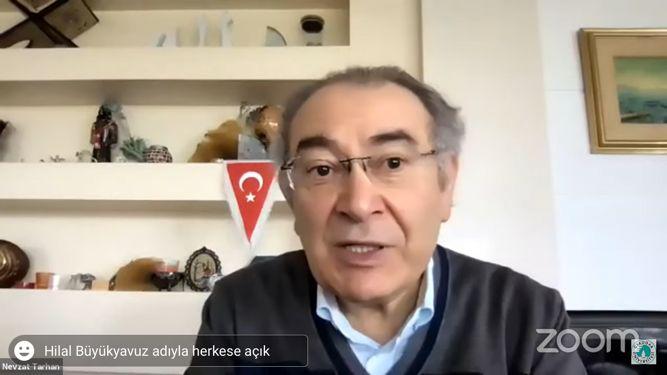
Üsküdar Üniversitesi Faculty of Engineering and Natural Sciences Bioengineering Department and the Bioengineering Club organized an online symposium titled '9th Bioengineering Days'. The 9th Bioengineering Days Symposium, held online due to pandemic conditions, brought together students studying in this field with expert names. The program was hosted by Mehmet Akyıldız, President of the Bioengineering Club, and Şeyma Türkan Koyun, Vice President of the Club, both third-year students of the Bioengineering Department. The opening speeches of the two-session program were delivered by Üsküdar Üniversitesi Founding Rector, Psychiatrist Prof. Dr. Nevzat Tarhan and Head of the Bioengineering Department Dr. Tuba Sevimoğlu.
Prof. Dr. Nevzat Tarhan: “Bioengineering Also Has a Neuroscience Leg”
Prof. Dr. Nevzat Tarhan, drawing attention to the importance of chemical bioengineering, especially in drug production and various research, said, “Bioengineering also has a neuroscience leg. In 2018, the importance of neural networks exploded worldwide at Davos. The bioinformatics aspect of bioengineering and its use with neurotechnology opened up a new field for bioengineering. At that time, of course, bioengineers were primarily chemists. We had emphasized incorporating some courses and considering research related to these. Currently, with scientific developments, it is not correct to reduce bioengineering solely to medicine. It is also necessary to bring the neuroscience aspect of bioengineering to the forefront.”
Prof. Dr. Nevzat Tarhan: “Bioengineering Should Also Touch Upon Quantum”
Prof. Dr. Nevzat Tarhan stated that the human brain system works in three ways and continued his words as follows:
“The brain generates electrical signals, operates with chemical firings, and within these ongoing processes, information flow occurs alongside energy flow. There is electrical flow, chemical flow, and simultaneous information flow. These occur in the brain. In studies related to the brain, bioengineering should now also touch upon quantum. When examining how the brain makes decisions, electrophysiological measurements show that the P300 wave appears 300 milliseconds after a decision related to an action is made. In that case, it is not the brain that makes the decision. There is a quantum brain above the brain, and in new consciousness studies, we call this consciousness. There is a quantum brain connected to universal energy above the brain. That also influences decision-making. After a decision is made, the electrical potential in the brain emerges. Then, as the electrical potential continues, it undergoes chemical transformation. When it undergoes chemical transformation, it becomes permanent information.”
Prof. Dr. Nevzat Tarhan: “We Must Invest in R&D to be the Subject of Science”
Tarhan, stating that humans initially record information electrically in the brain, continued his words as follows:
“If a person repeats it or accepts it with a very strong emotional charge, it is written into the brain not electrically but chemically, and it becomes permanent. These findings are very important in studies related to brain chemistry. Elon Musk conducted brain-computer interface studies on experimental animals. He made a monkey play a game. Should a businessman really be doing this? Üniversitesi should be doing it, but they have capital, and we have ideas. It is not possible to bring the two together in Turkey. America is not like that. When Elon Musk decides on something, he brings together those who know that field best and forms a magnificent R&D team. For example, the owner of Amazon reportedly invests 80 percent of his earnings in R&D. In Turkey, unfortunately, it has only recently risen to 3 percent. If you don't invest in R&D, you will only be an object of science. If we want to be the subject of science, we must invest in R&D. Unfortunately, we are a country that invests in stone and soil. In agricultural societies, investments are made in stone and soil. In information societies, investments are made in designs. Unless we invest in knowledge, we will only boast to ourselves.”
Prof. Dr. Nevzat Tarhan: “Covid-19 Taught the Importance of Bioengineers”
Tarhan, stating that he does not yet believe the Turkish scientific community fully recognizes or realizes the importance of bioengineering, said, “Covid-19 very seriously taught the importance of bioengineers. Our students in molecular biology, genetics, and bioengineering will start working as soon as they graduate. Some have even started working before graduating. Currently, health investments have taken the top spot globally. In bioengineering, a synthesis of these two will be made. We are in a digital universe; there is a universal database. Above the universal database, there is first information, then mathematics, geometric design, energy, physics, chemistry, which means matter, and then biological life. These are all rings of each other, they are within each other. There is no such thing as matter, in fact, matter is a concentration of energy.”
Prof. Dr. Nevzat Tarhan: “There Will Always Be Sub-disciplines in Bioengineering”
Tarhan stated that their application partner, NPİSTANBUL Beyin Hastanesi, uses track monitoring, specifically LCMS devices, to check drug blood levels, saying, “One measures toxicology, meaning substances. The other measures drug blood levels for psychiatric medications. For example, a piece of meat comes in, and it shows which animal the meat belongs to by looking at the ion charge of its protein. It can show whether honey is real or fake. It also indicates the suitability of a drug based on its ion charge. It provides accuracy results over 99 percent. All of these fall within the scope of bioengineering. We can say that there are areas related to the common use of brain, chemistry, and technology. People who know these fields will be the engineers of the future. Some will progress by focusing on chemistry, while others may focus on neuroscience. Individuals will make this decision themselves. There will constantly be sub-disciplines.”
Prof. Dr. Nevzat Tarhan: “Sciences Need to Work Multidisciplinarily”
Emphasizing that biological sciences and engineering sciences need to work together in a multidisciplinary way, Prof. Dr. Nevzat Tarhan said, “Currently, it is not the singularity of sciences but the plurality and holism of sciences that are at the forefront. The eclectic approach is prominent. Sciences working as a team lead to new discoveries. In highly developed countries, there are more engineers than doctors. They predict, present options, and perform tasks more easily with fewer errors. Therefore, these need to be implemented, but for humanity to understand this, we needed a slap like Covid-19. The Covid-19 slap broke the rote learning in minds. It no longer makes people look at engineering with just a materialist perspective; it has revealed more clearly that all disciplines are together and that all branches of science must work as a team.”
Prof. Dr. Nevzat Tarhan: “Students Must Absolutely Do Projects”
Tarhan stated that innovations should teach society certain things, saying, “We need to rethink, restructure, and discover some things. I believe Covid-19 paved the way for bioengineering, molecular biology, and genetics. It seems it will open it up even further. It needs to be evaluated from this perspective. Our future student friends must also undertake projects. Institutions like TÜBİTAK support student projects. They will gain a lot of knowledge through those projects under the guidance of their professors. Doing projects during undergraduate studies provides a different perspective on the future. Those who stand scientifically, stand objectively. Objectivism is the greatest characteristic of science. We must be objective about everything.”
Dr. Tuba Sevimoğlu, Head of the Bioengineering Department at Üsküdar Üniversitesi and one of the opening speakers, stated that there were participants from outside the city due to the online format, and wished for a productive and successful symposium.
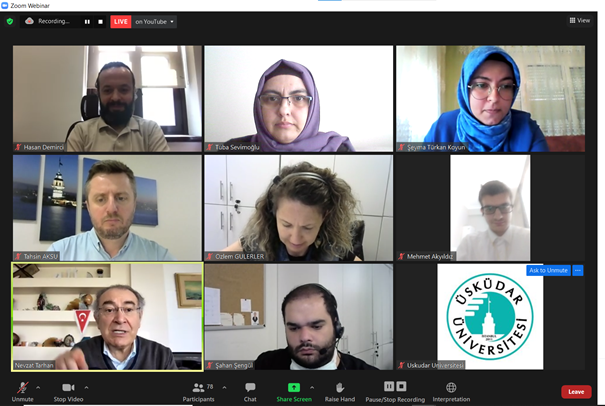
2 Sessions Held at the Symposium
Following the opening speeches, the sessions began. In the first session, Dr. Öğr. Üyesi Hasan Demirci from Koç Üniversitesi presented “Structural Biology”, Prof. Dr. Tanıl Kocagöz from Acıbadem Üniversitesi presented “Laboratory methods used in the diagnosis of COVID-19”, and Dr. Öğr. Üyesi Christopher Mayack from Sabancı Üniversitesi shared his presentation titled “Systems Biology” with the participants.
The second and final session of the symposium featured 6 speakers. In the second session, Prof. Dr. Metehan Özen from Acıbadem Üniversitesi presented “The Miracle of Microbiota”, Dr. Öğr. Üyesi Ayça Zeynep İlter from İstinye Üniversitesi presented “Cancer Biology”, Doç. Dr. Emre Yörük from İstanbul Yeni Yüzyıl Üniversitesi presented “Plant Pathology”, Dr. Öğr. Üyesi Zeynep Büşra Bolat from Sabahattin Zaim Üniversitesi presented “Targeted Drug Delivery in Cancer Therapy”, Majid Hajihosseinali, Founder and CEO of Omid Afarinan company, presented “3D BioPrinting Technology”, and Prof. Dr. Kayhan Erciyeş from Üsküdar Üniversitesi presented “Bioinformatics Algorithms”.
The program concluded after the completion of the presentations in the second session.
Share
Request a Call
Other News
- Experts warn: 'Instead of memorizing letters, teach pencil grip, scissor use, and coloring'
- School fear and school love both start in the family!
- Family is not merely transforming, it is being battered under a serious assault
- Artificial intelligence opens the door to early diagnosis in autism!
- Artificial intelligence doesn't end engineering, it transforms it!