

Organized by the Conscience of the Age Club with the support of Üsküdar Üniversitesi Health, Culture and Sports Department, ‘Psychological Conversations from Existence to the Search for Meaning’ with Üsküdar Üniversitesi Founding Rector Prof. Dr. Nevzat Tarhan continue during Ramadan. In the program, Prof. Dr. Nevzat Tarhan made evaluations in the context of Ramadan, stating that patience provides resilience training to overcome difficulties and that gratitude enables people to appreciate what they have, see the positive, and look at life with a sense of hope. Tarhan said; “Complying with Ramadan actually means living in accordance with existence, returning to factory settings.”
Content
Prof. Dr. Nevzat Tarhan: “Complying with Ramadan means living in accordance with existence”
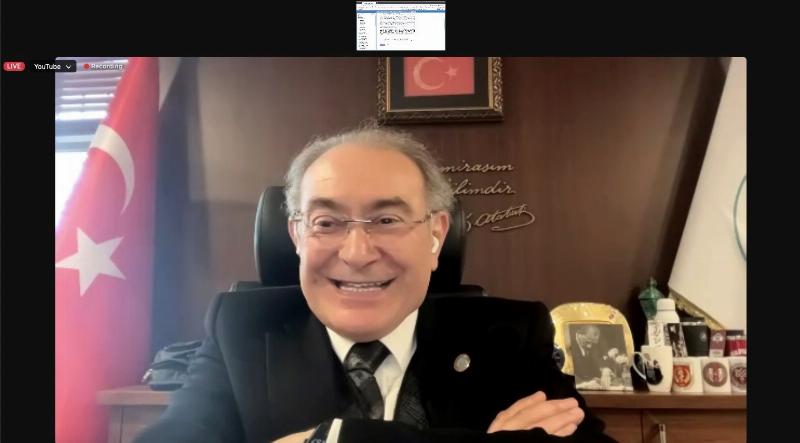
Two magical concepts: Patience and gratitude
Drawing attention to the fact that Ramadan provides humans with two skills, Üsküdar Üniversitesi Founding Rector Prof. Dr. Nevzat Tarhan said; “In the second point, he addresses Ramadan from the perspective of the blessing of gratitude, because two human emotions are important magical concepts. One of these two concepts is patience, the other is gratitude. Patience, when we talk about psychological conversations from existence, is referred to as resilience training in psychology. What is in resilience training? You keep your stomach hungry, you control your ego, you temporarily postpone many desires in the legitimate sphere, in the halal sphere, such as eating, drinking, and many pleasures. You postpone them from sunrise to sunset, from imsak to iftar. This is a kind of normal, that is, you postpone many things like human eating, drinking, and reproduction. Besides that, you also make yourself keep an emotional fast, in terms of self-discipline, in addition to the normal stomach fast, such as postponing your five senses. You discipline your desires, your impulses; it has this dimension. Then, worship has a social dimension. It appeals to many psychosocial emotions. Therefore, it appeals not only to our physical humanity, our biological living humanity, but also to our psychosocial humanity, in three dimensions. While doing this, patience is resilience training, and its second teaching is the skill of delaying gratification. It provides humans with two skills. We measure this with tests. For example, when we look at substance users, their resilience training always comes out low. Their gratification delay skill comes out low. That's why people make a lot of mistakes.”
“Ramadan puts our ego into gratitude training”
Prof. Dr. Nevzat Tarhan spoke about how, with the rule, one steps outside the routine. Tarhan said; “If a person cannot learn to control themselves, if they do not give thanks and do not think of the giver of blessings, they begin to see themselves as the giver of blessings and deify themselves. This characteristic exists in humans. Ramadan is for preventing a person from deifying their ego; it says, ‘There is a willpower for you to give thanks, for you to express gratitude. It’s waiting on the table, you can’t reach out. You are not the owner of this blessing; there is one who gives it; think of Him and give thanks.’ It puts our ego into such gratitude training. When a person is hungry during Ramadan, in such situations, they need to think about blessings. There is the rule we mentioned earlier, you kind of step out of the routine. Because it comes automatically like this, people get used to it after a while. When you are deprived of something, for example, when you get sick, you understand the value of health. When blessings don't come, when you are hungry, you understand the value of the blessing, but a wise person should be able to give thanks without losing this blessing. Then Allah would not send calamities upon you. One must see the blessing, and there is even a story about a priest related to this, which was mentioned before. It is told about France, in a flood-stricken area, the priest said; ‘Allah will save me. I am a good person.’ The flood waters rose, and a rescue team came, but the man said; ‘Allah will save me.’ When the flood waters rose further, they sent a boat, but the man said; ‘Allah will save me,’ and still didn’t come. When he was completely on the roof, they brought a helicopter as a rescue team, but he didn’t go with it, saying Allah would save him. Then he dies. When he appears before Allah, he says; ‘Oh Allah, I waited for you to save me, why didn’t you save me?’ Allah says; ‘My servant, I sent rescue teams to people, you didn’t return with them. Then I sent a boat, you didn’t get in. I sent a helicopter, you didn’t get in. What should I do?’ Here, you did not attempt the means sent by Allah, and when you don't, Allah sends messages to people in the language of events and occurrences in this world. What is the equivalent of wisdom? It is the world of causes; there are visible causes and invisible causes. The visible cause is the one who brings the boat, who sends the rescue team. The invisible cause is Allah, the name of the Sustainer who governs this universe, establishes this order, first created everything, and whose existence now sustains everything.”
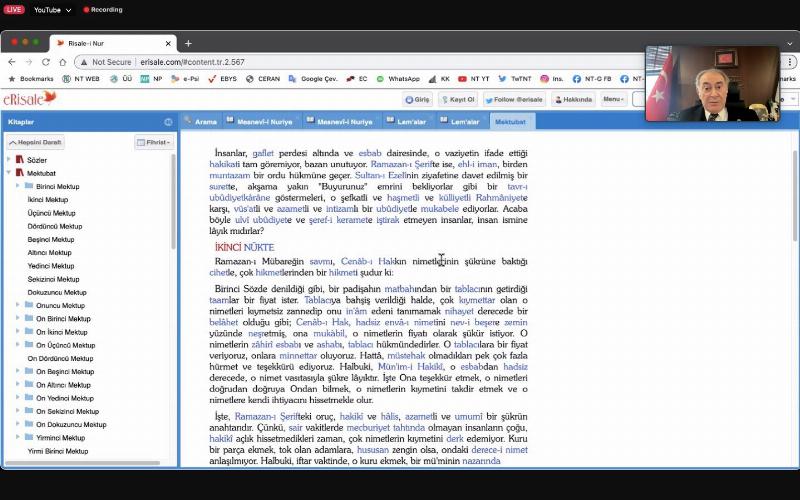
“We will be ambitious during the time of study, and accepting, contented fatalists during the time of harvest”
Underlining that Ramadan is a period of realization, Tarhan said; “We will be ambitious during the time of study, and accepting, contented fatalists during the time of harvest. While working, planting, harvesting, and watering, we will do our utmost, but at harvest time; instead of saying, ‘Why was the yield low, why is their field good and mine like this?’ they will be accepting. If this happens, there is peace, which is something given by faith. Ramadan becomes a period of realization. At that moment, a person is unjustly worthy of gratitude to the true giver; thanking Him means appreciating those blessings and being able to use them directly. I am trying to express this as Spinoza’s Fallacy. He is one of the philosophers of the Enlightenment along with Descartes. He says, ‘Do not seek Allah in the sky; Allah is in nature, nature itself is Allah. Everything is orderly,’ and gives sacredness to nature. Nature worship emerged from there, and here he says; ‘It is flawless, nature is perfect,’ but then adds; ‘Why do these evils exist, why these uglinesses, why do some people get sick, why are they born disabled, if life is perfect, why do these exist, if nature does these, it is intelligent but also merciless. Since it does so much evil, or is not powerful enough not to do these,’ he concludes. He says, ‘Therefore, I cannot believe that nature is Allah. I am an Agnostic.’ If he knew Tawhid, he would accept it. We explain this with the dialectic of examination, the existence of evils, the disadvantaged birth of some people, meaning there is an examination in the race of equals. Are they equal in rights and opportunities, or not? If a person is sane, and conscious, they are equal in rights and opportunities. Both those born disabled and those born into wealth are all equal in the race to be good people, but if you think only terrestrially, not just about being a good person, there is tremendous injustice. If we say it is a race to be a good person, if we say it is a race that will end at the end of life, perhaps those who are chronically ill at a young age, perhaps those born disabled, are more advantageous, therefore there is no injustice here, we will approach it with the dialectic of examination.”
“Ramadan is a great opportunity to return to our factory settings”
Emphasizing that patience provides resilience training to overcome difficulties, Prof. Dr. Nevzat Tarhan said; “Ramadan is a tremendous opportunity to return to our factory settings. If during Ramadan we pause, reflect, adjust ourselves, develop our skills, increase our capacity for patience and gratitude, and expand our reserves of patience and thankfulness, we will better cope with the difficulties that arise in life. We will be happy with the small things we have. Patience provides resilience training to overcome difficulties. Gratitude enables people to appreciate what they currently possess, see the positive, and look at life with a sense of hope. Why should I be patient for these words to exist? One is also patient to reach a goal, but the goal also has a goal. Destiny also has its destiny, and there is a giver of destiny. When you see that, you establish your connection with Allah, you surrender. At that time, you will have lived in accordance with your existence. Therefore, we can say that complying with Ramadan actually means living in accordance with existence, returning to factory settings.”
Share
Update Date: March 01, 2026
Creation Date: April 04, 2023
Request a Call
Other News
- Social responsibility courses moved to the field
- Erasmus+ Orientation Week completed at Üsküdar
- Prof. Nevzat Tarhan: “Brain secretes ‘dark glue’ in social media lynchers!”
- Prof. Nevzat Tarhan: “Every segment of society should be able to say, ‘This constitution is my constitution!’”
- OHS releases guide for safe operation of industrial robots